蛤
| ||||||||
Translingual
[edit]Han character
[edit]蛤 (Kangxi radical 142, 虫+6, 12 strokes, cangjie input 中戈人一口 (LIOMR), four-corner 58161, composition ⿰虫合)
Derived characters
[edit]References
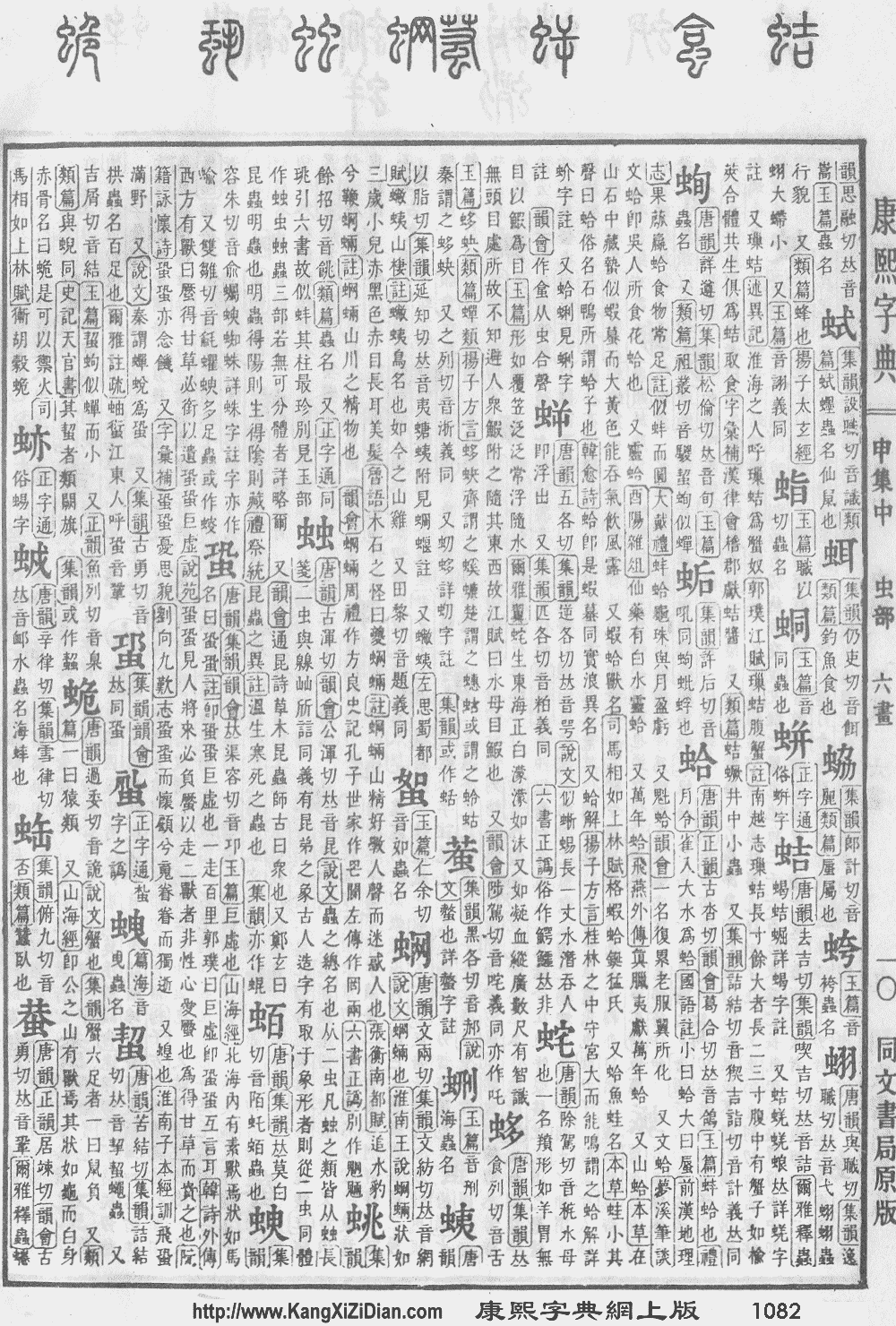
[edit]- Kangxi Dictionary: page 1082, character 12
- Dai Kanwa Jiten: character 33023
- Dae Jaweon: page 1550, character 14
- Hanyu Da Zidian (first edition): volume 4, page 2850, character 13
- Unihan data for U+86E4
Chinese
[edit]Glyph origin
[edit]| Historical forms of the character 蛤 |
|---|
| Shuowen Jiezi (compiled in Han) |
| Small seal script |
| Old Chinese | |
|---|---|
| 龕 | *kʰuːm |
| 媕 | *quːm, *qromʔ, *qɯːm, *qramʔ, *qɯːb |
| 頜 | *ɡuːmʔ, *kuːb |
| 答 | *tkuːb |
| 畣 | *tkuːb |
| 荅 | *tkuːb |
| 嗒 | *tuːb, *tʰoːb |
| 褡 | *tuːb, *toːb |
| 撘 | *tuːb |
| 搭 | *tuːb, *tʰoːb |
| 榙 | *tkuːb, *ɡuːb |
| 佮 | *tkʰuːb, *kuːb, *quːb, *quːb |
| 蛤 | *kuːb |
| 鴿 | *kuːb |
| 合 | *kuːb, *ɡuːb |
| 郃 | *kuːb, *ɡuːb |
| 匌 | *kuːb, *kʰuːb |
| 鉿 | *kuːb |
| 閤 | *kuːb |
| 鞈 | *kuːb, *kruːb |
| 韐 | *kuːb, *kruːb |
| 鮯 | *kuːb |
| 哈 | *ŋɡuːb |
| 姶 | *quːb, *quːb |
| 欱 | *qʰuːb, *qʰruːb |
| 盒 | *ɡuːb |
| 耠 | *ɡuːb |
| 詥 | *ɡuːb |
| 塔 | *tʰuːb |
| 鞳 | *tʰoːb |
| 劄 | *rtuːb |
| 跲 | *kruːb, *kob, *ɡob |
| 袷 | *kruːb, *ŋkob |
| 餄 | *kruːb |
| 恰 | *kʰruːb |
| 帢 | *kʰruːb |
| 洽 | *ɡruːb |
| 祫 | *ɡruːb |
| 珨 | *ɡruːb |
| 烚 | *ɡruːb |
| 歙 | *qʰjob, *qʰrub |
| 湁 | *tkʰub |
| 拾 | *ɡjub |
| 給 | *krub |
| 翕 | *qʰrub |
| 噏 | *qʰrub |
| 潝 | *qʰrub |
| 熻 | *qʰrub |
| 嬆 | *qʰrub |
| 翖 | *qʰrub |
| 闟 | *qʰrub |
Phono-semantic compound (形聲 / 形声, OC *kuːb): semantic 虫 + phonetic 合 (OC *kuːb, *ɡuːb).
Etymology 1
[edit]| simp. and trad. |
蛤 | |
|---|---|---|
| alternative forms | 𧊧 | |
Cognate with 合 (OC *kuːb, *ɡuːb, “to be together”) (Schuessler, 2007).
Pronunciation
[edit]- Mandarin
- Cantonese (Jyutping): gap3 / gaap3
- Eastern Min (BUC): gák
- Southern Min
- Wu (Shanghai, Wugniu): 7keq
- Mandarin
- (Standard Chinese)+
- Hanyu Pinyin: gé
- Zhuyin: ㄍㄜˊ
- Tongyong Pinyin: gé
- Wade–Giles: ko2
- Yale: gé
- Gwoyeu Romatzyh: ger
- Palladius: гэ (gɛ)
- Sinological IPA (key): /kɤ³⁵/
- (Standard Chinese)+
- Cantonese
- (Standard Cantonese, Guangzhou–Hong Kong)
- Jyutping: gap3 / gaap3
- Yale: gap / gaap
- Cantonese Pinyin: gap8 / gaap8
- Guangdong Romanization: geb3 / gab3
- Sinological IPA (key): /kɐp̚³/, /kaːp̚³/
- (Standard Cantonese, Guangzhou–Hong Kong)
- Eastern Min
- (Fuzhou)
- Bàng-uâ-cê: gák
- Sinological IPA (key): /kɑʔ²⁴/
- (Fuzhou)
- Southern Min
- Wu
- Middle Chinese: kop
- Old Chinese
- (Zhengzhang): /*kuːb/
Definitions
[edit]蛤
Compounds
[edit]Etymology 2
[edit]| simp. and trad. |
蛤 | |
|---|---|---|
| alternative forms | 蝦/虾 | |
Pronunciation
[edit]- Mandarin
- Cantonese (Jyutping): haa1 / haa4
- Gan (Wiktionary): ha2
- Hakka
- Jin (Wiktionary): hah4
- Eastern Min (BUC): hà
- Southern Min (Teochew, Peng'im): gab4
- Wu (Shanghai, Wugniu): 5ho
- Xiang (Changsha, Wiktionary): ge2 / ga2
- Mandarin
- (Standard Chinese)+
- Hanyu Pinyin: há
- Zhuyin: ㄏㄚˊ
- Tongyong Pinyin: há
- Wade–Giles: ha2
- Yale: há
- Gwoyeu Romatzyh: har
- Palladius: ха (xa)
- Sinological IPA (key): /xä³⁵/
- (Standard Chinese)+
- Cantonese
- (Standard Cantonese, Guangzhou–Hong Kong)
- Jyutping: haa1 / haa4
- Yale: hā / hàh
- Cantonese Pinyin: haa1 / haa4
- Guangdong Romanization: ha1 / ha4
- Sinological IPA (key): /haː⁵⁵/, /haː²¹/
- (Standard Cantonese, Guangzhou–Hong Kong)
- Gan
- (Nanchang)
- Wiktionary: ha2
- Sinological IPA (key): /ha²⁴/
- (Nanchang)
- Hakka
- (Sixian, incl. Miaoli and Neipu)
- Pha̍k-fa-sṳ: hà
- Hakka Romanization System: haˇ
- Hagfa Pinyim: ha2
- Sinological IPA: /ha¹¹/
- (Meixian)
- (Sixian, incl. Miaoli and Neipu)
- Jin
- (Taiyuan)+
- Wiktionary: hah4
- Sinological IPA (old-style): /xaʔ²/
- (Taiyuan)+
- Eastern Min
- (Fuzhou)
- Bàng-uâ-cê: hà
- Sinological IPA (key): /ha⁵³/
- (Fuzhou)
- Southern Min
- (Teochew)
- Peng'im: gab4
- Pe̍h-ōe-jī-like: kap
- Sinological IPA (key): /kap̚²/
- (Teochew)
- Wu
- Xiang
- (Changsha)
- Wiktionary: ge2 / ga2
- Sinological IPA (key): /kɤ̞¹³/, /ka̠¹³/
- (Changsha)
- Dialectal data
Definitions
[edit]蛤
- only used in 蛤蟆 (háma); also used as its short form frog; toad
- (Mainland China, Internet slang) Nickname of Jiang Zemin in Moha culture.
Derived terms
[edit]Etymology 3
[edit]Pronunciation
[edit]- Mandarin
- (Standard Chinese)+
- Hanyu Pinyin: há
- Zhuyin: ㄏㄚˊ
- Tongyong Pinyin: há
- Wade–Giles: ha2
- Yale: há
- Gwoyeu Romatzyh: har
- Palladius: ха (xa)
- Sinological IPA (key): /xä³⁵/
- (Standard Chinese)+
Definitions
[edit]蛤
Synonyms
[edit]Etymology 4
[edit]Compare Proto-Tai *kɤpᴰ (“frog”), whence Thai กบ (gòp), Lao ກົບ (kop), Zhuang goep, Shan ၵူပ်း (kúup), Ahom 𑜀𑜤𑜆𑜫 (kup).
Pronunciation
[edit]- Cantonese (Jyutping): gap3 / gaap3 / gap1
- Eastern Min (BUC): gák
- Southern Min
- Cantonese
- (Standard Cantonese, Guangzhou–Hong Kong)
- Jyutping: gap3 / gaap3 / gap1
- Yale: gap / gaap / gāp
- Cantonese Pinyin: gap8 / gaap8 / gap7
- Guangdong Romanization: geb3 / gab3 / geb1
- Sinological IPA (key): /kɐp̚³/, /kaːp̚³/, /kɐp̚⁵/
- (Standard Cantonese, Guangzhou–Hong Kong)
- Eastern Min
- (Fuzhou)
- Bàng-uâ-cê: gák
- Sinological IPA (key): /kɑʔ²⁴/
- (Fuzhou)
- Southern Min
Definitions
[edit]蛤
Synonyms
[edit]Compounds
[edit]Japanese
[edit]Kanji
[edit]Readings
[edit]- Go-on: こう (kō)←こふ (kofu, historical)
- Kan-on: こう (kō)←こふ (kofu, historical)
- Kan’yō-on: か (ka)
- Kun: はまぐり (hamaguri, 蛤)
Etymology 1
[edit]| Kanji in this term |
|---|
| 蛤 |
| はまぐり Hyōgai |
| kun'yomi |
| Alternative spellings |
|---|
| 文蛤 蚌 |

First attested in the Wamyō Ruijushō of 934:[1]
Compound of 浜 (hama, “beach”) + 栗 (kuri, “chestnut”).[1][2][3] The kuri changes to guri as an instance of rendaku (連濁).
Sense "inconsistency": from the reversal of the compound elements, forming ぐりはま (gurihama), etc.[1]
Pronunciation
[edit]- Historical evolution of the Kyoto pitch accent
- (the Heian period) LLLH
- (the Edo period) HHLL
- ※ H for high and flat syllables (◌́), L for low and flat syllables (◌̀), F for high-to-low syllables (◌̂), R for low-to-high syllables (◌̌).
※ References: [1]
Noun
[edit]- [from 934] a clam, Meretrix lusoria
- 1603, Vocabvlario da Lingoa de Iapam (Nippo Jisho) [Vocabulary of the Language of Japan] (in Portuguese), Nagasaki:[4]
- Famaguri. ハマグリ (蛤) 蛤.
- Famaguri - Clam.
- 1888, 庖丁鹽梅[3], page 99:
- 〔五十九〕蛤いも 生にておろし蒸て蛤の肉の貌に造りはまぐり殻の中へいれ豆油少しさして貝共に焼ていたす
- 〔gojūkyū〕hamaguri imo nama nite oroshi mushite hamaguri no mi no katachi ni tsukuri hamaguri kara no naka e ire hōyu sukoshi sashite kai tomoni yaiteitasu
- (509) Clam potatoes. Place it down raw, then boil it the meat contents of the clam; then put in the contents of the clam shell; stick in soybean sauce; then grill the molluscs together.
- 〔五十九〕蛤いも 生にておろし蒸て蛤の肉の貌に造りはまぐり殻の中へいれ豆油少しさして貝共に焼ていたす
- [from late Heian] the shell of a clam
- [from 1770] an inconsistency
- [from c. 1743] a pussy; a vulva (especially of a young woman)
- Synonym: 女陰 (jo'in)
- [from 1931] a geisha becoming a single one after deflowering
- [unspecified] a 家紋 (kamon, “family crest”) consisting of a clam-shaped butterfly, three clams in a circle, five clams, etc.
- [from 1500 (?)] abbreviation of 蛤刃 (hamaguriba, “a sharp but curved blade”)
- [unspecified] a 鷺流 (sagiryū) type of kyogen play
Usage notes
[edit]As with many terms that name organisms, this term is often spelled in katakana, especially in biological contexts (where katakana is customary), as ハマグリ (hamaguri).
Etymology 2
[edit]| For pronunciation and definitions of 蛤 – see the following entry. | ||
| ||
| (This term, 蛤, is an alternative spelling of the above term.) |
References
[edit]- ↑ 1.0 1.1 1.2 1.3 1.4 1.5 “はま‐ぐり 【蛤・文蛤・蚌】
”, in 日本国語大辞典 [Nihon Kokugo Daijiten][1] (in Japanese), 2nd edition, Tokyo: Shogakukan, 2000-2002, released online 2007, →ISBN, concise edition entry available here
- ^ “蛤”, in デジタル大辞泉 [Digital Daijisen][2] (in Japanese), Tōkyō: Shogakukan, updated roughly every four months
- ↑ 3.0 3.1 Yamada, Tadao et al., editors (2011), 新明解国語辞典 [Shin Meikai Kokugo Jiten] (in Japanese), Seventh edition, Tokyo: Sanseidō, →ISBN
- ^ Doi, Tadao (1603–1604), Hōyaku Nippo Jisho (in Japanese), Tōkyō: Iwanami Shoten, published 1980, →ISBN, page 200.
- “▲蛤”, in 漢字ぺディア [Kanjipedia][4] (in Japanese), The Japan Kanji Aptitude Testing Foundation, 2015–2025
Korean
[edit]Hanja
[edit]蛤 • (hap) (hangeul 합, revised hap, McCune–Reischauer hap, Yale hap)
- This term needs a translation to English. Please help out and add a translation, then remove the text
{{rfdef}}.
Vietnamese
[edit]Han character
[edit]- This term needs a translation to English. Please help out and add a translation, then remove the text
{{rfdef}}.
- CJK Unified Ideographs block
- Han script characters
- Translingual lemmas
- Translingual symbols
- Han phono-semantic compounds
- Chinese lemmas
- Mandarin lemmas
- Cantonese lemmas
- Eastern Min lemmas
- Hokkien lemmas
- Teochew lemmas
- Wu lemmas
- Middle Chinese lemmas
- Old Chinese lemmas
- Chinese hanzi
- Mandarin hanzi
- Cantonese hanzi
- Eastern Min hanzi
- Hokkien hanzi
- Teochew hanzi
- Wu hanzi
- Middle Chinese hanzi
- Old Chinese hanzi
- Chinese nouns
- Mandarin nouns
- Cantonese nouns
- Eastern Min nouns
- Hokkien nouns
- Teochew nouns
- Wu nouns
- Middle Chinese nouns
- Old Chinese nouns
- Chinese terms with IPA pronunciation
- Chinese terms spelled with 蛤
- Gan lemmas
- Hakka lemmas
- Jin lemmas
- Xiang lemmas
- Gan hanzi
- Hakka hanzi
- Jin hanzi
- Xiang hanzi
- Gan nouns
- Hakka nouns
- Jin nouns
- Xiang nouns
- Chinese proper nouns
- Mandarin proper nouns
- Cantonese proper nouns
- Gan proper nouns
- Hakka proper nouns
- Jin proper nouns
- Eastern Min proper nouns
- Teochew proper nouns
- Wu proper nouns
- Xiang proper nouns
- Chinese short forms
- Mainland China Chinese
- Chinese internet slang
- Chinese interjections
- Mandarin interjections
- zh:Internet
- Mandarin terms with usage examples
- Chinese dialectal terms
- zh:Nicknames for individuals
- Japanese kanji
- Japanese hyōgai kanji
- Japanese kanji with goon reading こう
- Japanese kanji with historical goon reading こふ
- Japanese kanji with kan'on reading こう
- Japanese kanji with historical kan'on reading こふ
- Japanese kanji with kan'yōon reading か
- Japanese kanji with kun reading はまぐり
- Japanese terms spelled with 蛤 read as はまぐり
- Japanese terms read with kun'yomi
- Japanese terms with usage examples
- Japanese compound terms
- Japanese terms with rendaku
- Japanese terms with IPA pronunciation
- Japanese terms with Nakadaka pitch accent (Tōkyō)
- Japanese terms with IPA pronunciation with pitch accent
- Japanese lemmas
- Japanese nouns
- Japanese terms with multiple readings
- Japanese terms spelled with hyōgai kanji
- Japanese terms with 1 kanji
- Japanese terms spelled with 蛤
- Japanese single-kanji terms
- Japanese abbreviations
- ja:Venerida order mollusks
- ja:Seafood
- ja:Genitalia
- Korean lemmas
- Korean hanja
- Vietnamese lemmas
- Vietnamese Han characters
