枚
| ||||||||
Translingual[edit]
| Stroke order | |||

| |||
Han character[edit]
枚 (Kangxi radical 75, 木+4, 8 strokes, cangjie input 木人大 (DOK), four-corner 48940, composition ⿰木攵)
References[edit]
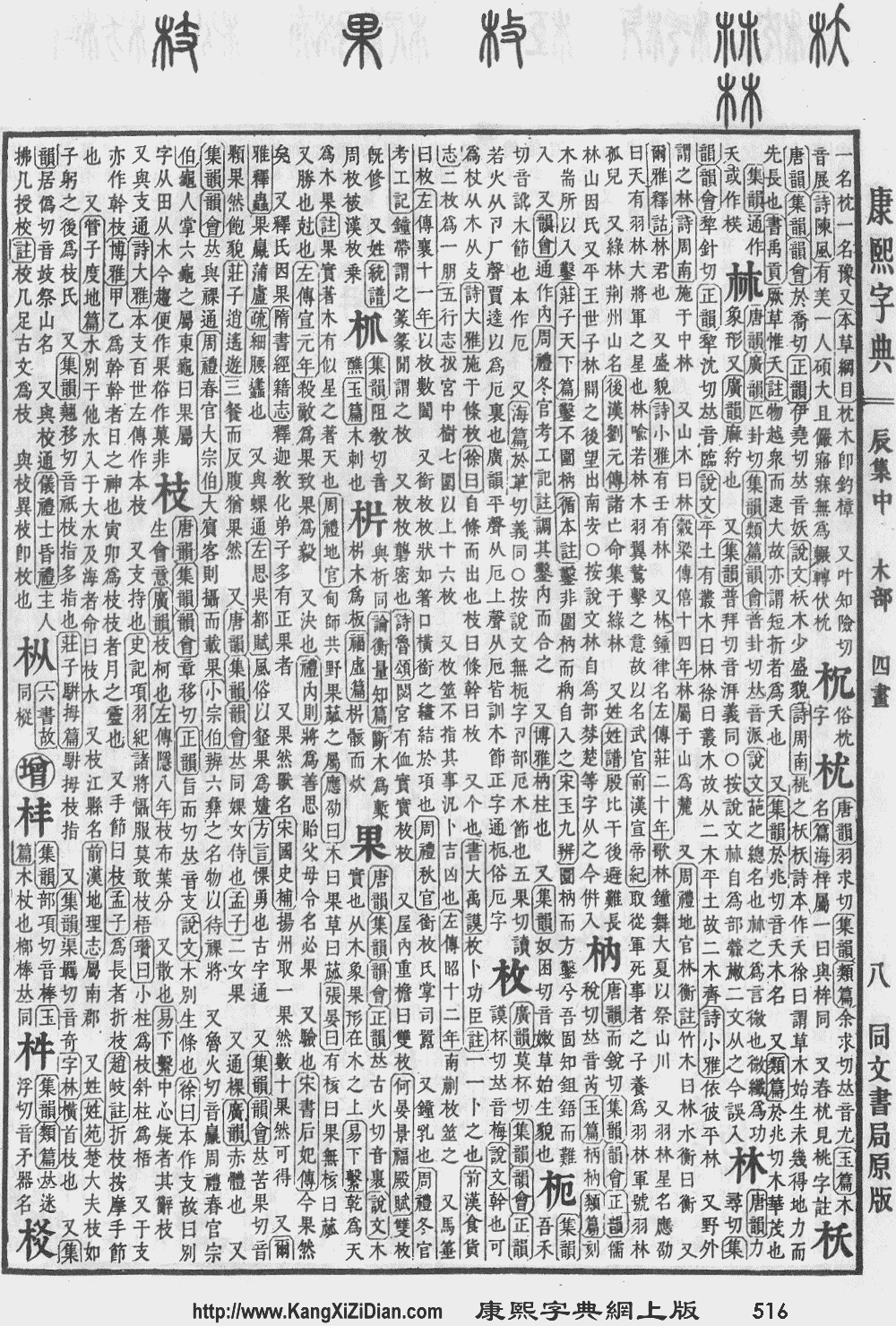
- Kangxi Dictionary: page 516, character 8
- Dai Kanwa Jiten: character 14554
- Dae Jaweon: page 904, character 3
- Hanyu Da Zidian (first edition): volume 2, page 1171, character 1
- Unihan data for U+679A
Chinese[edit]
| simp. and trad. |
枚 | |
|---|---|---|
| alternative forms | 𣏽 | |
Glyph origin[edit]
Generally thought to be an ideogrammic compound (會意/会意) : 木 (“tree; wood”) + 攴 (“hand holding a stick”).
However, Zhengzhang (2003) considers it to be a phono-semantic compound (形聲/形声, OC *mɯːl) : semantic 木 (“wood”) + phonetic 文 (OC *mɯn), where 文 was later corrupted to 攴.
Etymology 1[edit]
From Austroasiatic; compare Old Khmer mek (“branch; bough”) (Schuessler, 2007).
Pronunciation[edit]
Definitions[edit]
枚
- (archaic) stalk of shrub; trunk of tree
- (historical) wooden peg (a gag for marching soldiers to prevent talking)
- 又如赴敵之兵,銜枚疾走,不聞號令,但聞人馬之行聲。 [Classical Chinese, trad.]
- From: c. 1059, Ouyang Xiu (歐陽修), Autumn (《秋聲賦》). English translation by Arthur Waley (1919).
- Yòu rú fùdí zhī bīng, xiánméi jízǒu, bùwén hàolìng, dànwén rénmǎ zhī xíng shēng. [Pinyin]
- Or again, like the sound of soldiers going to battle, who march swiftly with their gags between their teeth, when the captain's voice cannot be heard, but only the tramp of horses and men moving.
又如赴敌之兵,衔枚疾走,不闻号令,但闻人马之行声。 [Classical Chinese, simp.]
- (obsolete) small wooden rod; counting rod
- (dated) Classifier for generic countable objects.
- Classifier for small, flat objects, such as coins, stamps, badges, pearls, sporting medals. ⇒ all nouns using this classifier
- Classifier for rockets, satellites and certain weapons (especially bombs).
- a surname: Mei
Compounds[edit]
Etymology 2[edit]
From Lingao mɔʔ⁸ (classifier for objects) (Fu, 2008).
Pronunciation[edit]

Definitions[edit]
枚
Synonyms[edit]
Japanese[edit]
Kanji[edit]
Readings[edit]
Etymology 1[edit]
| Kanji in this term |
|---|
| 枚 |
| ひら Grade: 6 |
| kun’yomi |
pira > ɸira > hira. Cognate with 平 (hira, “flat”).
Alternative forms[edit]
Noun[edit]
- an object that is thin and flat
Derived terms[edit]
- 帷子 (katabira)
- 湯帷子 (yukatabira)
Etymology 2[edit]
| Kanji in this term |
|---|
| 枚 |
| まい Grade: 6 |
| on’yomi |
(This etymology is missing or incomplete. Please add to it, or discuss it at the Etymology scriptorium.)
Counter[edit]
- counter for flat thin objects or sheets
See also[edit]
| Japanese number-counter combinations for 枚 (mai) | ||||
|---|---|---|---|---|
| 1 | 2 | 3 | 4 | 5 |
| 一枚 (ichimai) | 二枚 (nimai) | 三枚 (sanmai) | 四枚 (yonmai) 四枚 (yomai) |
五枚 (gomai) |
| 6 | 7 | 8 | 9 | 10 |
| 六枚 (rokumai) | 七枚 (nanamai) 七枚 (shichimai) |
八枚 (hachimai) | 九枚 (kyūmai) | 十枚 (jūmai) |
| 100 | 1,000 | 10,000 | How many? | |
| 百枚 (hyakumai) | 千枚 (senmai) | 一万枚 (ichimanmai) | 何枚 (nanmai) | |
Korean[edit]
Hanja[edit]
枚 (eum 매 (mae))
- This term needs a translation to English. Please help out and add a translation, then remove the text
{{rfdef}}.
Okinawan[edit]
Kanji[edit]
Readings[edit]
Etymology[edit]
| Kanji in this term |
|---|
| 枚 |
| めー Grade: 6 |
| on’yomi |
(This etymology is missing or incomplete. Please add to it, or discuss it at the Etymology scriptorium.)
Counter[edit]
枚 (-mē)
- counter for flat thin objects or sheets
Tày[edit]
Noun[edit]
枚 (mười)
References[edit]
- Lục Văn Pảo, Hoàng Tuấn Nam (2003) Hoàng Triều Ân, editor, Từ điển chữ Nôm Tày [A Dictionary of (chữ) Nôm Tày][1] (in Vietnamese), Hanoi: Nhà xuất bản Khoa học Xã hội
Vietnamese[edit]
Han character[edit]
- This term needs a translation to English. Please help out and add a translation, then remove the text
{{rfdef}}.
- CJK Unified Ideographs block
- Han script characters
- Translingual lemmas
- Translingual symbols
- Han ideogrammic compounds
- Han phono-semantic compounds
- Chinese terms derived from Austroasiatic languages
- Middle Chinese lemmas
- Old Chinese lemmas
- Chinese lemmas
- Mandarin lemmas
- Cantonese lemmas
- Hakka lemmas
- Hokkien lemmas
- Wu lemmas
- Chinese nouns
- Mandarin nouns
- Cantonese nouns
- Hakka nouns
- Hokkien nouns
- Wu nouns
- Chinese classifiers
- Mandarin classifiers
- Cantonese classifiers
- Hakka classifiers
- Hokkien classifiers
- Wu classifiers
- Chinese proper nouns
- Mandarin proper nouns
- Cantonese proper nouns
- Hakka proper nouns
- Hokkien proper nouns
- Wu proper nouns
- Chinese terms with IPA pronunciation
- Chinese Han characters
- Chinese terms with archaic senses
- Literary Chinese terms with quotations
- Chinese terms with historical senses
- Chinese terms with obsolete senses
- Chinese dated terms
- Mandarin terms with usage examples
- Chinese surnames
- Hainanese terms borrowed from Lingao
- Hainanese terms derived from Lingao
- Hainanese Chinese
- Hainanese terms with quotations
- Advanced Mandarin
- Japanese Han characters
- Grade 6 kanji
- Japanese kanji with goon reading まい
- Japanese kanji with goon reading め
- Japanese kanji with kan'on reading ばい
- Japanese kanji with kun reading ひら
- Japanese terms spelled with 枚 read as ひら
- Japanese terms read with kun'yomi
- Japanese lemmas
- Japanese nouns
- Japanese terms with multiple readings
- Japanese terms spelled with sixth grade kanji
- Japanese terms written with one Han script character
- Japanese terms spelled with 枚
- Japanese single-kanji terms
- Japanese terms spelled with 枚 read as まい
- Japanese terms read with on'yomi
- Japanese counters
- Korean lemmas
- Korean Han characters
- Okinawan Han characters
- Okinawan kanji with on reading めー
- Okinawan terms spelled with 枚 read as めー
- Okinawan terms read with on'yomi
- Okinawan lemmas
- Okinawan counters
- Okinawan terms spelled with sixth grade kanji
- Okinawan terms written with one Han script character
- Okinawan terms spelled with 枚
- Okinawan single-kanji terms
- Tày lemmas
- Tày nouns
- Tày Nôm forms
- Vietnamese lemmas
- Vietnamese Han characters