than
English
[edit]
Alternative forms
[edit]Etymology
[edit]From Middle English than, thanne, from Old English þanne, a variant of þonne (“then, since, because”), from Proto-West Germanic *þan, from Proto-Germanic *þan (“at that, at that time, then”), from earlier *þam, from Proto-Indo-European *tóm, accusative masculine of *só (“demonstrative pronoun, that”).
Cognate with Dutch dan (“than”), German denn (“than”), German dann (“then”). Doublet of then.
Pronunciation
[edit]- (stressed form) enPR: thăn, thĕn, IPA(key): /ðæn/, /ðɛn/
Audio (US, stressed form): (file) - Rhymes: -æn, -ɛn
- (unstressed form) enPR: thən, IPA(key): /ðən/, [ðn̩]
Audio (US, unstressed form): (file)
- Homophone: then (unstressed form, also for some speakers stressed form)
Conjunction
[edit]than
- Used in comparisons, to introduce the basis of comparison.
- 2013 July 20, “Old Soldiers?”, in The Economist, volume 408, number 8845:
- Whether modern, industrial man is less or more warlike than his hunter-gatherer ancestors is impossible to determine. The machine gun is so much more lethal than the bow and arrow that comparisons are meaningless.
- 1665, Edward Stillingfleet, William Laud, Thomas Carwell, A Rational Account of the Grounds of Protestant Religion:
- Answer me if you can, any other way, than because the Scriptures, which are infallible, Say so.
- she's taller than I am; she found his advice more witty than helpful; we have less work today than we had yesterday; We had no choice than to return home
- (obsolete outside dialects, usually used with for) Because; for.
- 1854, Reformation series:
- If thou say yes, then puttest thou on Christ (that is, the wisdome of God, the Father) unkunning, unpower, or euil will: for than he could not make his rule so good as an other did his.
- 1668, William Lawson, A Way to Get Wealth:
- You shall also take the fine earth or mould which is found in the hollow of old Willow trees, rising from the root almost to the middle of the Tree, at least so far as the tree is hollow, for than this, there is no earth or mould finer or richer.
- 1854, Reformation series:
Preposition
[edit]than
- introduces a comparison, and is associated with comparatives, and with words such as more, less, and fewer. Typically, it seeks to measure the force of an adjective or similar description between two predicates.
- Patients diagnosed more recently are probably surviving an average of longer than two years.
- No player is more skillful than Greg.
Usage notes
[edit]Usage prescriptivists have a number of rules concerning than. According to them, than is not a preposition to govern the oblique case (although it has been used as such by writers such as William Shakespeare, whose 1600 play Julius Caesar contains the line A man no mightier than thyself or me. . ., and Samuel Johnson, who wrote No man had ever more discernment than him, in finding out the ridiculous.). Than functions as both conjunction and preposition; when it is used as a conjunction, it governs the nominative case, and when a preposition, the oblique case. To determine the case of a pronoun following "than", a writer can look to implied words and determine how they would relate to the pronoun.
Examples :
- You are a better swimmer than she.
- represents You are a better swimmer than she is.
- therefore You are a better swimmer than her is, according to such prescriptivists, a solecism.
- They like you more than her.
- represents They like you more than they like her.
- therefore They like you more than she is a solecism, if it attempts to represent the previous sentence. It may be correct, however, if it represents They like you more than she likes you.
Some prescriptivists insist that whom must follow than (not who); although according to the above rule, who would be the "correct" form in the first example. Critics of this often cite this mandatory exception as evidence that the prescriptivist rule is logically erroneous, in addition to its being inconsistent with well-established usage.
Translations
[edit]
|
Adverb
[edit]than (not comparable)
Anagrams
[edit]Cornish
[edit]Noun
[edit]than
- Aspirate mutation of tan.
Middle English
[edit]Alternative forms
[edit]Etymology
[edit]From Old English þonne.
Conjunction
[edit]than
- than
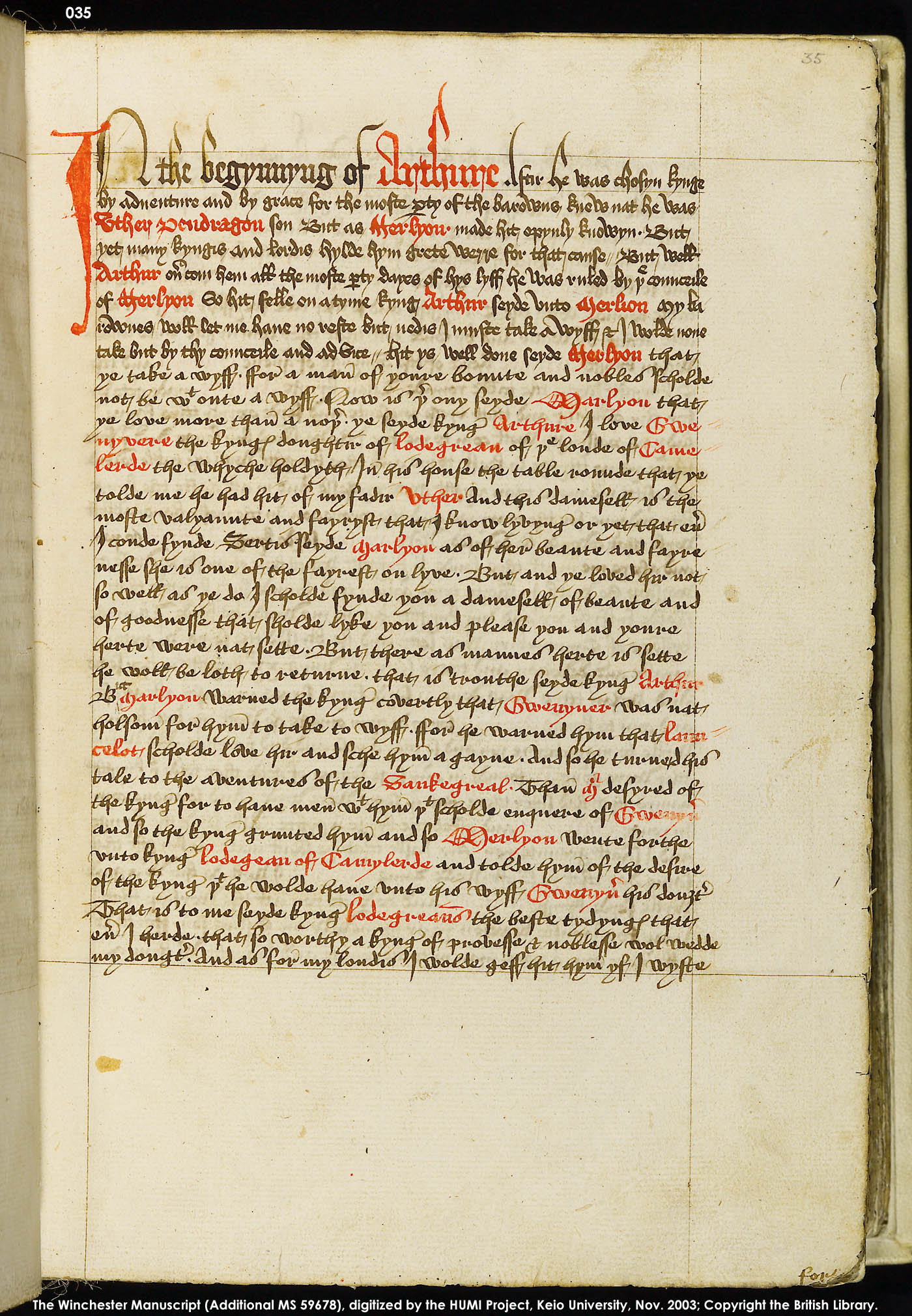
- 1470–1483 (date produced), Thom̃s Malleorre [i.e., Thomas Malory], “[The Tale of King Arthur]”, in Le Morte Darthur (British Library Additional Manuscript 59678), [England: s.n.], folio 35, recto, lines 10–11:
- Now is þ[er] ony ſeyde Marlyon that ye love more than a noþ[er] ·
- (please add an English translation of this quotation)
Descendants
[edit]- English: than
Adverb
[edit]than
- then
- 14th Century, Chaucer, General Prologue
- And whan that he wel dronken hadde the wyn,
Than wolde he speke no word but Latyn.- And when he had drunk all the wine
He would not speak a word other than Latin
- And when he had drunk all the wine
- And whan that he wel dronken hadde the wyn,
- 14th Century, Chaucer, General Prologue
Descendants
[edit]Old Dutch
[edit]Etymology
[edit]From Proto-West Germanic *þan
Adverb
[edit]than
- then
References
[edit]Old High German
[edit]Alternative forms
[edit]Etymology
[edit]From Proto-West Germanic *þan
Adverb
[edit]than
Conjunction
[edit]than
References
[edit]- Braune, Wilhelm. Althochdeutsches Lesebuch, zusammengestellt und mit Glossar versehen
Vietnamese
[edit]Pronunciation
[edit]- (Hà Nội) IPA(key): [tʰaːn˧˧]
- (Huế) IPA(key): [tʰaːŋ˧˧]
- (Saigon) IPA(key): [tʰaːŋ˧˧]
- Homophone: thang
Etymology 1
[edit]Non-Sino-Vietnamese reading of Chinese 炭 (“coal”, SV: thán).
Noun
[edit]- coal
- than củi
- charcoal
Derived terms
[edit]Etymology 2
[edit]Non-Sino-Vietnamese reading of Chinese 嘆 (SV: thán).
Verb
[edit]than
- to complain
Derived terms
[edit]Anagrams
[edit]Welsh
[edit]Preposition
[edit]than
- Aspirate mutation of tan.
Mutation
[edit]| Welsh mutation | |||
|---|---|---|---|
| radical | soft | nasal | aspirate |
| tan | dan | nhan | than |
| Note: Some of these forms may be hypothetical. Not every possible mutated form of every word actually occurs. | |||
Yola
[edit]Etymology
[edit]From Middle English than, from Old English þonne.
Pronunciation
[edit]Adverb
[edit]than
- then
- 1867, “A YOLA ZONG”, in SONGS, ETC. IN THE DIALECT OF FORTH AND BARGY, number 5, page 86:
- Zitch vezzeen, tarvizzeen, 'tell than w'ne'er zey.
- Such driving, and struggling, 'till then we ne'er saw.
- 1867, “A YOLA ZONG”, in SONGS, ETC. IN THE DIALECT OF FORTH AND BARGY, number 8, page 86:
- Than caame ee shullereen, ee teap an corkite;
- Then came the shouldering, tossing, and tumbling;
- 1867, “A YOLA ZONG”, in SONGS, ETC. IN THE DIALECT OF FORTH AND BARGY, number 12, page 88:
- Than stalket, an gandelt, wie o! an gridane.
- Then stalked and wondered, with oh! and with grief.
Preposition
[edit]than
- than
- 1867, “THE WEDDEEN O BALLYMORE”, in SONGS, ETC. IN THE DIALECT OF FORTH AND BARGY, number 4, page 96:
- An neeat wooden trenshoorès var whiter than snow.
- And neat wooden trenchers far whiter than snow.
References
[edit]- Jacob Poole (d. 1827) (before 1828) William Barnes, editor, A Glossary, With some Pieces of Verse, of the old Dialect of the English Colony in the Baronies of Forth and Bargy, County of Wexford, Ireland, London: J. Russell Smith, published 1867, page 86 & 96
- English terms inherited from Middle English
- English terms derived from Middle English
- English terms inherited from Old English
- English terms derived from Old English
- English terms inherited from Proto-West Germanic
- English terms derived from Proto-West Germanic
- English terms inherited from Proto-Germanic
- English terms derived from Proto-Germanic
- English terms derived from Proto-Indo-European
- English 1-syllable words
- English terms with IPA pronunciation
- English terms with audio links
- Rhymes:English/æn
- Rhymes:English/æn/1 syllable
- Rhymes:English/ɛn
- Rhymes:English/ɛn/1 syllable
- English terms with homophones
- English lemmas
- English conjunctions
- English terms with quotations
- English terms with usage examples
- English terms with obsolete senses
- English dialectal terms
- English prepositions
- English adverbs
- English uncomparable adverbs
- Cornish non-lemma forms
- Cornish mutated nouns
- Cornish aspirate-mutation forms
- Middle English terms inherited from Old English
- Middle English terms derived from Old English
- Middle English lemmas
- Middle English conjunctions
- Middle English terms with quotations
- Middle English adverbs
- Old Dutch terms inherited from Proto-West Germanic
- Old Dutch terms derived from Proto-West Germanic
- Old Dutch lemmas
- Old Dutch adverbs
- Old High German terms inherited from Proto-West Germanic
- Old High German terms derived from Proto-West Germanic
- Old High German lemmas
- Old High German adverbs
- Old High German conjunctions
- Vietnamese terms with IPA pronunciation
- Vietnamese terms with homophones
- Vietnamese terms derived from Chinese
- Vietnamese lemmas
- Vietnamese nouns
- Vietnamese terms with usage examples
- Vietnamese verbs
- Welsh non-lemma forms
- Welsh mutated prepositions
- Welsh aspirate-mutation forms
- Yola terms inherited from Middle English
- Yola terms derived from Middle English
- Yola terms inherited from Old English
- Yola terms derived from Old English
- Yola terms with IPA pronunciation
- Yola lemmas
- Yola adverbs
- Yola terms with quotations
- Yola prepositions