吾
Jump to navigation
Jump to search
| ||||||||
Translingual[edit]
| Stroke order | |||
|---|---|---|---|

| |||
| Stroke order (Sans-serif) | |||
|---|---|---|---|
.gif)
| |||
Han character[edit]
吾 (Kangxi radical 30, 口+4, 7 strokes, cangjie input 一一口 (MMR), four-corner 10601, composition ⿱五口)
Derived characters[edit]
- 俉, 唔, 娪, 峿, 悟, 捂, 晤, 梧, 浯, 焐, 牾, 㹳, 珸, 䎸, 䏸, 語(语), 鋙(铻), 䮏, 鯃, 齬(龉/𪘚), 啎, 逜, 鼯, 敔, 郚, 痦, 衙, 䦜, 圄, 䓊, 㐚
- 𠗐, 𪣔, 𪩳, 𢓲, 𭭢, 𤕻, 𥆐, 𥏒, 𥒾, 𥟊, 𦀡, 𧋋, 𮗰, 𬤿, 𧳎, 𮠬, 𫕁, 𩩑, 𫥩, 𦥉, 𩳌, 𢆖, 𢻊, 𣣄, 𤭑, 𩒾, 𪁙, 𪕡, 𠵦, 𫪸, 𫬮, 𢈪, 𡨂, 𥭠, 𣬕, 𬰜, 𠵥
References[edit]
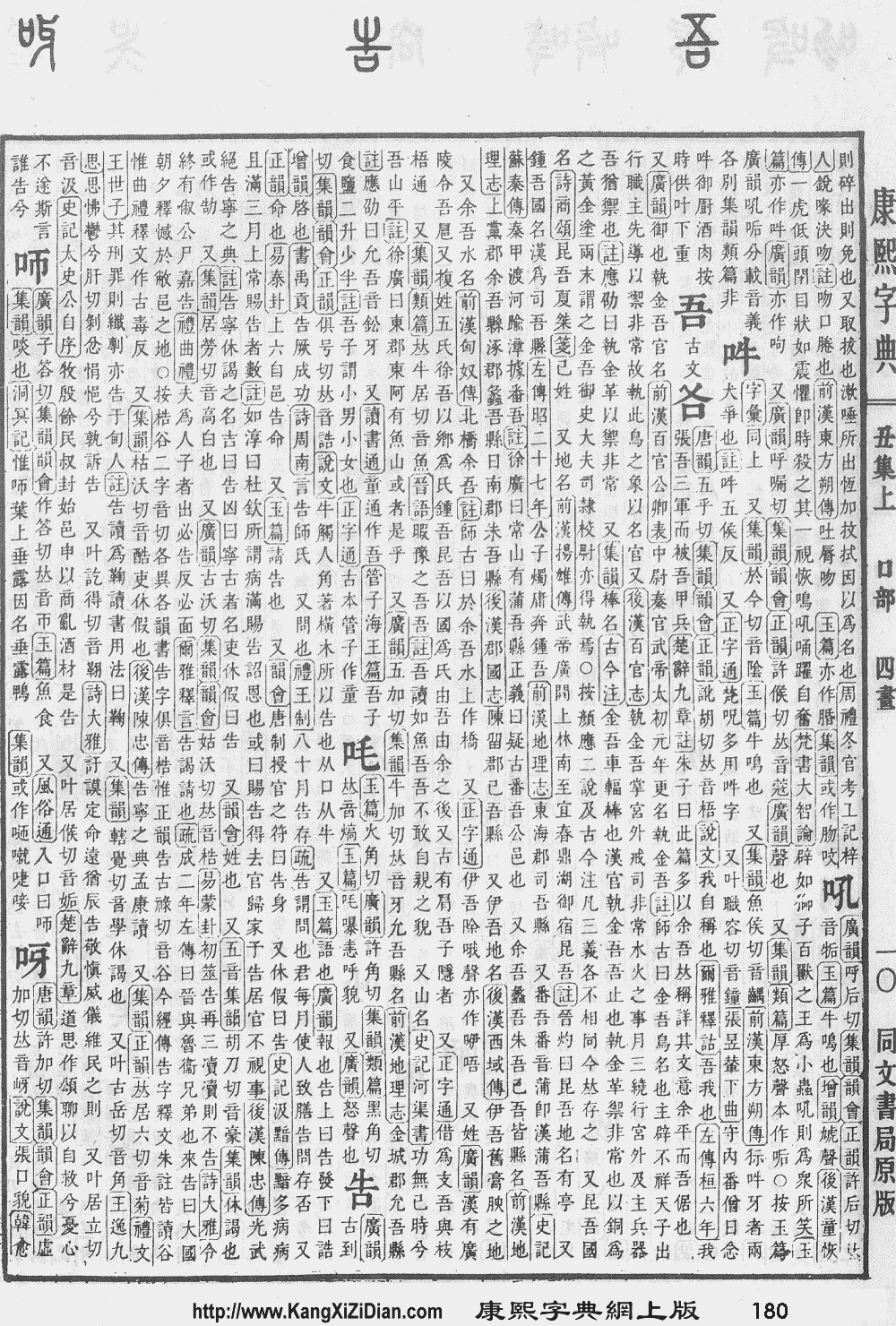
- Kangxi Dictionary: page 180, character 3
- Dai Kanwa Jiten: character 3379
- Dae Jaweon: page 398, character 2
- Hanyu Da Zidian (first edition): volume 1, page 585, character 13
- Unihan data for U+543E
Chinese[edit]
| trad. | 吾 | |
|---|---|---|
| simp. # | 吾 | |
| alternative forms | 𫊣 | |
Glyph origin[edit]
| Historical forms of the character 吾 | ||||
|---|---|---|---|---|
| Shang | Western Zhou | Warring States | Shuowen Jiezi (compiled in Han) | Liushutong (compiled in Ming) |
| Oracle bone script | Bronze inscriptions | Chu slip and silk script | Small seal script | Transcribed ancient scripts |

|

|

|

|

|
Phono-semantic compound (形聲/形声, OC *ŋraː, *ŋaː) : phonetic 五 (OC *ŋaːʔ) + semantic 口 (“mouth”).
Etymology[edit]
From Proto-Sino-Tibetan *ŋa-j ~ ka (“I”). Cognate with Burmese ငါ (nga, “I”), 我 (OC *ŋaːlʔ, “I”), Hakka 𠊎 (ngài, “I”).
Pronunciation 1[edit]
Definitions[edit]
吾
- (literary or dialectal) I
- 如有政,雖不吾以,吾其與聞之。 [Classical Chinese, trad.]
- From: The Analects of Confucius, c. 475 – 221 BCE, translated based on James Legge's version
- Rú yǒu zhèng, suī bù wú yǐ, wú qí yù wén zhī. [Pinyin]
- If there had been government business, though I am now not appointed, I should have been consulted about it.
如有政,虽不吾以,吾其与闻之。 [Classical Chinese, simp.]- 吾觀全地球之社會,未有凌亂舊金山之華人者。 [Classical Chinese, trad.]
- From: 1904 February, Liang Qichao, "Travel Notes of the New Continent"
- Wú guān quán dìqiú zhī shèhuì, wèi yǒu língluàn Jiùjīnshān zhī huárén zhě. [Pinyin]
- (please add an English translation of this usage example)
吾观全地球之社会,未有凌乱旧金山之华人者。 [Classical Chinese, simp.]
- (literary or dialectal) my
- 吾皇 [Classical Chinese] ― wú huáng [Pinyin] ― my emperor
- 吾姆 [Sixian Hakka] ― ngâ mê [Pha̍k-fa-sṳ] ― my mom
- a surname. Wu
Synonyms[edit]
Usage notes[edit]
Before the Three Kingdoms period, 吾 ("I") was mostly only used as a subject, a pronoun object of a negated sentence or an interrogative pronoun object (the latter two cases are where the pronoun object is placed before the verb), meaning 吾 seldom occurred as the pronoun object that is placed after a verb.
Compounds[edit]
- 伊吾 (Yīwú)
- 余吾
- 先吾著鞭
- 吾人 (wúrén)
- 吾伊
- 吾儕/吾侪 (wúchái)
- 吾兄 (wúxiōng)
- 吾合沙魯/吾合沙鲁 (Wúhéshālǔ)
- 吾吾
- 吾塔木 (Wútǎmù)
- 吾子 (wúzǐ)
- 吾宗肖 (Wúzōngxiào)
- 吾徒
- 吾愛/吾爱
- 吾當/吾当 (wúdāng)
- 吾輩/吾辈 (wúbèi)
- 吾道東矣/吾道东矣
- 唯吾獨尊/唯吾独尊
- 執金吾/执金吾 (zhí jīnwú)
- 左支右吾
- 希吾勒 (Xīwúlè)
- 托木吾斯塘 (Tuōmù Wúsītáng)
- 支吾 (zhīwú)
- 支吾其詞/支吾其词 (zhīwuqící)
- 支支吾吾 (zhīzhīwúwú)
- 故吾
- 新疆維吾爾自治區/新疆维吾尔自治区 (Xīnjiāng Wéiwú'ěr Zìzhìqū)
- 昆吾
- 東支西吾/东支西吾
- 江左夷吾
- 維吾爾/维吾尔 (Wéiwú'ěr)
- 英吾斯塘 (Yīngwúsītáng)
- 蒼吾讓兄/苍吾让兄
- 薩勒吾則克/萨勒吾则克 (Sàlèwúzékè)
- 金吾 (jīnwú)
- 金吾不禁
Pronunciation 2[edit]
Definitions[edit]
吾
- Only used in 允吾 (yányá; qiānyá). A county established during the Western Han, disestablished during the Northern Wei, and briefly reestablished during the Sui dynasty
Pronunciation 3[edit]
Definitions[edit]
吾
- Only used in 吾吾.
References[edit]
- “吾”, in 漢語多功能字庫 (Multi-function Chinese Character Database)[1], 香港中文大學 (the Chinese University of Hong Kong), 2014–
Japanese[edit]
Kanji[edit]
吾
(“Jinmeiyō” kanji used for names)
Readings[edit]
Etymology 1[edit]
| Kanji in this term |
|---|
| 吾 |
| われ Jinmeiyō |
| kun’yomi |
| Kanji in this term |
|---|
| 吾 |
| わ Jinmeiyō |
| kun’yomi |
| For pronunciation and definitions of 吾 – see the following entry. | ||||
| ||||
| (This term, 吾, is an alternative spelling of the above term.) |
Etymology 2[edit]
| Kanji in this term |
|---|
| 吾 |
| あれ Jinmeiyō |
| kun’yomi |
| For pronunciation and definitions of 吾 – see the following entry. | ||
| ||
| (This term, 吾, is an alternative spelling of the above term.) |
Etymology 3[edit]
| Kanji in this term |
|---|
| 吾 |
| あ Jinmeiyō |
| kun’yomi |
| For pronunciation and definitions of 吾 – see the following entry. | ||
| ||
| (This term, 吾, is an alternative spelling of the above term.) |
Korean[edit]
Hanja[edit]
吾 • (o) (hangeul 오, revised o, McCune–Reischauer o)
- This term needs a translation to English. Please help out and add a translation, then remove the text
{{rfdef}}.
Old Japanese[edit]
Pronoun[edit]
吾 (wa) (kana わ)
Descendants[edit]
- Satsugū dialect: おい (oi)
Old Korean[edit]
Noun[edit]
吾 (*nA)
- the first-person singular pronoun; I
Descendants[edit]
Vietnamese[edit]
Han character[edit]
- This term needs a translation to English. Please help out and add a translation, then remove the text
{{rfdef}}.
References[edit]
- Thiều Chửu : Hán Việt Tự Điển Hà Nội 1942
- Trần Văn Chánh: Từ Điển Hán Việt NXB Trẻ, Ho Chi Minh Ville, 1999
- Vũ Văn Kính: Đại Tự Điển Chữ Nôm, NXB Văn Nghệ, Ho Chi Minh Ville, 1999
Categories:
- CJK Unified Ideographs block
- Han script characters
- Translingual lemmas
- Translingual symbols
- Han phono-semantic compounds
- Chinese terms inherited from Proto-Sino-Tibetan
- Chinese terms derived from Proto-Sino-Tibetan
- Mandarin terms with audio links
- Middle Chinese lemmas
- Old Chinese lemmas
- Chinese lemmas
- Mandarin lemmas
- Cantonese lemmas
- Hakka lemmas
- Eastern Min lemmas
- Hokkien lemmas
- Teochew lemmas
- Wu lemmas
- Chinese pronouns
- Mandarin pronouns
- Cantonese pronouns
- Hakka pronouns
- Eastern Min pronouns
- Hokkien pronouns
- Teochew pronouns
- Wu pronouns
- Chinese determiners
- Mandarin determiners
- Cantonese determiners
- Hakka determiners
- Eastern Min determiners
- Hokkien determiners
- Teochew determiners
- Wu determiners
- Chinese proper nouns
- Mandarin proper nouns
- Cantonese proper nouns
- Hakka proper nouns
- Eastern Min proper nouns
- Hokkien proper nouns
- Teochew proper nouns
- Wu proper nouns
- Chinese terms with IPA pronunciation
- Chinese Han characters
- Chinese literary terms
- Chinese dialectal terms
- Literary Chinese terms with quotations
- Literary Chinese terms with usage examples
- Hakka terms with usage examples
- Chinese surnames
- Chinese adjectives
- Mandarin adjectives
- Japanese Han characters
- Kanji used for names
- Japanese kanji with goon reading ぐ
- Japanese kanji with kan'on reading ご
- Japanese kanji with kun reading われ
- Japanese kanji with kun reading わ-が
- Japanese kanji with kun reading あ
- Japanese kanji with kun reading あが
- Japanese terms spelled with 吾
- Japanese terms read with kun'yomi
- Japanese pronouns
- Japanese lemmas
- Japanese terms spelled with jinmeiyō kanji
- Japanese terms written with one Han script character
- Japanese single-kanji terms
- Korean lemmas
- Korean Han characters
- Old Japanese lemmas
- Old Japanese pronouns
- Old Korean lemmas
- Old Korean pronouns
- Vietnamese lemmas
- Vietnamese Han characters