f
 | ||||||||
 | ||||||||
| ||||||||
| ||||||||
Azerbaijani • Basque • Dutch • Esperanto • Estonian • Faroese • Finnish • French • Fula • Gothic • Hungarian • Icelandic • Ido • Indonesian • Italian • Kashubian • Latvian • Livonian • Malay • Maltese • Norwegian • Nupe • Polish • Portuguese • Romani • Romanian • Scottish Gaelic • Serbo-Croatian • Silesian • Skolt Sami • Slovene • Spanish • Tagalog • Turkish • Turkmen • Welsh • Yoruba • Zulu
Page categories
Translingual
[edit]
Etymology
[edit] Modification of upper case Latin letter F, from Greek Ϝ (W, “Digamma”), from Phœnician 𐤅 (W, “waw”), the ultimate source being probably Egyptian.
Letter
[edit]f (upper case F)
- The sixth letter of the basic modern Latin alphabet.
See also
[edit]- (Latin script): Aa Bb Cc Dd Ee Ff Gg Hh Ii Jj Kk Ll Mm Nn Oo Pp Qq Rr Sſs Tt Uu Vv Ww Xx Yy Zz
- (Variations of letter F): Ḟḟ Ƒƒ ᵮ ᶂ ꜰ Ff ff fi ffi fl ffl
Pronunciation
[edit]Pronunciation of IPA [ɑffɑʔ] with the sound [f]: (file)
Symbol
[edit]f
- (music) forte
- (IPA) a voiceless labiodental fricative.
- (superscript ⟨ᶠ⟩, IPA) [f]-fricated release of a plosive (e.g. [pᶠ], sometimes implying an affricate [p͜f]); [f]-coloring; or a weak, fleeting or epenthetic [f].
- (physics) frequency
- (optics) focal length
- (linguistics) feminine gender
Gallery
[edit]- Letter styles
-
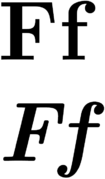 Uppercase and lowercase versions of F, in normal and italic type
 -
 Uppercase and lowercase F in Fraktur


See also
[edit]Other representations of F:


English
[edit]Etymology 1
[edit]
Old English lower case letter f, from 7th century replacement by Latin lower case f of the Anglo-Saxon Futhorc letter ᚠ (f, “fe”).
Pronunciation
[edit]- (phoneme): IPA(key): /f/
- (letter name): Rhymes: -ɛf
- See Guide to Pronunciation, §§ 178, 179, 188, 198, 230 in the 1913 Webster dictionary
Letter
[edit]f (lower case, upper case F, plural fs or f's)
- The sixth letter of the English alphabet, called ef and written in the Latin script.
Usage notes
[edit]eff as a verb.
Derived terms
[edit]See also
[edit]- (Latin-script letters) letter; A a, B b, C c, D d, E e, F f, G g, H h, I i, J j, K k, L l, M m, N n, O o, P p, Q q, R r, S s, T t, U u, V v, W w, X x, Y y, Z z
Number
[edit]f (lower case, upper case F)
- The ordinal number sixth, derived from this letter of the English alphabet, called ef and written in the Latin script.
Derived terms
[edit]Etymology 2
[edit]Abbreviations.
f
- (stenoscript) Abbreviation of for.
- (stenoscript) prefix for-.
- (stenoscript) suffix/sequence for(e).
Symbol
[edit]f
- (music) The name of the fourth tone of the model scale, or scale of C. F sharp (F♯) is a tone intermediate between F and G.
Derived terms
[edit]Noun
[edit]f
- (printing, abbreviation) Folio, paper and book size (10"-12.5" x 15"-20")
- (euphemistic) Abbreviation of fuck.
- What the f do you think you're doing?
- (grammar) Abbreviation of feminine.
Derived terms
[edit]Translations
[edit]See also
[edit]Azerbaijani
[edit]Pronunciation
[edit]Letter
[edit]f lower case (upper case F)
- The eighth letter of the Azerbaijani alphabet, called fe and written in the Latin script.
See also
[edit]- (Latin-script letters) hərf; A a, B b, C c, Ç ç, D d, E e, Ə ə, F f, G g, Ğ ğ, H h, X x, I ı, İ i, J j, K k, Q q, L l, M m, N n, O o, Ö ö, P p, R r, S s, Ş ş, T t, U u, Ü ü, V v, Y y, Z z
Basque
[edit]Pronunciation
[edit]Letter
[edit]f (lower case, upper case F)
- The sixth letter of the Basque alphabet, called efe and written in the Latin script.
See also
[edit]- (Latin-script letters) A a, B b, C c (Ç ç), D d, E e, F f, G g, H h, I i, J j, K k, L l, M m, N n, Ñ ñ, O o, P p, Q q, R r, S s, T t, U u (Ü ü), V v, W w, X x, Y y, Z z
Dutch
[edit]Pronunciation
[edit]Letter
[edit]f (lower case, upper case F)
- The sixth letter of the Dutch alphabet, written in the Latin script.
See also
[edit]Esperanto
[edit]Pronunciation
[edit]Letter
[edit]f (lower case, upper case F)
- The seventh letter of the Esperanto alphabet, called fo and written in the Latin script.
See also
[edit]- (Latin-script letters) litero; A a, B b, C c, Ĉ ĉ, D d, E e, F f, G g, Ĝ ĝ, H h, Ĥ ĥ, I i, J j, Ĵ ĵ, K k, L l, M m, N n, O o, P p, R r, S s, Ŝ ŝ, T t, U u, Ŭ ŭ, V v, Z z
Estonian
[edit]Pronunciation
[edit]Letter
[edit]f (lower case, upper case F)
- The sixth letter of the Estonian alphabet, called eff and written in the Latin script.
Usage notes
[edit]- Used only in loanwords.
See also
[edit]- (Latin-script letters) täht; A a, B b (C c), D d, E e, F f, G g, H h, I i, J j, K k, L l, M m, N n, O o, P p (Q q), R r, S s, Š š, Z z, Ž ž, T t, U u, V v (W w), Õ õ, Ä ä, Ö ö, Ü ü (X x, Y y)
Faroese
[edit]Pronunciation
[edit]Letter
[edit]f (upper case F)
- The seventh letter of the Faroese alphabet, written in the Latin script.
See also
[edit]- (Latin-script letters) bókstavur; A a, Á á, B b, D d, Ð ð, E e, F f, G g, H h, I i, Í í, J j, K k, L l, M m, N n, O o, Ó ó, P p, R r, S s, T t, U u, Ú ú, V v, Y y, Ý ý, Æ æ, Ø ø
Finnish
[edit]Etymology 1
[edit]The Finnish orthography using the Latin script was based on those of Swedish, German and Latin, and was first used in the mid-16th century. No earlier script is known. See the Wikipedia article on Finnish for more information, and f for information on the development of the glyph itself.
Pronunciation
[edit]- IPA(key): /ˈæf/, [ˈæf] (letter name)
- IPA(key): /ˈef/, [ˈe̞f] (letter name, dated)
Audio: äf, faarao, äf: (file)
Letter
[edit]f (lower case, upper case F)
- The sixth letter of the Finnish alphabet, called äf or ef and written in the Latin script.
Usage notes
[edit]- Used only in loanwords.
See also
[edit]- (Latin-script letters) kirjain; A a, B b, C c, D d, E e, F f, G g, H h, I i, J j, K k, L l, M m, N n, O o, P p, Q q, R r, S s (Š š), T t, U u, V v (W w), X x, Y y, Z z (Ž ž), Å å, Ä ä, Ö ö
Etymology 2
[edit]Noun
[edit]f
Usage notes
[edit]Capitalized for the great octave or any octave below that, or in names of major keys; not capitalized for the small octave or any octave above that, or in names of minor keys.
Declension
[edit]Inflection of f (type koira)
|
Derived terms
[edit]French
[edit]Pronunciation
[edit]Letter
[edit]f (lower case, upper case F)
- The sixth letter of the French alphabet, written in the Latin script.
Fula
[edit]Pronunciation
[edit]Letter
[edit]f (lower case, upper case F)
- A letter of the Fula alphabet, written in the Latin script.
Usage notes
[edit]See also
[edit]- (Latin-script letters) karfeeje; ', A a, B b, Mb mb, Ɓ ɓ, C c, D d, Nd nd, Ɗ ɗ, E e, F f, G g, Ng ng, Ɠ ɠ, H h, I i, J j, Nj nj, K k, L l, M m, N n, Ŋ ŋ, Ñ ñ, Ɲ ɲ, O o, P p, R r, S s, T t, U u, W w, Y y, Ƴ ƴ
Gothic
[edit]Romanization
[edit]f
- Romanization of 𐍆
Hungarian
[edit]Pronunciation
[edit]Letter
[edit]f (lower case, upper case F)
- The eleventh letter of the Hungarian alphabet, called eff and written in the Latin script.
Declension
[edit]| Inflection (stem in -e-, front unrounded harmony) | ||
|---|---|---|
| singular | plural | |
| nominative | f | f-ek |
| accusative | f-et | f-eket |
| dative | f-nek | f-eknek |
| instrumental | f-fel | f-ekkel |
| causal-final | f-ért | f-ekért |
| translative | f-fé | f-ekké |
| terminative | f-ig | f-ekig |
| essive-formal | f-ként | f-ekként |
| essive-modal | — | — |
| inessive | f-ben | f-ekben |
| superessive | f-en | f-eken |
| adessive | f-nél | f-eknél |
| illative | f-be | f-ekbe |
| sublative | f-re | f-ekre |
| allative | f-hez | f-ekhez |
| elative | f-ből | f-ekből |
| delative | f-ről | f-ekről |
| ablative | f-től | f-ektől |
| non-attributive possessive - singular |
f-é | f-eké |
| non-attributive possessive - plural |
f-éi | f-ekéi |
| Possessive forms of f | ||
|---|---|---|
| possessor | single possession | multiple possessions |
| 1st person sing. | f-em | f-jeim |
| 2nd person sing. | f-ed | f-jeid |
| 3rd person sing. | f-je | f-jei |
| 1st person plural | f-ünk | f-jeink |
| 2nd person plural | f-etek | f-jeitek |
| 3rd person plural | f-jük | f-jeik |
Derived terms
[edit]See also
[edit]- (Latin-script letters) betű; A a, Á á, B b, C c, Cs cs, D d, Dz dz, Dzs dzs, E e, É é, F f, G g, Gy gy, H h, I i, Í í, J j, K k, L l, Ly ly, M m, N n, Ny ny, O o, Ó ó, Ö ö, Ő ő, P p, R r, S s, Sz sz, T t, Ty ty, U u, Ú ú, Ü ü, Ű ű, V v, Z z, Zs zs. Only in the extended alphabet: Q q W w X x Y y. Commonly used: ch. Also defined: à ë. In surnames (selection): ä aa cz ds eé eö ew oe oó th ts ÿ.
Further reading
[edit]- (speech sound, letter, abbreviation): f in Bárczi, Géza and László Országh. A magyar nyelv értelmező szótára (“The Explanatory Dictionary of the Hungarian Language”, abbr.: ÉrtSz.). Budapest: Akadémiai Kiadó, 1959–1962. Fifth ed., 1992: →ISBN
- (musical sound, its symbol, or its key or chord position): f in Bárczi, Géza and László Országh. A magyar nyelv értelmező szótára (“The Explanatory Dictionary of the Hungarian Language”, abbr.: ÉrtSz.). Budapest: Akadémiai Kiadó, 1959–1962. Fifth ed., 1992: →ISBN
- (interjection expressing pain): f in Bárczi, Géza and László Országh. A magyar nyelv értelmező szótára (“The Explanatory Dictionary of the Hungarian Language”, abbr.: ÉrtSz.). Budapest: Akadémiai Kiadó, 1959–1962. Fifth ed., 1992: →ISBN
- f in Nóra Ittzés, editor, A magyar nyelv nagyszótára [A Comprehensive Dictionary of the Hungarian Language] (Nszt.), Budapest: Akadémiai Kiadó, 2006–2031 (work in progress; published a–ez as of 2024).
Icelandic
[edit]Pronunciation
[edit]Letter
[edit]f (upper case F)
- The eighth letter of the Icelandic alphabet, written in the Latin script.
See also
[edit]- (Latin-script letters) bókstafur; A a, Á á, B b, D d, Ð ð, E e, É é, F f, G g, H h, I i, Í í, J j, K k, L l, M m, N n, O o, Ó ó, P p, R r, S s, T t, U u, Ú ú, V v, X x, Y y, Ý ý, Þ þ, Æ æ, Ö ö
Ido
[edit]Pronunciation
[edit]Letter
[edit]f (upper case F)
- The sixth letter of the Ido alphabet, written in the Latin script.
See also
[edit]- (Latin-script letters) litero; A a, B b, C c, D d, E e, F f, G g, H h, I i, J j, K k, L l, M m, N n, O o, P p, Q q, R r, S s, T t, U u, V v, W w, X x, Y y, Z z
Indonesian
[edit]Pronunciation
[edit]Letter
[edit]f (lower case, upper case F)
- The sixth letter of the Indonesian alphabet, written in the Latin script.
See also
[edit]- (Latin-script letters) huruf; A a, B b, C c, D d, E e, F f, G g, H h, I i, J j, K k, L l, M m, N n, O o, P p, Q q, R r, S s, T t, U u, V v, W w, X x, Y y, Z z
Italian
[edit]Letter
[edit]f f or m (invariable, lower case, upper case F)
- The sixth letter of the Italian alphabet, called effe and written in the Latin script.
Kashubian
[edit]Etymology
[edit]The Kashubian orthography is based on the Latin alphabet. No earlier script is known. See the Kashubian alphabet article on Wikipedia for more, and f for development of the glyph itself.
Letter
[edit]f (lower case, upper case F)
- The tenth letter of the Kashubian alphabet, written in the Latin script.
See also
[edit]- (Latin-script letters) A a, Ą ą, Ã ã, B b, C c, D d, E e, É é, Ë ë, F f, G g, H h, I i, J j, K k, L l, Ł ł, M m, N n, O o, Ò ò, Ó ó, Ô ô, P p, R r, S s, T t, U u, Ù ù, W w, Y y, Z z, Ż ż
Latvian
[edit]Etymology
[edit]Proposed in 1908 as part of the new Latvian spelling by the scientific commission headed by K. Mīlenbahs, which was accepted and began to be taught in schools in 1909. Prior to that, Latvian had been written in German Fraktur, and sporadically in Cyrillic.
Pronunciation
[edit]Letter
[edit]
f (lower case, upper case F)
- The ninth letter of the Latvian alphabet, called ef and written in the Latin script.
Usage notes
[edit]The letter F/f (like H/h, and O/o representing [o], [oː] instead of [uə̯]) is found only in words of foreign origin (borrowings).
See also
[edit]- Letters of the Latvian alphabet:
Livonian
[edit]Pronunciation
[edit]Letter
[edit]f (upper case F)
- The tenth letter of the Livonian alphabet, written in the Latin script.
See also
[edit]- (Latin-script letters) kēratēd̦; A a, Ā ā, Ä ä, Ǟ ǟ, B b, D d, D̦ d̦, E e, Ē ē, F f, G g, H h, I i, Ī ī, J j, K k, L l, Ļ ļ, M m, N n, Ņ ņ, O o, Ō ō, Ȯ ȯ, Ȱ ȱ, Õ õ, Ȭ ȭ, P p, R r, Ŗ ŗ, S s, Š š, T t, Ț ț, U u, Ū ū, V v, Z z, Ž ž
Malay
[edit]Letter
[edit]f (lower case, upper case F)
- The sixth letter of the Malay alphabet, written in the Latin script.
See also
[edit]- (Latin-script letters) A a, B b, C c, D d, E e, F f, G g, H h, I i, J j, K k, L l, M m, N n, O o, P p, Q q, R r, S s, T t, U u, V v, W w, X x, Y y, Z z
Maltese
[edit]Pronunciation
[edit]Letter
[edit]f (lower case, upper case F)
- The sixth letter of the Maltese alphabet, written in the Latin script.
See also
[edit]- (Latin-script letters) ittra; A a, B b, Ċ ċ, D d, E e, F f, Ġ ġ, G g, Għ għ, H h, Ħ ħ, I i, Ie ie, J j, K k, L l, M m, N n, O o, P p, Q q, R r, S s, T t, U u, V v, W w, X x, Ż ż, Z z
Norwegian
[edit]Pronunciation
[edit]Letter
[edit]f (upercase F)
- The sixth letter of the Norwegian alphabet, written in the Latin script.
Usage notes
[edit]In Norwegian runic inscriptions from 17-19 centuries this letter is usually written as ᚠ.
See also
[edit]- (Latin script letters) Aa, Bb, Cc, Dd, Ee, Ff, Gg, Hh, Ii, Jj, Kk, Ll, Mm, Nn, Oo, Pp, Qq, Rr, Ss, Tt, Uu, Vv, Ww, Xx, Yy, Zz, Ææ, Øø, Åå
Nupe
[edit]Pronunciation
[edit]Letter
[edit]f (lower case, upper case F)
- The seventh letter of the Nupe alphabet, written in the Latin script.
See also
[edit]- (Latin-script letters) banki; A a (Á á, À à), B b, C c, D d, Dz dz, E e (É é, È è), F f, G g, Gb gb, H h, I i (Í í, Ì ì), J j, K k, Kp kp, L l, M m (Ḿ ḿ, M̀ m̀, M̄ m̄), N n (Ń ń, Ǹ ǹ, N̄ n̄), O o (Ó ó, Ò ò), P p, R r, S s, Sh sh, T t, Ts ts, U u (Ú ú, Ù ù), V v, W w, Y y, Z z, Zh zh
Polish
[edit]Etymology
[edit]The Polish orthography is based on the Latin alphabet. No earlier script is known. See the history of Polish orthography article on Wikipedia for more, and f for development of the glyph itself.
Pronunciation
[edit]Letter
[edit]f (upper case F, lower case)
- The ninth letter of the Polish alphabet, called ef and written in the Latin script.
See also
[edit]- (Latin-script letters) A a, Ą ą, B b, C c, Ć ć, D d, E e, Ę ę, F f, G g, H h, I i, J j, K k, L l, Ł ł, M m, N n, Ń ń, O o, Ó ó, P p (Q q), R r, S s, Ś ś, T t, U u (V v), W w (X x), Y y, Z z, Ź ź, Ż ż
Portuguese
[edit]Pronunciation
[edit]Letter
[edit]f (lower case, upper case F)
- The sixth letter of the Portuguese alphabet, written in the Latin script.
See also
[edit]- (Latin-script letters) letra; A a (Á á, À à, Â â, Ã ã), B b, C c (Ç ç), D d, E e (É é, Ê ê), F f, G g, H h, I i (Í í), J j, K k, L l, M m, N n, O o (Ó ó, Ô ô, Õ õ), P p, Q q, R r, S s, T t, U u (Ú ú), V v, W w, X x, Y y, Z z
Romani
[edit]Pronunciation
[edit]Letter
[edit]f (lower case, upper case F)
- (International Standard) The eighth letter of the Romani alphabet, written in the Latin script.
- (Pan-Vlax) The ninth letter of the Romani alphabet, written in the Latin script.
See also
[edit]- (Latin-script letters) A a, B b, C c, D d, E e, F f, G g, H h, X x, I i, J j, K k, Kh kh, L l, M m, N n, O o, P p, Ph ph, R r, S s, T t, Th th, U u, V v, Z z International Standard: (À à, Ä ä, Ǎ ǎ), Ć ć, Ćh ćh, (È è, Ë ë, Ě ě), (Ì ì, Ï ï, Ǐ ǐ), (Ò ò, Ö ö, Ǒ ǒ), Rr rr, Ś ś, (Ù ù, Ü ü, Ǔ ǔ), Ź ź, Ʒ ʒ, Q q, Ç ç, ϴ θ. Pan-Vlax: Č č, Čh čh, Dž dž, (Dź dź), Ř ř, Š š, (Ś ś), Ž ž, (Ź ź).
Romanian
[edit]Pronunciation
[edit]Letter
[edit]f (lower case, upper case F)
See also
[edit]- (Latin-script letters) A a, Ă ă, Â â, B b, C c, D d, E e, F f, G g, H h, I i, Î î, J j, K k, L l, M m, N n, O o, P p, Q q, R r, S s, Ș ș, T t, Ț ț, U u, V v, W w, X x, Y y, Z z
Scottish Gaelic
[edit]Etymology 1
[edit]Letter
[edit]f (lower case, upper case F)
- The sixth letter of the Scottish Gaelic alphabet, written in the Latin script. It is preceded by e and followed by g. Its traditional name is feàrna (“alder”).
See also
[edit]- (Latin-script letters) litir; A a (À à), B b (Bh bh), C c (Ch ch), D d (Dh dh), E e (È è), F f (Fh fh), G g (Gh gh), H h, I i (Ì ì), L l, M m (Mh mh), N n, O o (Ò ò), P p (Ph ph), R r, S s (Sh sh), T t (Th th), U u (Ù ù)
- (diacritics) ◌̀
- (obsolete vowels) Á á É é Ó ó
Etymology 2
[edit]Adverb
[edit]f
- Abbreviation of feasgar (“(in the) afternoon, post meridiem”); pm, p.m.
- Antonyms: m, sa mhadainn
Serbo-Croatian
[edit]Alternative forms
[edit]- F (uppercase)
Pronunciation
[edit]Letter
[edit]f (Cyrillic spelling ф)
Preposition
[edit]f (Cyrillic spelling ф)
- (Kajkavian) in, at (location) [with locative]
- (Kajkavian) to, into (direction) [with accusative]
- (Kajkavian) on, in, at, during (time) [with accusative]
- (Kajkavian) in, during (time) [with accusative]
Synonyms
[edit]Silesian
[edit]Etymology
[edit]The Silesian orthography is based on the Latin alphabet. No earlier script is known. See the Silesian language article on Wikipedia for more, and f for development of the glyph itself.
Letter
[edit]f (lower case, upper case F)
- The eighth letter of the Silesian alphabet, written in the Latin script.
See also
[edit]- (Latin-script letters) A a, Ã ã, B b, C c, Ć ć, D d, E e, F f, G g, H h, I i, J j, K k, L l, Ł ł, M m, N n, Ń ń, O o, Ŏ ŏ, Ō ō, Ô ô, Õ õ, P p, R r, S s, Ś ś, T t, U u, W w, Y y, Z z, Ź ź, Ż ż
Skolt Sami
[edit]Pronunciation
[edit]Letter
[edit]f (upper case F)
- The eleventh letter of the Skolt Sami alphabet, written in the Latin script.
See also
[edit]- (Latin-script letters) bukva; A a, Â â, B b, C c, Č č, Ʒ ʒ, Ǯ ǯ, D d, Đ đ, E e, F f, G g, Ǧ ǧ, Ǥ ǥ, H h, I i, J j, K k, Ǩ ǩ, L l, M m, N n, Ŋ ŋ, O o, Õ õ, P p, R r, S s, Š š, T t, U u, V v, Z z, Ž ž, Å å, Ä ä, ʹ
Slovene
[edit]Etymology 1
[edit]From Gaj's Latin alphabet f, from Czech alphabet f, which is a modification of upper case Latin letter F, from Greek Ancient Greek letter Ϝ (W, “digamma”), derived from the Phoenician letter 𐤅 (w, “waw”), from the Egyptian hieroglyph 𓏲. Pronunciation as IPA(key): /fə/ is initial Slovene (phoneme plus a fill vowel) and the second pronunciation is probably taken from German f.
Pronunciation
[edit]- Phoneme
|
• (Standard Slovene, tonal) IPA(key): /f/, [v], SNPT: /f/, [v] |
Note:different distinctions and accent shifts do not necessarily exclude other and most of them exist in both tonal and non-tonal Slovene.
- Letter name
|
• (Standard Slovene, tonal) IPA(key): [ˈfə̂], [ˈɛ̂f], SNPT: [fə̏], [ȅf] • (Standard Slovene, non-tonal) IPA(key): [ˈfə], [ˈɛf], SNPT: [fə̀], [èf],
|
Note:different distinctions and accent shifts do not necessarily exclude other and most of them exist in both tonal and non-tonal Slovene.
|
• Rhymes: -ə, -ɛf (ə̀, èf) (non-tonal)
|
|
|
Letter
[edit]f (lower case, upper case F)
- The seventh letter of the Slovene alphabet, written in the Latin script.
- The tenth letter of the Slovene alphabet (Resian), written in the Latin script.
- The seventh letter of the Slovene alphabet (Natisone Valley dialect), written in the Latin script.
Symbol
[edit]f
- (SNPT) Phonetic transcription of sound [f].
Noun
[edit]f m inan
- The name of the Latin script letter F / f.
- (linguistics) The name of the phoneme /f/.
Inflection
[edit]- First pronunciation
| First masculine declension (soft o-stem, inanimate) , -j- infix | |||
|---|---|---|---|
| nom. sing. | f | ||
| gen. sing. | f-ja | ||
| singular | dual | plural | |
| nominative imenovȃlnik |
f | f-ja | f-ji |
| genitive rodȋlnik |
f-ja | f-jev | f-jev |
| dative dajȃlnik |
f-ju, f-ji | f-jema | f-jem |
| accusative tožȋlnik |
f | f-ja | f-je |
| locative mẹ̑stnik |
f-ju, f-ji | f-jih | f-jih |
| instrumental orọ̑dnik |
f-jem | f-jema | f-ji |
| (vocative) (ogȏvorni imenovȃlnik) |
f | f-ja | f-ji |
- Second pronunciation
| First masculine declension (hard o-stem, inanimate) | |||
|---|---|---|---|
| nom. sing. | f | ||
| gen. sing. | f-a | ||
| singular | dual | plural | |
| nominative imenovȃlnik |
f | f-a | f-i |
| genitive rodȋlnik |
f-a | f-ov | f-ov |
| dative dajȃlnik |
f-u, f-i | f-oma | f-om |
| accusative tožȋlnik |
f | f-a | f-e |
| locative mẹ̑stnik |
f-u, f-i | f-ih | f-ih |
| instrumental orọ̑dnik |
f-om | f-oma | f-i |
| (vocative) (ogȏvorni imenovȃlnik) |
f | f-a | f-i |
- More common when with a definite adjective
| Third masculine declension (no endings) | |||
|---|---|---|---|
| nom. sing. | f | ||
| gen. sing. | f | ||
| singular | dual | plural | |
| nominative imenovȃlnik |
f | f | f |
| genitive rodȋlnik |
f | f | f |
| dative dajȃlnik |
f | f | f |
| accusative tožȋlnik |
f | f | f |
| locative mẹ̑stnik |
f | f | f |
| instrumental orọ̑dnik |
f | f | f |
| (vocative) (ogȏvorni imenovȃlnik) |
f | f | f |
- First pronunciation, dialectal, in common written language used till 19th century
| First masculine declension (hard o-stem, inanimate) , -j- infix | |||
|---|---|---|---|
| nom. sing. | f | ||
| gen. sing. | f-ja | ||
| singular | dual | plural | |
| nominative imenovȃlnik |
f | f-ja | f-ji |
| genitive rodȋlnik |
f-ja | f-jov | f-jov |
| dative dajȃlnik |
f-ju, f-ji | f-joma | f-jom |
| accusative tožȋlnik |
f | f-ja | f-je |
| locative mẹ̑stnik |
f-ju, f-ji | f-jih | f-jih |
| instrumental orọ̑dnik |
f-jom | f-joma | f-ji |
| (vocative) (ogȏvorni imenovȃlnik) |
f | f-ja | f-ji |
Etymology 2
[edit]From f, an abbreviation for fuck, from Middle English *fukken, probably from Proto-Germanic *fukkōną, from Proto-Indo-European *pewǵ- (“to strike, punch, stab”).
Pronunciation
[edit]|
• (Standard Slovene, tonal) IPA(key): [ˈɛ̂f], SNPT: [ȅf] • (Standard Slovene, non-tonal) IPA(key): [ˈɛf], SNPT: [èf],
|
Note:different distinctions and accent shifts do not necessarily exclude other and most of them exist in both tonal and non-tonal Slovene.
|
• Rhymes: -ɛf (èf) (non-tonal)
|
|
|
Interjection
[edit]f
Noun
[edit]f m inan
- (slang, euphemistic, usually in nominative case) fuck
Inflection
[edit]| Third masculine declension (no endings) | |||
|---|---|---|---|
| nom. sing. | f | ||
| gen. sing. | f | ||
| singular | dual | plural | |
| nominative imenovȃlnik |
f | f | f |
| genitive rodȋlnik |
f | f | f |
| dative dajȃlnik |
f | f | f |
| accusative tožȋlnik |
f | f | f |
| locative mẹ̑stnik |
f | f | f |
| instrumental orọ̑dnik |
f | f | f |
| (vocative) (ogȏvorni imenovȃlnik) |
f | f | f |
| First masculine declension (hard o-stem, inanimate) | |||
|---|---|---|---|
| nom. sing. | f | ||
| gen. sing. | f-a | ||
| singular | dual | plural | |
| nominative imenovȃlnik |
f | f-a | f-i |
| genitive rodȋlnik |
f-a | f-ev | f-ev |
| dative dajȃlnik |
f-u, f-i | f-ema | f-em |
| accusative tožȋlnik |
f | f-a | f-e |
| locative mẹ̑stnik |
f-u, f-i | f-ih | f-ih |
| instrumental orọ̑dnik |
f-em | f-ema | f-i |
| (vocative) (ogȏvorni imenovȃlnik) |
f | f-a | f-i |
Etymology 3
[edit]A dialectal variant of v made by analogy to s/z in dialects where [w] turned into [v] and got its devoiced part, [f].
Pronunciation
[edit]- Noramlly
|
• (Standard Slovene, tonal) IPA(key): [f], SNPT: [f] |
Note:different distinctions and accent shifts do not necessarily exclude other and most of them exist in both tonal and non-tonal Slovene.
- Otside usual context
|
• (Standard Slovene, tonal) IPA(key): [ˈfə̂], SNPT: [fə̏] • (Standard Slovene, non-tonal) IPA(key): [ˈfə], SNPT: [fə̀],
|
Note:different distinctions and accent shifts do not necessarily exclude other and most of them exist in both tonal and non-tonal Slovene.
|
• Rhymes: -ə (ə̀) (non-tonal)
|
|
|
Preposition
[edit]f
- (dialectal, particularly eastern dialects, with accusative) into, in
- 2020 July 24, “Dejo: Pa kdu je ta Branko?”, in Radio Odeon[1]:
- I ko ne vrjameš več v njega, on še skus vrjame f tebe.
- And when you don't believe in him anymore, he still believes in you.
- (dialectal, particularly eastern dialects, with locative) in, at
Usage notes
[edit]This variant of preposition v is used only before words that start with a devoiced consonant and binds to the syllable of the following word or geminates [f] if the following word starts with it.
See also
[edit]- (Latin script letters) Aa, Bb, Cc, Čč, Dd, Ee, Ff, Gg, Hh, Ii, Jj, Kk, Ll, Mm, Nn, Oo, Pp, Rr, Ss, Šš, Tt, Uu, Vv, Zz, Žž
- jebati
- v
Further reading
[edit]- “f”, in Slovarji Inštituta za slovenski jezik Frana Ramovša ZRC SAZU, portal Fran
Spanish
[edit]Pronunciation
[edit]Letter
[edit]f (lower case, upper case F)
- The sixth letter of the Spanish alphabet, called ef and written in the Latin script.
Tagalog
[edit]Etymology
[edit]Borrowed from Spanish f. Each pronunciation has a different source:
- Filipino alphabet pronunciation is influenced by English f.
- Abecedario pronunciation is from Spanish f.
Pronunciation
[edit]- (Standard Tagalog)
Letter
[edit]f (lower case, upper case F, Baybayin spelling ᜁᜉ᜔)
- The sixth letter of the Tagalog alphabet (the Filipino alphabet), called ef and written in the Latin script.
Usage notes
[edit]- This letter is mostly used only in Spanish-based spellings, proper nouns, or unadapted loanwords.
- Some purists of Tagalog replace f in words with p.
See also
[edit]- (Latin-script letters) titik; A a, B b, C c, D d, E e, F f, G g, H h, I i, J j, K k, L l, M m, N n, Ñ ñ, Ng ng, O o, P p, Q q, R r, S s, T t, U u, V v, W w, X x, Y y, Z z
Letter
[edit]f (lower case, upper case F, Baybayin spelling ᜁᜉᜒ)
- (historical) The seventh letter of the Tagalog alphabet (the Abecedario), called efe and written in the Latin script.
Further reading
[edit]- “f”, in Pambansang Diksiyonaryo | Diksiyonaryo.ph, Manila, 2018
Turkish
[edit]Letter
[edit]f (lower case, upper case F)
- The seventh letter of the Turkish alphabet, called fe and written in the Latin script.
See also
[edit]- (Latin-script letters) harf; A a (Â â), B b, C c, Ç ç, D d, E e, F f, G g, Ğ ğ, H h, I ı, İ i (Î î), J j, K k, L l, M m, N n, O o, Ö ö, P p, R r, S s, Ş ş, T t, U u (Û û), Ü ü, V v, Y y, Z z
Turkmen
[edit]Pronunciation
[edit]Letter
[edit]f (upper case F)
- The seventh letter of the Turkmen alphabet, called fe and written in the Latin script.
See also
[edit]- (Latin-script letters) harp; A a, B b, Ç ç, D d, E e, Ä ä, F f, G g, H h, I i, J j, Ž ž, K k, L l, M m, N n, Ň ň, O o, Ö ö, P p, R r, S s, Ş ş, T t, U u, Ü ü, W w, Y y, Ý ý, Z z
Welsh
[edit]Pronunciation
[edit]Letter
[edit]f (lower case, upper case F)
- The eighth letter of the Welsh alphabet, called èf and written in the Latin script. It is preceded by e and followed by ff.
See also
[edit]- (Latin-script letters) llythyren; A a (Á á, À à, Â â, Ä ä), B b, C c, Ch ch, D d, Dd dd, E e (É é, È è, Ê ê, Ë ë), F f, Ff ff, G g, Ng ng, H h, I i (Í í, Ì ì, Î î, Ï ï), J j, L l, Ll ll, M m, N n, O o (Ó ó, Ò ò, Ô ô, Ö ö), P p, Ph ph, R r, Rh rh, S s, T t, Th th, U u (Ú ú, Ù ù, Û û, Ü ü), W w (Ẃ ẃ, Ẁ ẁ, Ŵ ŵ, Ẅ ẅ), Y y (Ý ý, Ỳ ỳ, Ŷ ŷ, Ÿ ÿ)
Further reading
[edit]- R. J. Thomas, G. A. Bevan, P. J. Donovan, A. Hawke et al., editors (1950–present), “f”, in Geiriadur Prifysgol Cymru Online (in Welsh), University of Wales Centre for Advanced Welsh & Celtic Studies
Yoruba
[edit]Pronunciation
[edit]Letter
[edit]f (lower case, upper case F)
- The sixth letter of the Yoruba alphabet, called fí and written in the Latin script.
See also
[edit]- (Latin-script letters) lẹ́tà; A a (Á á, À à, Ā ā), B b, D d, E e (É é, È è, Ē ē), Ẹ ẹ (Ẹ́ ẹ́, Ẹ̀ ẹ̀, Ẹ̄ ẹ̄), F f, G g, Gb gb, H h, I i (Í í, Ì ì, Ī ī), J j, K k, L l, M m (Ḿ ḿ, M̀ m̀, M̄ m̄), N n (Ń ń, Ǹ ǹ, N̄ n̄), O o (Ó ó, Ò ò, Ō ō), Ọ ọ (Ọ́ ọ́, Ọ̀ ọ̀, Ọ̄ ọ̄), P p, R r, S s, Ṣ ṣ, T t, U u (Ú ú, Ù ù, Ū ū), W w, Y y
- (Benin) (Latin-script letters) lɛ́tà; A a, B b, D d, E e, Ɛ ɛ, F f, G g, Gb gb, H h, I i, J j, K k, Kp kp, L l, M m, N n, O o, Ɔ ɔ, P p, R r, S s, Sh sh, T t, U u, W w, Y y
Zulu
[edit]Letter
[edit]f (lower case, upper case F)
- The sixth letter of the Zulu alphabet, written in the Latin script.
See also
[edit]- Character boxes with images
- Basic Latin block
- Latin script characters
- Phonetic Extensions Supplement block
- Musical Symbols block
- Musical notation script characters
- Halfwidth and Fullwidth Forms block
- Translingual lemmas
- Translingual letters
- Translingual terms with audio links
- Translingual symbols
- mul:Music
- IPA symbols
- mul:Physics
- mul:Optics
- mul:Linguistics
- Musical symbols
- English terms inherited from Old English
- English terms derived from Old English
- English 1-syllable words
- English terms with IPA pronunciation
- English terms with audio links
- Rhymes:English/ɛf
- Rhymes:English/ɛf/1 syllable
- English lemmas
- English letters
- English numeral symbols
- English ordinal numbers
- English prepositions
- English stenoscript abbreviations
- English abbreviations
- English symbols
- en:Music
- English nouns
- English countable nouns
- English nouns with unknown or uncertain plurals
- English words without vowels
- en:Printing
- English euphemisms
- English terms with usage examples
- en:Grammar
- en:Paper sizes
- Azerbaijani terms with IPA pronunciation
- Azerbaijani lemmas
- Azerbaijani letters
- Basque terms with IPA pronunciation
- Basque lemmas
- Basque letters
- Dutch terms with audio links
- Rhymes:Dutch/ɛf
- Rhymes:Dutch/ɛf/1 syllable
- Dutch terms with IPA pronunciation
- Dutch lemmas
- Dutch letters
- Esperanto terms with IPA pronunciation
- Esperanto terms with audio links
- Esperanto lemmas
- Esperanto letters
- Estonian terms with IPA pronunciation
- Estonian lemmas
- Estonian letters
- Faroese terms with IPA pronunciation
- Faroese lemmas
- Faroese letters
- Finnish 1-syllable words
- Finnish terms with IPA pronunciation
- Finnish terms with audio links
- Finnish lemmas
- Finnish letters
- Finnish nouns
- fi:Music
- Finnish koira-type nominals
- French 1-syllable words
- French terms with IPA pronunciation
- French lemmas
- French letters
- Fula terms with IPA pronunciation
- Fula lemmas
- Fula letters
- Gothic non-lemma forms
- Gothic romanizations
- Hungarian terms with IPA pronunciation
- Hungarian terms with manual IPA pronunciation
- Hungarian terms with audio links
- Hungarian lemmas
- Hungarian letters
- Icelandic 1-syllable words
- Icelandic terms with IPA pronunciation
- Icelandic lemmas
- Icelandic letters
- Ido terms with IPA pronunciation
- Ido lemmas
- Ido letters
- Indonesian terms with IPA pronunciation
- Indonesian lemmas
- Indonesian letters
- Italian lemmas
- Italian letters
- Italian nouns
- Kashubian lemmas
- Kashubian letters
- Latvian terms with IPA pronunciation
- Latvian terms with audio links
- Latvian lemmas
- Latvian letters
- Livonian terms with IPA pronunciation
- Livonian lemmas
- Livonian letters
- Malay lemmas
- Malay letters
- Maltese terms with IPA pronunciation
- Maltese lemmas
- Maltese letters
- Norwegian terms with IPA pronunciation
- Norwegian lemmas
- Norwegian letters
- Nupe terms with IPA pronunciation
- Nupe lemmas
- Nupe letters
- Polish terms with IPA pronunciation
- Polish lemmas
- Polish letters
- Portuguese terms with audio links
- Portuguese lemmas
- Portuguese letters
- Romani terms with IPA pronunciation
- Romani lemmas
- Romani letters
- Romani International Standard spellings
- Romani Pan-Vlax spellings
- Romanian terms with IPA pronunciation
- Romanian lemmas
- Romanian letters
- Scottish Gaelic lemmas
- Scottish Gaelic letters
- Scottish Gaelic adverbs
- Scottish Gaelic abbreviations
- Serbo-Croatian terms with IPA pronunciation
- Serbo-Croatian lemmas
- Serbo-Croatian letters
- Serbo-Croatian prepositions
- Kajkavian Serbo-Croatian
- Silesian lemmas
- Silesian letters
- Skolt Sami terms with IPA pronunciation
- Skolt Sami lemmas
- Skolt Sami letters
- Slovene terms derived from Czech
- Slovene terms derived from Ancient Greek
- Slovene terms derived from Phoenician
- Slovene terms derived from Egyptian
- Slovene 1-syllable words
- Slovene terms with IPA pronunciation
- Slovene terms derived from German
- Slovene terms with SNPT pronunciation
- Slovene terms with audio links
- Rhymes:Slovene/ə
- Rhymes:Slovene/ɛf
- Slovene terms with homophones
- Slovene lemmas
- Slovene letters
- Slovene symbols
- Slovene nouns
- Slovene masculine inanimate nouns
- Slovene masculine nouns
- Slovene inanimate nouns
- sl:Linguistics
- Slovene masculine soft o-stem nouns
- Slovene masculine nouns with j-infix
- Requests for accentual type in Slovene noun entries
- Slovene masculine hard o-stem nouns
- Slovene masculine nouns with no infix
- Slovene masculine nouns with no endings
- Slovene terms derived from Middle English
- Slovene terms derived from Proto-Germanic
- Slovene terms derived from Proto-Indo-European
- Slovene interjections
- Slovene terms with usage examples
- Slovene prepositions
- Slovene terms with quotations
- Spanish 2-syllable words
- Spanish terms with IPA pronunciation
- Spanish terms with audio links
- Rhymes:Spanish/efe
- Rhymes:Spanish/efe/2 syllables
- Spanish lemmas
- Spanish letters
- Tagalog terms borrowed from Spanish
- Tagalog terms derived from Spanish
- Tagalog terms derived from English
- Tagalog 1-syllable words
- Tagalog terms with IPA pronunciation
- Rhymes:Tagalog/ef
- Rhymes:Tagalog/ef/1 syllable
- Rhymes:Tagalog/ep
- Rhymes:Tagalog/ep/1 syllable
- Tagalog 2-syllable words
- Rhymes:Tagalog/efe
- Rhymes:Tagalog/efe/2 syllables
- Rhymes:Tagalog/epe
- Rhymes:Tagalog/epe/2 syllables
- Tagalog terms with mabilis pronunciation
- Tagalog terms with malumay pronunciation
- Tagalog lemmas
- Tagalog letters
- Tagalog terms with Baybayin script
- Tagalog terms with historical senses
- Turkish lemmas
- Turkish letters
- Turkmen terms with IPA pronunciation
- Turkmen lemmas
- Turkmen letters
- Welsh terms with IPA pronunciation
- Welsh lemmas
- Welsh letters
- Yoruba terms with IPA pronunciation
- Yoruba lemmas
- Yoruba letters
- Zulu lemmas
- Zulu letters