m
 | ||||||||
| ||||||||
 | ||||||||
| ||||||||
| ||||||||
Amal • Azerbaijani • Basque • Central Mazahua • Dutch • Egyptian • Esperanto • Estonian • Etulo • Faroese • Finnish • French • Fula • Ghomala' • Gothic • Haitian Creole • Hungarian • Icelandic • Ido • Igbo • Indonesian • Ingrian • Italian • Kashubian • Lashi • Latin • Latvian • Livonian • Malay • Maltese • Mandarin • Mandinka • Norwegian • Nupe • Polish • Portuguese • Romani • Romanian • Scottish Gaelic • Serbo-Croatian • Silesian • Skolt Sami • Spanish • Swahili • Swedish • Tagalog • Turkish • Turkmen • Xhosa • Yele • Yoruba • Zulu • ǃKung
Page categories
Translingual
[edit]
Etymology 1
[edit] Modification of capital letter M, from Ancient Greek letter Μ (M, Mu).
Letter
[edit]m (upper case M)
- The thirteenth letter of the basic modern Latin alphabet.
See also
[edit]- (Latin script): Aa Bb Cc Dd Ee Ff Gg Hh Ii Jj Kk Ll Mm Nn Oo Pp Qq Rr Sſs Tt Uu Vv Ww Xx Yy Zz
- (Variations of letter M): Ḿḿ Ṁṁ Ṃṃ ᵯ ᶆ Ɱɱ ᴍ Mm M̄m̄
- (other scripts) μ (mu), м (em)
- Turned: ɯ
Etymology 2
[edit]Various abbreviations.
Pronunciation
[edit]Symbol
[edit]m
- metre (U.S. meter), the unit of length in the International System of Units
- milli-
- (phonetics) used in the International Phonetic Alphabet and in several romanization systems of non-Latin scripts to represent the voiced bilabial nasal (/m/), including Cyrillic м (em), the beginning of various kana including ま (ma), and Korean jamo ㅁ (mieum).
- (superscript ⟨ᵐ⟩, IPA) light to full [m]-prenasalization, [m]-release or light post-nasalization, [m]-coloring, or a weak, fleeting or epenthetic [m].
- mass
- month or months
- million (since mid-20th century)
- thousand (M being the Roman numeral for 1,000)
- 1798 Letter from William Short to Thomas Jefferson
- Having made a divorce with politics as I have already mentioned I have only to trouble you on my personal affairs ... —The principle & most pressing is that of the 9. m. dollars—
- 1798 Letter from William Short to Thomas Jefferson
- (music) minor
- (music) mezzo, as in mezzo piano and mezzo forte
- (chemistry) Of a tactic diad, having structural units in identical orientation.
Etymology 3
[edit]From upper case roman numeral M (1000), an alteration of ⋈, from ∞, an alteration of ↀ, an alteration of Ⓧ, from encircling X (the roman numeral for ten) to indicate the hundredth ten.
Alternative forms
[edit]Numeral
[edit]m (lower case roman numeral, upper case M)
- (Roman numerals) The cardinal number one thousand (1000).
Synonyms
[edit]Gallery
[edit]- Letter styles
-
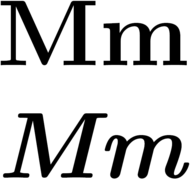 Uppercase and lowercase versions of M, in normal and italic type
 -
 Uppercase and lowercase M in Fraktur


See also
[edit]Other representations of M:


English
[edit]Etymology 1
[edit]Pronunciation
[edit]Letter
[edit]m (lower case, upper case M, plural ms or m's)
- The thirteenth letter of the English alphabet, called em and written in the Latin script.
Derived terms
[edit]See also
[edit]- (Latin-script letters) letter; A a, B b, C c, D d, E e, F f, G g, H h, I i, J j, K k, L l, M m, N n, O o, P p, Q q, R r, S s, T t, U u, V v, W w, X x, Y y, Z z
Number
[edit]m (lower case, upper case M)
- The ordinal number thirteenth, derived from this letter of the English alphabet, called em and written in the Latin script.
Etymology 2
[edit]Abbreviations.
- (stenoscript) Abbreviation of am.
- (stenoscript) Abbreviation of him.
- (stenoscript) Abbreviation of my and mine.
- (stenoscript) Abbreviation of many.
- (stenoscript) the prefix mis-.
- (stenoscript) the prefix im-.
Adjective
[edit]m
- (grammar) Abbreviation of masculine.
Noun
[edit]m (plural ms)
- Abbreviation of meter.
- Abbreviation of mile.
- Abbreviation of month.
- Abbreviation of minute.
- 1908, Francis Ernest Lloyd, The Physiology of Stomata, Carnegie Institution of Washington, page 83:
- Another instance: 2h28m p. m., 10 micra; 3h08m p. m., 0 micra; irrigated with water: 3h09m p. m., 4 micra.
- Abbreviation of million.
- 2012 May 5, Phil McNulty, “Chelsea 2-1 Liverpool”, in BBC Sport[1]:
- The final started with £85m worth of striking talent on the bench as Carroll was a Liverpool substitute and Chelsea's Fernando Torres missed out on a starting place against his former club.
- Abbreviation of minim (“unit of volume”).
- (music) Abbreviation of measure.
- (obsolete) thousand
- 1798 Letter from w:William Short (American ambassador) to Thomas Jefferson:
- Having made a divorce with politics as I have already mentioned I have only to trouble you on my personal affairs ... —The principle & most pressing is that of the 9. m. dollars—
- 1798 Letter from w:William Short (American ambassador) to Thomas Jefferson:
Verb
[edit]m
- (knitting) make
- 2011, Kristi Porter, Knitting Patterns For Dummies, page 232:
- Row 1 (RS): Kfb, knit to marker A, slip marker A, knit to marker B (there are no sts to knit between markers A and B in Row 1), m1, slip marker B, k1, slip marker B, m1, […]
Translations
[edit]See also
[edit]Amal
[edit]Noun
[edit]m
References
[edit]- transnewguinea.org, citing D. C. Laycock, Languages of the Lumi Subdistrict (West Sepik District), New Guinea (1968), Oceanic Linguistics, 7 (1): 36-66
Azerbaijani
[edit]Pronunciation
[edit]Letter
[edit]m lower case (upper case M)
- The nineteenth letter of the Azerbaijani alphabet, written in the Latin script.
See also
[edit]- (Latin-script letters) hərf; A a, B b, C c, Ç ç, D d, E e, Ə ə, F f, G g, Ğ ğ, H h, X x, I ı, İ i, J j, K k, Q q, L l, M m, N n, O o, Ö ö, P p, R r, S s, Ş ş, T t, U u, Ü ü, V v, Y y, Z z
Basque
[edit]Pronunciation
[edit]Letter
[edit]m (lower case, upper case M)
- The thirteenth letter of the Basque alphabet, called eme and written in the Latin script.
See also
[edit]- (Latin-script letters) A a, B b, C c (Ç ç), D d, E e, F f, G g, H h, I i, J j, K k, L l, M m, N n, Ñ ñ, O o, P p, Q q, R r, S s, T t, U u (Ü ü), V v, W w, X x, Y y, Z z
Central Mazahua
[edit]Pronunciation
[edit]Letter
[edit]m (upper case M)
- A letter of the Mazahua alphabet.
See also
[edit]- (Latin-script letters) A a, Ⱥ ⱥ, A̱ a̱, B b, C c, Cꞌ cꞌ, Cj cj, Cu cu, Cꞌu cꞌu, Cju cju, Ch ch, Chꞌ chꞌ, Chj chj, D d, Dy dy, E e, Ɇ ɇ, E̱ e̱, G g, Gu gu, Hu hu, ꞌHu ꞌhu, I i, I̱ i̱, J j, Jꞌ jꞌ, Jm jm, Jn jn, Jñ jñ, Ju ju, Jy jy, L l, M m, Mꞌ mꞌ, N n, Nꞌ nꞌ, Ñ ñ, Ñꞌ ñꞌ, O o, Ø ø, O̱ o̱, P p, Pj pj, R r, S s, T t, Tꞌ tꞌ, Tj tj, Ts ts, Tsꞌ tsꞌ, Tsj tsj, U u, Ꞹ ꞹ, U̱ u̱, X x, Z z, Zh zh, ꞌ
Dutch
[edit]Pronunciation
[edit]Letter
[edit]m (lower case, upper case M)
- The thirteenth letter of the Dutch alphabet, written in the Latin script.
See also
[edit]See also
[edit]Egyptian
[edit]Etymology 1
[edit]Often suggested to be cognate to Hebrew בְּ־ (bə-), Arabic بِـ (bi-); however, more recent scholarship disputes this on phonological grounds, as Egyptian m is not held to regularly correspond with Semitic *b by either the traditional school of Egyptian comparison or the Rösslerian school.
Pronunciation
[edit]- (reconstructed) IPA(key): /ma/ → /mə/ → /mə/ → /m̩/
- (modern Egyptological) IPA(key): /ɛm/
- Conventional anglicization: em
Preposition
[edit]
|

- in
- (of time) in, for, during
- (with certain verbs of motion) into
- (with most verbs of motion) from within, out of, from
- (of material) made of, consisting of
- (of contents, e.g. of a group) consisting of, comprising
- by means of
- in a state of
- in the capacity of, in the role of, as, being
- together with, along with
- (with following infinitive) forms the periphrastic imperfective of a verb
Usage notes
[edit]This preposition is often used with definition 9 to indicate temporary identity, so, for example, z m ꜣhw (“the man is a poor man”) implies that this a temporary, rather than an eternal or generally true, state. Egyptian generally has an expansive view of what counts as a temporary identity compared to English.
Inflection
[edit]
Alternative forms
[edit]
| ||
| m |

When the object of the preposition is an attached suffix pronoun, the adverbial form jm is used instead.
Derived terms
[edit]- ꜣḫ m jb
- ꜣst-m-ꜣḫ-bjt
- jj-m-ḥtp
- jw-m-jtrw
- jw-n-ꜣmw-m-sḫt-sjsj
- jwḥ m zšn
- jm
- jmj
- jmn-m-ḥꜣt
- wꜣḥ-nsyt-mj-rꜥ-m-pt
- wꜥ m
- pwj-m-rꜥ
- pr-m-ws
- m ꜣw
- m ꜣwt ḏt
- m ꜣmmt
- m ꜣt
- m ꜣt.f
- m ꜣt nt
- m ꜣt r ꜣt
- m-ꜥ
- m ꜥb
- m-ꜥ ntt
- m wḥm
- m wḥm ꜥ
- m wsṯn
- m bꜣḥ
- m-bjꜣt
- m mꜣwt
- m mjtt
- m mnt
- m ḥꜣt
- m ḥr
- m ḥrt
- m ḥtp
- m ḫm
- m ḫnt
- m ḫt
- m ḫd
- m ẖnw
- m ẖrt-hrw
- m zp
- m sꜣ
- m sḫm
- m qꜣb
- m km n ꜣt
- m tꜣ ꜣt
- mdwt m ḥr
- m ḏd
- nj zp jwt ḫt nb jm
- nmtj-m-zꜣ.f
- rw nw prt m hrw
- rḏj m ḥr
- ḥꜣt-ꜥ m
- ḥr-m-ꜣḫt
- ḥr-m-ꜣḫt-ḫprj-rꜥ-tm
- ḥr-m-ꜥḥ.f
- ḥr-m-pr.f
- ḥr-m-ḥꜣt
- ḫꜥ-m-wꜣst
- sbk-m-ḥꜣb
- kꜣ-nḫt-ḫꜥ-m-wꜣst
Etymology 2
[edit]Possibly originally a verb form, an imperative meaning ‘see’.
Particle
[edit]
|

proclitic
- (chiefly Old and Middle Egyptian, with a suffix pronoun) behold, lo, look
- Synonym: (Late Egyptian) ptr
- (without a suffix pronoun) whether, although
Usage notes
[edit]This particle must introduce a sentence. In Middle Egyptian, it is usually followed by an attached second-person suffix pronoun, such as .k, .ṯ, .ṯnj, or .ṯn, indicating the person being addressed; after this comes the subject, in the form of a nominal subject, a demonstrative pronoun, or a dependent pronoun. In Old Egyptian, a dependent pronoun could be used instead of a suffix pronoun, reflecting the word’s origins as an imperative.
Alternative forms
[edit]
|
| ||||||
| m | m |


Etymology 3
[edit]Verb
[edit]
|

- imperative of jmj (“to not be, to not do”): don't
Alternative forms
[edit]
| ||
| m |
See also
[edit]References
[edit]- James P[eter] Allen (2010) Middle Egyptian: An Introduction to the Language and Culture of Hieroglyphs, 2nd edition, Cambridge: Cambridge University Press, →ISBN, pages 86, 115, 179–180, 194–195.
- Faulkner, Raymond Oliver (1962) A Concise Dictionary of Middle Egyptian, Oxford: Griffith Institute, →ISBN
- Hoch, James (1997) Middle Egyptian Grammar, Mississauga: Benben Publications, →ISBN, page 15
Esperanto
[edit]Pronunciation
[edit]Letter
[edit]m (lower case, upper case M)
- The sixteenth letter of the Esperanto alphabet, called mo and written in the Latin script.
See also
[edit]- (Latin-script letters) litero; A a, B b, C c, Ĉ ĉ, D d, E e, F f, G g, Ĝ ĝ, H h, Ĥ ĥ, I i, J j, Ĵ ĵ, K k, L l, M m, N n, O o, P p, R r, S s, Ŝ ŝ, T t, U u, Ŭ ŭ, V v, Z z
Estonian
[edit]Pronunciation
[edit]Letter
[edit]m (lower case, upper case M)
- The thirteenth letter of the Estonian alphabet, called emm and written in the Latin script.
See also
[edit]- (Latin-script letters) täht; A a, B b (C c), D d, E e, F f, G g, H h, I i, J j, K k, L l, M m, N n, O o, P p (Q q), R r, S s, Š š, Z z, Ž ž, T t, U u, V v (W w), Õ õ, Ä ä, Ö ö, Ü ü (X x, Y y)
Etulo
[edit]Pronoun
[edit]ḿ
- I, first-person singular pronoun
- ḿ wēnî — I drink water
- ḿ wēnī — I drank water
References
[edit]- Rose-Juliet Anyanwu, Fundamentals of Phonetics, Phonology and Tonology (2008)
Faroese
[edit]Pronunciation
[edit]Letter
[edit]m (upper case M)
- The fifteenth letter of the Faroese alphabet, written in the Latin script.
See also
[edit]- (Latin-script letters) bókstavur; A a, Á á, B b, D d, Ð ð, E e, F f, G g, H h, I i, Í í, J j, K k, L l, M m, N n, O o, Ó ó, P p, R r, S s, T t, U u, Ú ú, V v, Y y, Ý ý, Æ æ, Ø ø
Finnish
[edit]Etymology
[edit]The Finnish orthography using the Latin script was based on those of Swedish, German and Latin, and was first used in the mid-16th century. No earlier script is known. See the Wikipedia article on Finnish for more information, and m for information on the development of the glyph itself.
Pronunciation
[edit]- IPA(key): /ˈæm/, [ˈæm] (letter name)
- IPA(key): /ˈem/, [ˈe̞m] (letter name, dated)
Audio: äm, mämmi, kumi, äm: (file)
Letter
[edit]m (lower case, upper case M)
- The thirteenth letter of the Finnish alphabet, called äm or em and written in the Latin script.
Noun
[edit]m
- Abbreviation of miehet (“gentlemen”) (used to mark toilets and similar installations to be for men only)
See also
[edit]- (Latin-script letters) kirjain; A a, B b, C c, D d, E e, F f, G g, H h, I i, J j, K k, L l, M m, N n, O o, P p, Q q, R r, S s (Š š), T t, U u, V v (W w), X x, Y y, Z z (Ž ž), Å å, Ä ä, Ö ö
French
[edit]Pronunciation
[edit]Letter
[edit]m (lower case, upper case M)
- The thirteenth letter of the French alphabet, written in the Latin script.
- 1837, Louis Viardot, L’Ingénieux Hidalgo Don Quichotte de la Manchefr.Wikisource, translation of El ingenioso hidalgo Don Quijote de la Mancha by Miguel de Cervantes Saavedra, Chapter III:
- L’aube du jour commençait à poindre quand don Quichotte sortit de l’hôtellerie, si content, si glorieux, si plein de ravissement de se voir armé chevalier, que sa joie en faisait tressaillir jusqu’aux sangles de son cheval.
- The dawn of the day was beginning to break when Don Quixote left the inn, so content, so glorious, so full of ravishment of seeing himself armed a knight, that his joy made him tremble all the way to the girths of his horse.
Fula
[edit]Pronunciation
[edit]Letter
[edit]m (lower case, upper case M)
- A letter of the Fula alphabet, written in the Latin script.
Usage notes
[edit]See also
[edit]- (Latin-script letters) karfeeje; ', A a, B b, Mb mb, Ɓ ɓ, C c, D d, Nd nd, Ɗ ɗ, E e, F f, G g, Ng ng, Ɠ ɠ, H h, I i, J j, Nj nj, K k, L l, M m, N n, Ŋ ŋ, Ñ ñ, Ɲ ɲ, O o, P p, R r, S s, T t, U u, W w, Y y, Ƴ ƴ
Ghomala'
[edit]Preposition
[edit]m
References
[edit]- Erika Eichholzer (editor) et al, Dictionnaire ghomala’ (2002)
Gothic
[edit]Romanization
[edit]m
- Romanization of 𐌼
Haitian Creole
[edit]Etymology
[edit]Contraction of mwen, from French moi.
Pronunciation
[edit]Pronoun
[edit]m
- Contraction of mwen.
Hungarian
[edit]Etymology 1
[edit]Abbreviation of méter (“meter”).
Pronunciation
[edit]Noun
[edit]m (plural m-ek)
- m (the unit of length in the International System of Units)
Declension
[edit]| Inflection (stem in -e-, front unrounded harmony) | ||
|---|---|---|
| singular | plural | |
| nominative | m | m-ek |
| accusative | m-t | m-eket |
| dative | m-nek | m-eknek |
| instrumental | m-rel | m-ekkel |
| causal-final | m-ért | m-ekért |
| translative | m-ré | m-ekké |
| terminative | m-ig | m-ekig |
| essive-formal | m-ként | m-ekként |
| essive-modal | — | — |
| inessive | m-ben | m-ekben |
| superessive | m-en | m-eken |
| adessive | m-nél | m-eknél |
| illative | m-be | m-ekbe |
| sublative | m-re | m-ekre |
| allative | m-hez | m-ekhez |
| elative | m-ből | m-ekből |
| delative | m-ről | m-ekről |
| ablative | m-től | m-ektől |
| non-attributive possessive - singular |
m-é | m-eké |
| non-attributive possessive - plural |
m-éi | m-ekéi |
| Possessive forms of m | ||
|---|---|---|
| possessor | single possession | multiple possessions |
| 1st person sing. | m-em | m-eim |
| 2nd person sing. | m-ed | m-eid |
| 3rd person sing. | m-e | m-ei |
| 1st person plural | m-ünk | m-eink |
| 2nd person plural | m-etek | m-eitek |
| 3rd person plural | m-ük | m-eik |
Etymology 2
[edit]Pronunciation
[edit]Letter
[edit]m (lower case, upper case M)
- The twenty-first letter of the Hungarian alphabet, called emm and written in the Latin script.
Declension
[edit]| Inflection (stem in -e-, front unrounded harmony) | ||
|---|---|---|
| singular | plural | |
| nominative | m | m-ek |
| accusative | m-et | m-eket |
| dative | m-nek | m-eknek |
| instrumental | m-mel | m-ekkel |
| causal-final | m-ért | m-ekért |
| translative | m-mé | m-ekké |
| terminative | m-ig | m-ekig |
| essive-formal | m-ként | m-ekként |
| essive-modal | — | — |
| inessive | m-ben | m-ekben |
| superessive | m-en | m-eken |
| adessive | m-nél | m-eknél |
| illative | m-be | m-ekbe |
| sublative | m-re | m-ekre |
| allative | m-hez | m-ekhez |
| elative | m-ből | m-ekből |
| delative | m-ről | m-ekről |
| ablative | m-től | m-ektől |
| non-attributive possessive - singular |
m-é | m-eké |
| non-attributive possessive - plural |
m-éi | m-ekéi |
| Possessive forms of m | ||
|---|---|---|
| possessor | single possession | multiple possessions |
| 1st person sing. | m-em | m-eim |
| 2nd person sing. | m-ed | m-eid |
| 3rd person sing. | m-e | m-ei |
| 1st person plural | m-ünk | m-eink |
| 2nd person plural | m-etek | m-eitek |
| 3rd person plural | m-ük | m-eik |
See also
[edit]- (Latin-script letters) betű; A a, Á á, B b, C c, Cs cs, D d, Dz dz, Dzs dzs, E e, É é, F f, G g, Gy gy, H h, I i, Í í, J j, K k, L l, Ly ly, M m, N n, Ny ny, O o, Ó ó, Ö ö, Ő ő, P p, R r, S s, Sz sz, T t, Ty ty, U u, Ú ú, Ü ü, Ű ű, V v, Z z, Zs zs. Only in the extended alphabet: Q q W w X x Y y. Commonly used: ch. Also defined: à ë. In surnames (selection): ä aa cz ds eé eö ew oe oó th ts ÿ.
Further reading
[edit]- m in Bárczi, Géza and László Országh. A magyar nyelv értelmező szótára (“The Explanatory Dictionary of the Hungarian Language”, abbr.: ÉrtSz.). Budapest: Akadémiai Kiadó, 1959–1962. Fifth ed., 1992: →ISBN
Icelandic
[edit]Pronunciation
[edit]Letter
[edit]m (upper case M)
- The sixteenth letter of the Icelandic alphabet, written in the Latin script.
See also
[edit]- (Latin-script letters) bókstafur; A a, Á á, B b, D d, Ð ð, E e, É é, F f, G g, H h, I i, Í í, J j, K k, L l, M m, N n, O o, Ó ó, P p, R r, S s, T t, U u, Ú ú, V v, X x, Y y, Ý ý, Þ þ, Æ æ, Ö ö
Ido
[edit]Pronunciation
[edit]Letter
[edit]m (upper case M)
- The thirteenth letter of the Ido alphabet, written in the Latin script.
See also
[edit]- (Latin-script letters) litero; A a, B b, C c, D d, E e, F f, G g, H h, I i, J j, K k, L l, M m, N n, O o, P p, Q q, R r, S s, T t, U u, V v, W w, X x, Y y, Z z
Igbo
[edit]Etymology 1
[edit]Pronunciation
[edit]Letter
[edit]m (upper case M)
- The nineteenth letter of the Igbo alphabet, written in the Latin script.
Etymology 2
[edit]Pronunciation
[edit]Pronoun
[edit]m (dependent/independent form, independent forms m, mụ)
See also
[edit]Indonesian
[edit]Pronunciation
[edit]Letter
[edit]m (lower case, upper case M)
- The thirteenth letter of the Indonesian alphabet, written in the Latin script.
See also
[edit]- (Latin-script letters) huruf; A a, B b, C c, D d, E e, F f, G g, H h, I i, J j, K k, L l, M m, N n, O o, P p, Q q, R r, S s, T t, U u, V v, W w, X x, Y y, Z z
Ingrian
[edit]Noun
[edit]m (invariable)
- Abbreviation of metra.
- 1937, N. S. Popova, translated by Mihailov and D. I. Efimov, Arifmetiikan oppikirja alkușkouluja vart (kolmas osa), Leningrad: Ucebno-Pedagogiceskoi Izdateljstva, page 18:
- 1 m = 10 dm, 1 dm = 10 sm,
- 1 m = 10 dm, 1 dm = 10 cm,
Italian
[edit]Letter
[edit]m f or m (invariable, lower case, upper case M)
- The eleventh letter of the Italian alphabet, called emme and written in the Latin script.
Kashubian
[edit]Etymology
[edit]The Kashubian orthography is based on the Latin alphabet. No earlier script is known. See the Kashubian alphabet article on Wikipedia for more, and m for development of the glyph itself.
Letter
[edit]m (lower case, upper case M)
- The eighteenth letter of the Kashubian alphabet, written in the Latin script.
See also
[edit]- (Latin-script letters) A a, Ą ą, Ã ã, B b, C c, D d, E e, É é, Ë ë, F f, G g, H h, I i, J j, K k, L l, Ł ł, M m, N n, O o, Ò ò, Ó ó, Ô ô, P p, R r, S s, T t, U u, Ù ù, W w, Y y, Z z, Ż ż
Lashi
[edit]| < 4 | 5 | 6 > |
|---|---|---|
| Cardinal : m | ||
Etymology
[edit]From Proto-Sino-Tibetan *l/b-ŋa. Cognates include Chinese 五 (wǔ) and Burmese ငါး (nga:).
Pronunciation
[edit]Numeral
[edit]m
References
[edit]- Mark Wannemacher (2011) A phonological overview of the Lacid language[2], Chiang Mai: Payap University., page 35
- Hkaw Luk (2017) A grammatical sketch of Lacid[3], Chiang Mai: Payap University (master thesis), page 45
Latin
[edit]Letter
[edit]m
- The letter of the Latin alphabet, written in the Latin script.
Latvian
[edit]Etymology
[edit]Proposed in 1908 as part of the new Latvian spelling by the scientific commission headed by K. Mīlenbahs, which was accepted and began to be taught in schools in 1909. Prior to that, Latvian had been written in German Fraktur, and sporadically in Cyrillic.
Pronunciation
[edit]Letter
[edit]
m (lower case, upper case M)
- The twentieth letter of the Latvian alphabet, called em and written in the Latin script.
See also
[edit]- Letters of the Latvian alphabet:
Livonian
[edit]Pronunciation
[edit]Letter
[edit]m (upper case M)
- The nineteenth letter of the Livonian alphabet, written in the Latin script.
See also
[edit]- (Latin-script letters) kēratēd̦; A a, Ā ā, Ä ä, Ǟ ǟ, B b, D d, D̦ d̦, E e, Ē ē, F f, G g, H h, I i, Ī ī, J j, K k, L l, Ļ ļ, M m, N n, Ņ ņ, O o, Ō ō, Ȯ ȯ, Ȱ ȱ, Õ õ, Ȭ ȭ, P p, R r, Ŗ ŗ, S s, Š š, T t, Ț ț, U u, Ū ū, V v, Z z, Ž ž
Malay
[edit]Letter
[edit]m (lower case, upper case M)
- The thirteenth letter of the Malay alphabet, written in the Latin script.
See also
[edit]- (Latin-script letters) A a, B b, C c, D d, E e, F f, G g, H h, I i, J j, K k, L l, M m, N n, O o, P p, Q q, R r, S s, T t, U u, V v, W w, X x, Y y, Z z
Maltese
[edit]Pronunciation
[edit]Letter
[edit]m (lower case, upper case M)
- The seventeenth letter of the Maltese alphabet, written in the Latin script.
See also
[edit]- (Latin-script letters) ittra; A a, B b, Ċ ċ, D d, E e, F f, Ġ ġ, G g, Għ għ, H h, Ħ ħ, I i, Ie ie, J j, K k, L l, M m, N n, O o, P p, Q q, R r, S s, T t, U u, V v, W w, X x, Ż ż, Z z
Mandarin
[edit]Romanization
[edit]m
- Nonstandard spelling of m̄.
- Nonstandard spelling of ḿ.
- Nonstandard spelling of m̌.
- Nonstandard spelling of m̀.
Usage notes
[edit]- Transcriptions of Mandarin into the Latin script often do not distinguish between the critical tonal differences employed in the Mandarin language, using words such as this one without indication of tone.
Mandinka
[edit]Pronoun
[edit]m
See also
[edit]Norwegian
[edit]Pronunciation
[edit]Letter
[edit]m
- The thirteenth letter of the Norwegian alphabet, written in the Latin script.
Usage notes
[edit]- Word-final m is written single after short vowels (e.g. komme > kom), unlike all other consonants that can be doubled. This is due to the letter's width.
Nupe
[edit]Pronunciation
[edit]Letter
[edit]m (lower case, upper case M)
- The sixteenth letter of the Nupe alphabet, written in the Latin script.
See also
[edit]- (Latin-script letters) banki; A a (Á á, À à), B b, C c, D d, Dz dz, E e (É é, È è), F f, G g, Gb gb, H h, I i (Í í, Ì ì), J j, K k, Kp kp, L l, M m (Ḿ ḿ, M̀ m̀, M̄ m̄), N n (Ń ń, Ǹ ǹ, N̄ n̄), O o (Ó ó, Ò ò), P p, R r, S s, Sh sh, T t, Ts ts, U u (Ú ú, Ù ù), V v, W w, Y y, Z z, Zh zh
Polish
[edit]Etymology
[edit]The Polish orthography is based on the Latin alphabet. No earlier script is known. See the history of Polish orthography article on Wikipedia for more, and m for development of the glyph itself.
Pronunciation
[edit]Letter
[edit]m (upper case M, lower case)
- The seventeenth letter of the Polish alphabet, called em and written in the Latin script.
See also
[edit]- (Latin-script letters) A a, Ą ą, B b, C c, Ć ć, D d, E e, Ę ę, F f, G g, H h, I i, J j, K k, L l, Ł ł, M m, N n, Ń ń, O o, Ó ó, P p (Q q), R r, S s, Ś ś, T t, U u (V v), W w (X x), Y y, Z z, Ź ź, Ż ż
Portuguese
[edit]Pronunciation
[edit]Letter
[edit]m (upper case M, lower case b)
- The thirteenth letter of the Portuguese alphabet, written in the Latin script.
See also
[edit]- (Latin-script letters) letra; A a (Á á, À à, Â â, Ã ã), B b, C c (Ç ç), D d, E e (É é, Ê ê), F f, G g, H h, I i (Í í), J j, K k, L l, M m, N n, O o (Ó ó, Ô ô, Õ õ), P p, Q q, R r, S s, T t, U u (Ú ú), V v, W w, X x, Y y, Z z
Romani
[edit]Pronunciation
[edit]Letter
[edit]m (lower case, upper case M)
- (International Standard) The seventeenth letter of the Romani alphabet, written in the Latin script.
- (Pan-Vlax) The eighteenth letter of the Romani alphabet, written in the Latin script.
See also
[edit]- (Latin-script letters) A a, B b, C c, D d, E e, F f, G g, H h, X x, I i, J j, K k, Kh kh, L l, M m, N n, O o, P p, Ph ph, R r, S s, T t, Th th, U u, V v, Z z International Standard: (À à, Ä ä, Ǎ ǎ), Ć ć, Ćh ćh, (È è, Ë ë, Ě ě), (Ì ì, Ï ï, Ǐ ǐ), (Ò ò, Ö ö, Ǒ ǒ), Rr rr, Ś ś, (Ù ù, Ü ü, Ǔ ǔ), Ź ź, Ʒ ʒ, Q q, Ç ç, ϴ θ. Pan-Vlax: Č č, Čh čh, Dž dž, (Dź dź), Ř ř, Š š, (Ś ś), Ž ž, (Ź ź).
Romanian
[edit]Pronunciation
[edit]Letter
[edit]m (lower case, upper case M)
- The sixteenth letter of the Romanian alphabet, called em, me, or mî and written in the Latin script.
See also
[edit]- (Latin-script letters) A a, Ă ă, Â â, B b, C c, D d, E e, F f, G g, H h, I i, Î î, J j, K k, L l, M m, N n, O o, P p, Q q, R r, S s, Ș ș, T t, Ț ț, U u, V v, W w, X x, Y y, Z z
Scottish Gaelic
[edit]Etymology 1
[edit]Letter
[edit]m (lower case, upper case M)
- The eleventh letter of the Scottish Gaelic alphabet, written in the Latin script. It is preceded by l and followed by n. Its traditional name is muin (“vine”).
See also
[edit]- (Latin-script letters) litir; A a (À à), B b (Bh bh), C c (Ch ch), D d (Dh dh), E e (È è), F f (Fh fh), G g (Gh gh), H h, I i (Ì ì), L l, M m (Mh mh), N n, O o (Ò ò), P p (Ph ph), R r, S s (Sh sh), T t (Th th), U u (Ù ù)
- (diacritics) ◌̀
- (obsolete vowels) Á á É é Ó ó
Etymology 2
[edit]Adverb
[edit]m
- Abbreviation of sa mhadainn (“in the morning, ante meridiem”); am, a.m.
Serbo-Croatian
[edit]Alternative forms
[edit]- (uppercase): M
Pronunciation
[edit]Letter
[edit]m (Cyrillic spelling м)
Noun
[edit]m ? (Cyrillic spelling м)
Silesian
[edit]Etymology
[edit]The Silesian orthography is based on the Latin alphabet. No earlier script is known. See the Silesian language article on Wikipedia for more, and m for development of the glyph itself.
Letter
[edit]m (lower case, upper case M)
- The sixteenth letter of the Silesian alphabet, written in the Latin script.
See also
[edit]- (Latin-script letters) A a, Ã ã, B b, C c, Ć ć, D d, E e, F f, G g, H h, I i, J j, K k, L l, Ł ł, M m, N n, Ń ń, O o, Ŏ ŏ, Ō ō, Ô ô, Õ õ, P p, R r, S s, Ś ś, T t, U u, W w, Y y, Z z, Ź ź, Ż ż
Skolt Sami
[edit]Pronunciation
[edit]Letter
[edit]m (upper case M)
- The twenty-first letter of the Skolt Sami alphabet, written in the Latin script.
See also
[edit]- (Latin-script letters) bukva; A a, Â â, B b, C c, Č č, Ʒ ʒ, Ǯ ǯ, D d, Đ đ, E e, F f, G g, Ǧ ǧ, Ǥ ǥ, H h, I i, J j, K k, Ǩ ǩ, L l, M m, N n, Ŋ ŋ, O o, Õ õ, P p, R r, S s, Š š, T t, U u, V v, Z z, Ž ž, Å å, Ä ä, ʹ
Spanish
[edit]Etymology 1
[edit]Pronunciation
[edit]Letter
[edit]m (lower case, upper case M)
- The thirteenth letter of the Spanish alphabet, written in the Latin script.
Etymology 2
[edit]Pronunciation
[edit]Pronoun
[edit]m
- (text messaging) Abbreviation of me.
Swahili
[edit]Verb
[edit]m
Usage notes
[edit]This term is archaic except in the common greeting m hali gani. Along with u and ni it is not conjugated.
See also
[edit]Swedish
[edit]Preposition
[edit]m
- w/, with; Abbreviation of med.
See also
[edit]Proper noun
[edit]m
Tagalog
[edit]Etymology
[edit]Borrowed from Spanish m. Each pronunciation has a different source:
- Filipino alphabet pronunciation is influenced by English m.
- Abakada alphabet pronunciation is influenced by Baybayin character ᜋ (ma).
- Abecedario pronunciation is from Spanish m.
Pronunciation
[edit]Letter
[edit]m (lower case, upper case M, Baybayin spelling ᜁᜋ᜔)
- The thirteenth letter of the Tagalog alphabet (the Filipino alphabet), called em and written in the Latin script.
See also
[edit]- (Latin-script letters) titik; A a, B b, C c, D d, E e, F f, G g, H h, I i, J j, K k, L l, M m, N n, Ñ ñ, Ng ng, O o, P p, Q q, R r, S s, T t, U u, V v, W w, X x, Y y, Z z
Letter
[edit]m (lower case, upper case M, Baybayin spelling ᜋ)
- The tenth letter of the Tagalog alphabet (the Abakada alphabet), called ma and written in the Latin script.
Letter
[edit]m (lower case, upper case M, Baybayin spelling ᜁᜋᜒ)
- (historical) The fifteenth letter of the Tagalog alphabet (the Abecedario), called eme and written in the Latin script.
Further reading
[edit]- “m”, in Pambansang Diksiyonaryo | Diksiyonaryo.ph, Manila, 2018
Turkish
[edit]Letter
[edit]m (lower case, upper case M)
- The sixteenth letter of the Turkish alphabet, called me and written in the Latin script.
See also
[edit]- (Latin-script letters) harf; A a (Â â), B b, C c, Ç ç, D d, E e, F f, G g, Ğ ğ, H h, I ı, İ i (Î î), J j, K k, L l, M m, N n, O o, Ö ö, P p, R r, S s, Ş ş, T t, U u (Û û), Ü ü, V v, Y y, Z z
Turkmen
[edit]Pronunciation
[edit]Letter
[edit]m (upper case M)
- The fifteenth letter of the Turkmen alphabet, called em and written in the Latin script.
See also
[edit]- (Latin-script letters) harp; A a, B b, Ç ç, D d, E e, Ä ä, F f, G g, H h, I i, J j, Ž ž, K k, L l, M m, N n, Ň ň, O o, Ö ö, P p, R r, S s, Ş ş, T t, U u, Ü ü, W w, Y y, Ý ý, Z z
Xhosa
[edit]Pronoun
[edit]-m
Yele
[edit]Pronunciation
[edit]Letter
[edit]m (upper case M)
- A letter of the Yele alphabet.
Derived terms
[edit]- The digraph ⟨mb⟩ transcribes the single consonant /ⁿp/ [mb]
- The digraph ⟨md⟩ transcribes the single consonant /ⁿʈ͡p/ [ɳ͡mɖ͡b]
- The digraph ⟨mg⟩ transcribes the single consonant /ⁿk͡p/ [ŋ͡mɡ͡b]
- The digraph ⟨mt⟩ transcribes the single consonant /ⁿt̪͡p/ [n̪͡md̪͡b]
Palatalized consonants are written ⟨mby, mty, my⟩, labialized consonants as ⟨mbw, mw⟩, and labio-palatalized consonants as ⟨mbyw, myw⟩.
See also
[edit]- (Latin-script letters) A a, â, b, Ch ch, D d, e, é, ê, Gh gh, i, î, j, K k, L l, M m, N n, Ń ń, o, ó, P p, T t, U u, V v, W w, Y y, ꞉
Yoruba
[edit]Etymology 1
[edit]Pronunciation
[edit]Letter
[edit]m (lower case, upper case M)
- The fourteenth letter of the Yoruba alphabet, called mí and written in the Latin script.
See also
[edit]- (Latin-script letters) lẹ́tà; A a (Á á, À à, Ā ā), B b, D d, E e (É é, È è, Ē ē), Ẹ ẹ (Ẹ́ ẹ́, Ẹ̀ ẹ̀, Ẹ̄ ẹ̄), F f, G g, Gb gb, H h, I i (Í í, Ì ì, Ī ī), J j, K k, L l, M m (Ḿ ḿ, M̀ m̀, M̄ m̄), N n (Ń ń, Ǹ ǹ, N̄ n̄), O o (Ó ó, Ò ò, Ō ō), Ọ ọ (Ọ́ ọ́, Ọ̀ ọ̀, Ọ̄ ọ̄), P p, R r, S s, Ṣ ṣ, T t, U u (Ú ú, Ù ù, Ū ū), W w, Y y
- (Benin) (Latin-script letters) lɛ́tà; A a, B b, D d, E e, Ɛ ɛ, F f, G g, Gb gb, H h, I i, J j, K k, Kp kp, L l, M m, N n, O o, Ɔ ɔ, P p, R r, S s, Sh sh, T t, U u, W w, Y y
Etymology 2
[edit]Pronunciation
[edit]Pronoun
[edit]m̄ or m
Etymology 3
[edit]Pronunciation
[edit]Particle
[edit]ḿ
- Standard spelling of ń (“imperfect aspect marker”) (used before verbs that start with a /b/ sound)
Zulu
[edit]Letter
[edit]m (lower case, upper case M)
- The thirteenth letter of the Zulu alphabet, written in the Latin script.
See also
[edit]- (Latin-script letters) A a, B b, C c, D d, E e, F f, G g, H h, I i, J j, K k, L l, M m, N n, O o, P p, Q q, R r, S s, T t, U u, V v, W w, X x, Y y, Z z
ǃKung
[edit]Verb
[edit]m
- Character boxes with images
- Basic Latin block
- Latin script characters
- Phonetic Extensions block
- Number Forms block
- Halfwidth and Fullwidth Forms block
- Musical Symbols block
- Musical notation script characters
- Translingual terms derived from Ancient Greek
- Translingual lemmas
- Translingual letters
- Translingual terms with audio links
- Translingual symbols
- mul:Phonetics
- IPA symbols
- mul:Music
- mul:Chemistry
- Translingual numerals
- Roman numerals
- mul:Thousand
- English 1-syllable words
- English terms with IPA pronunciation
- English terms with audio links
- Rhymes:English/ɛm
- Rhymes:English/ɛm/1 syllable
- English lemmas
- English letters
- English numeral symbols
- English ordinal numbers
- English stenoscript abbreviations
- English abbreviations
- English adjectives
- en:Grammar
- English nouns
- English countable nouns
- English words without vowels
- English terms with quotations
- en:Music
- English terms with obsolete senses
- English verbs
- en:Knitting
- Amal lemmas
- Amal nouns
- aad:Anatomy
- Azerbaijani terms with IPA pronunciation
- Azerbaijani lemmas
- Azerbaijani letters
- Basque terms with IPA pronunciation
- Basque lemmas
- Basque letters
- Central Mazahua terms with IPA pronunciation
- Central Mazahua lemmas
- Central Mazahua letters
- Rhymes:Dutch/ɛm
- Rhymes:Dutch/ɛm/1 syllable
- Dutch terms with IPA pronunciation
- Dutch lemmas
- Dutch letters
- Egyptian terms with IPA pronunciation
- Egyptian lemmas
- Egyptian prepositions
- Egyptian particles
- Egyptian proclitic particles
- Egyptian non-lemma forms
- Egyptian verb forms
- Esperanto terms with IPA pronunciation
- Esperanto terms with audio links
- Esperanto lemmas
- Esperanto letters
- Estonian terms with IPA pronunciation
- Estonian lemmas
- Estonian letters
- Etulo lemmas
- Etulo pronouns
- Faroese terms with IPA pronunciation
- Faroese lemmas
- Faroese letters
- Finnish 1-syllable words
- Finnish terms with IPA pronunciation
- Finnish terms with audio links
- Finnish lemmas
- Finnish letters
- Finnish non-lemma forms
- Finnish noun forms
- Finnish abbreviations
- French 1-syllable words
- French terms with IPA pronunciation
- French terms with audio links
- French lemmas
- French letters
- French terms with quotations
- Fula terms with IPA pronunciation
- Fula lemmas
- Fula letters
- Ghomala' lemmas
- Ghomala' prepositions
- Gothic non-lemma forms
- Gothic romanizations
- Haitian Creole terms derived from French
- Haitian Creole terms with IPA pronunciation
- Haitian Creole lemmas
- Haitian Creole pronouns
- Haitian Creole contractions
- Hungarian abbreviations
- Hungarian terms with IPA pronunciation
- Hungarian terms with manual IPA pronunciation
- Hungarian lemmas
- Hungarian nouns
- Hungarian letters
- Hungarian terms with multiple lemma etymologies
- Hungarian terms with letter and noun etymologies
- Icelandic 1-syllable words
- Icelandic terms with IPA pronunciation
- Icelandic lemmas
- Icelandic letters
- Ido terms with IPA pronunciation
- Ido lemmas
- Ido letters
- Igbo terms with IPA pronunciation
- Igbo lemmas
- Igbo letters
- Igbo pronouns
- Indonesian terms with IPA pronunciation
- Indonesian lemmas
- Indonesian letters
- Ingrian lemmas
- Ingrian nouns
- Ingrian abbreviations
- Ingrian terms with quotations
- Italian lemmas
- Italian letters
- Italian nouns
- Kashubian lemmas
- Kashubian letters
- Lashi terms inherited from Proto-Sino-Tibetan
- Lashi terms derived from Proto-Sino-Tibetan
- Lashi terms with IPA pronunciation
- Lashi lemmas
- Lashi numerals
- Lashi cardinal numbers
- Latin lemmas
- Latin letters
- Latvian terms with IPA pronunciation
- Latvian terms with audio links
- Latvian lemmas
- Latvian letters
- Livonian terms with IPA pronunciation
- Livonian lemmas
- Livonian letters
- Malay lemmas
- Malay letters
- Maltese terms with IPA pronunciation
- Maltese lemmas
- Maltese letters
- Hanyu Pinyin
- Mandarin non-lemma forms
- Mandarin nonstandard forms
- Mandinka lemmas
- Mandinka pronouns
- Norwegian terms with IPA pronunciation
- Norwegian Bokmål terms with audio links
- Norwegian lemmas
- Norwegian letters
- Nupe terms with IPA pronunciation
- Nupe lemmas
- Nupe letters
- Polish terms with IPA pronunciation
- Polish lemmas
- Polish letters
- Portuguese terms with audio links
- Portuguese lemmas
- Portuguese letters
- Romani terms with IPA pronunciation
- Romani lemmas
- Romani letters
- Romani International Standard spellings
- Romani Pan-Vlax spellings
- Romanian terms with IPA pronunciation
- Romanian lemmas
- Romanian letters
- Scottish Gaelic lemmas
- Scottish Gaelic letters
- Scottish Gaelic adverbs
- Scottish Gaelic abbreviations
- Serbo-Croatian terms with IPA pronunciation
- Serbo-Croatian lemmas
- Serbo-Croatian letters
- Serbo-Croatian nouns
- sh:Grammar
- sh:Units of measure
- Silesian lemmas
- Silesian letters
- Skolt Sami terms with IPA pronunciation
- Skolt Sami lemmas
- Skolt Sami letters
- Spanish terms with IPA pronunciation
- Spanish 2-syllable words
- Spanish terms with audio links
- Rhymes:Spanish/eme
- Rhymes:Spanish/eme/2 syllables
- Spanish lemmas
- Spanish letters
- Spanish 1-syllable words
- Rhymes:Spanish/e
- Rhymes:Spanish/e/1 syllable
- Spanish pronouns
- Spanish text messaging slang
- Spanish abbreviations
- Swahili lemmas
- Swahili verbs
- Swahili terms with uncommon senses
- Swahili terms with archaic senses
- Swahili terms with usage examples
- Swedish lemmas
- Swedish prepositions
- Swedish abbreviations
- Swedish proper nouns
- sv:Politics
- Tagalog terms borrowed from Spanish
- Tagalog terms derived from Spanish
- Tagalog terms derived from English
- Tagalog 1-syllable words
- Tagalog terms with IPA pronunciation
- Rhymes:Tagalog/em
- Rhymes:Tagalog/em/1 syllable
- Rhymes:Tagalog/a
- Rhymes:Tagalog/a/1 syllable
- Tagalog 2-syllable words
- Rhymes:Tagalog/eme
- Rhymes:Tagalog/eme/2 syllables
- Tagalog terms with mabilis pronunciation
- Tagalog terms with malumay pronunciation
- Tagalog lemmas
- Tagalog letters
- Tagalog terms with Baybayin script
- Tagalog terms with historical senses
- Turkish lemmas
- Turkish letters
- Turkmen terms with IPA pronunciation
- Turkmen lemmas
- Turkmen letters
- Xhosa non-lemma forms
- Xhosa pronoun forms
- Yele terms with IPA pronunciation
- Yele lemmas
- Yele letters
- Yoruba terms with IPA pronunciation
- Yoruba lemmas
- Yoruba letters
- Yoruba pronouns
- Yoruba particles
- Zulu lemmas
- Zulu letters
- ǃKung lemmas
- ǃKung verbs