User:Thadh/a
 | ||||||||
| ||||||||
| ||||||||
Abau • Afar • Albanian • Ama • Anguthimri • Aragonese • Asturian • Bambara • Bavarian • Belizean Creole • Big Nambas • Breton • Cameroon Pidgin • Catalan • Chayuco Mixtec • Chibcha • Choctaw • Chuukese • Cimbrian • Coatepec Nahuatl • Cora • Cornish • Corsican • Czech • Dalmatian • Danish • Dutch • Egyptian • Emilian • Estonian • Fala • Finnish • Franco-Provençal • French • Fula • Galician • German • Gilbertese • Gothic • Grass Koiari • Gun • Haitian Creole • Hawaiian • Hokkien • Hungarian • Ido • Igbo • Indo-Portuguese • Ingrian • Interlingua • Inupiaq • Irish • Istriot • Italian • Jamaican Creole • Japanese • K'iche' • Kabyle • Kalasha • Kapampangan • Kari'na • Kashubian • Koitabu • Krisa • Ladin • Lashi • Latgalian • Latin • Laz • Ligurian • Louisiana Creole • Lower Sorbian • Malay • Mandarin • Mandinka • Maori • Masurian • Mezquital Otomi • Middle Dutch • Middle English • Middle French • Middle Welsh • Mòcheno • Mopan Maya • Mountain Koiari • Murui Huitoto • Nauruan • Neapolitan • Nias • Norman • Norwegian Bokmål • Norwegian Nynorsk • Nupe • Occitan • Old Czech • Old Danish • Old Dutch • Old English • Old French • Old Galician-Portuguese • Old Irish • Old Polish • Old Swedish • Omaha-Ponca • Ometepec Nahuatl • Palauan • Papiamentu • Polish • Portuguese • Rapa Nui • Rawang • Romagnol • Romani • Romanian • Sardinian • Sassarese • Satawalese • Scots • Scottish Gaelic • Serbo-Croatian • Sicilian • Silesian • Skolt Sami • Slovak • Slovene • Slovincian • Spanish • Sranan Tongo • Sumerian • Swahili • Swedish • Tagalog • Tarantino • Tày • Tok Pisin • Tokelauan • Tooro • Tyap • Upper Sorbian • Vietnamese • Votic • Walloon • Welsh • West Makian • Yola • Yoruba • Yucatec Maya • Zazaki • Zhuang • Zou
Page categories
Translingual[edit]
Etymology 1[edit]
 Modification of capital A.
Pronunciation[edit]
Letter[edit]
a (upper case A)
- The first letter of the basic modern Latin alphabet.
- (superscript) See ª.
Symbol[edit]
a
- (IPA, phonetics) an open front or central unrounded vowel.
- (IPA, superscript ⟨ᵃ⟩) [a]-coloring or a weak, fleeting, epenthetic or echo [a].
- (international standards) transliterates Indic अ (or equivalent).
See also[edit]
- For more variations, see Appendix:Variations of "a".
Further reading[edit]
 Thadh/a on Wikipedia.Wikipedia
 - open front unrounded vowel on Wikipedia.Wikipedia

Etymology 2[edit]
Abbreviation of atto-, from Danish atten (“eighteen”).
Symbol[edit]
a
- atto-, prefix for 10-18 in the International System of Units.
Etymology 3[edit]
Symbol[edit]
a
- Year as a unit of time, specifically a Julian year or 365.25 days.
Etymology 4[edit]
Abbreviation of are, from French are.
Symbol[edit]
a
Etymology 5[edit]
Abbreviation of English acceleration.
Symbol[edit]
a
Etymology 6[edit]
(This etymology is missing or incomplete. Please add to it, or discuss it at the Etymology scriptorium. Particularly: “from annuity?”)
Symbol[edit]
a
- (actuarial notation) Annuity; (specifically) annuity-immediate.
- ax:n̅| ― n-year annuity-immediate to a person currently age x
- ax ― life annuity-immediate to a person currently age x
Character=A1Please see Module:checkparams for help with this warning.
Other representations of A:


Gallery[edit]
- Letter styles
-
 Uppercase and lowercase versions of A, in normal and italic type
 -
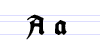 Uppercase and lowercase A in Fraktur
 -
 Approximate form of Greek uppercase Α (a, “alpha”), the source of both common variants of a A in uncial script


English[edit]
Etymology 1[edit]
From Middle English a, an, from Old English ān (“one; a; lone; sole”). More at one. The "n" was gradually lost before consonants in almost all dialects by the 15th century. Cognate with Alemannic German a (“a, an”), East Franconian a (“a, an”).
Pronunciation[edit]
- (stressed) IPA(key): /ˈeɪ/
- (unstressed) IPA(key): /ə/
Audio (US), stressed (file) Audio (US), unstressed (file) - Rhymes: -eɪ, -ə
- Homophone: her (non-rhotic, unstressed)
Article[edit]
a (indefinite)
- One; any indefinite example of. [from before 1150][1]
- There was a man here looking for you yesterday.
- 1992, Rudolf M[athias] Schuster, The Hepaticae and Anthocerotae of North America: East of the Hundredth Meridian, volume V, New York, N.Y.: Columbia University Press, →ISBN, page vii:
- With fresh material, taxonomic conclusions are leavened by recognition that the material examined reflects the site it occupied; a herbarium packet gives one only a small fraction of the data desirable for sound conclusions. Herbarium material does not, indeed, allow one to extrapolate safely: what you see is what you get […]
- 2005, Emily Kingsley (lyricist), Kevin Clash (voice actor), “A Cookie is a Sometime Food”, Sesame Street, season 36, Sesame Workshop:
- Hoots the Owl: Yes a, fruit, is a [sic], any, time, food!
- 2016, VOA Learning English (public domain)
- Anna, do you have a pen? — Yes. I have a pen in my bag. I have a (stressed) …
Audio (US) (file)
- Anna, do you have a pen? — Yes. I have a pen in my bag. I have a (stressed) …
- One; used before score, dozen, hundred, thousand, million, etc.
- I've seen it happen a hundred times.
- Used in some phrases denoting quantity, such as a few, a good many, a couple, a little (for an uncountable noun), etc.
- They asked me a few questions.
- Used in some adverbial phrases denoting degree or extent, such as a little, a bit, a lot, etc.
- The door was opened a little.
- The same; one and the same. Used in phrases such as of a kind, birds of a feather, etc.
- We are of a mind on matters of morals.
- They're two of a kind.
- Any; every; used before a noun which has become modified to limit its scope.[2]
- A man who dies intestate leaves his children troubles and difficulties.
- Any; used with a negative to indicate not a single one.[3]
- It was so dark that we couldn't see a thing.
- He fell all that way, and hasn't a bump on his head?
- Used before an adjective that modifies a noun (singular or plural) delimited by a numeral.
- a staggering three million dollars
- The holidays are a mere one week away.
- One; someone named; used before a person's name, suggesting that the speaker knows little about the person other than the name.[4]
- We've received an interesting letter from a Mrs. Miggins of London.
- Used before an adjective modifying a person's name.
- 2018, “Rwandan court drops all charges against opposition figure”, in Associated Press:
- "I will continue my campaign to fight for the rights of all Rwandans," a surprised but happy Rwigara told reporters after celebrating.
- Someone or something like; similar to;[3] Used before a proper noun to create an example out of it.
- The center of the village was becoming a Times Square.
- The man is a regular Romeo.
Usage notes[edit]
- In standard English, the article a is used before consonant sounds, while an is used before vowel sounds; for more, see the usage notes about an.
Derived terms[edit]
Translations[edit]
See also[edit]
Etymology 2[edit]
- From Middle English a, o, from Old English a-, an, on.
- Unstressed form of on.
Pronunciation[edit]
Preposition[edit]
a
- To do with separation; In, into. [from before 1150][1]
- Torn a pieces.
- To do with time; Each, per, in, on, by. Often occurs between two nouns, where the first noun occurs at the end of a verbal phrase.[from before 1150][1]
- I brush my teeth twice a day.
- c. 1599–1602 (date written), William Shakespeare, “The Tragedie of Hamlet, Prince of Denmarke”, in Mr. William Shakespeares Comedies, Histories, & Tragedies […] (First Folio), London: […] Isaac Iaggard, and Ed[ward] Blount, published 1623, →OCLC, [Act IV, scene v]:
- A Sundays
- 2019 February 3, “UN Study: China, US, Japan Lead World AI Development”, in Voice of America[3], archived from the original on 7 February 2019:
- Patent requests for machine learning activities grew on average by 28 percent a year between 2013 and 2016, the study found.
Audio (US) (file)
- To do with status; In. [from before 1150][1]
- King James Bible (II Chronicles 2:18)
- To set the people a worke.
- King James Bible (II Chronicles 2:18)
- (archaic) To do with position or direction; In, on, at, by, towards, onto. [from before 1150][1]
- Stand a tiptoe.
- (archaic) To do with process, with a passive verb; In the course of, experiencing. [from before 1150][1]
- 1964, Bob Dylan (lyrics and music), “The Times They Are a-Changin'”:
- The times, they are a-changin'.
- (archaic) To do with an action, an active verb; Engaged in. [16th c.][1]
- c. 1608–1609 (date written), William Shakespeare, “The Tragedy of Coriolanus”, in Mr. William Shakespeares Comedies, Histories, & Tragedies […] (First Folio), London: […] Isaac Iaggard, and Ed[ward] Blount, published 1623, →OCLC, [Act IV, scene ii]:
- It was a doing.
- 1611, The Holy Bible, […] (King James Version), London: […] Robert Barker, […], →OCLC, Hebrews 11:21:
- Jacob, when he was a dying
- (archaic) To do with an action/movement; To, into. [16th c.][1]
- (obsolete) To do with method; In, with. [from before 1150][1]
- c. 1589–1590 (date written), Christopher Marlo[we], edited by Tho[mas] Heywood, The Famous Tragedy of the Rich Iew of Malta. […], London: […] I[ohn] B[eale] for Nicholas Vavasour, […], published 1633, →OCLC, (please specify the page):
- Stands here a purpose.
- (obsolete) To do with role or capacity; In. [from before 1150][1]
Usage notes[edit]
- (position, direction): Can also be attached without a hyphen, as aback, ahorse, afoot. See a-
- (separation): Can also be attached without hyphen, as asunder. See a-
- (status): Can also be attached without hyphen, as afloat, awake. See a-.
- (process): Can also be attached with or without hyphen, as a-changing
See also[edit]
Etymology 3[edit]
From Middle English a, ha contraction of have, or haven.
Alternative forms[edit]
Pronunciation[edit]
Verb[edit]
a
- (archaic or slang) Have. [between 1150 and 1350, continued in some use until 1650; used again after 1950]
- I'd a come, if you'd a asked.
- 1884, Robert Holland, M.R.A.C., A Glossary of Words Used in the County of Chester, volume Part I--A to F., London: English Dialect Society, page 1:
- Oi'd a gen im a clout, if oi'd been theer.
- c. 1599–1602 (date written), William Shakespeare, “The Tragedie of Hamlet, Prince of Denmarke”, in Mr. William Shakespeares Comedies, Histories, & Tragedies […] (First Folio), London: […] Isaac Iaggard, and Ed[ward] Blount, published 1623, →OCLC, (please specify the act number in uppercase Roman numerals, and the scene number in lowercase Roman numerals):
- So would I a done by yonder ſunne
?And thou hadſt not come to my bed.
Usage notes[edit]
- Now often attached to preceding auxiliary verb. See -a.
Derived terms[edit]
Etymology 4[edit]
From Middle English a, a reduced form of he (“he”)/ha (“he”), heo (“she”)/ha (“she”), ha (“it”), and hie, hie (“they”).
Alternative forms[edit]
Pronunciation[edit]
- (Received Pronunciation) IPA(key): /ə/
- (it): (Received Pronunciation) IPA(key): /ə/, /ɑ/
- Rhymes: -ə, -ɑ
Pronoun[edit]
a
- (obsolete outside England and Scotland dialects) He, she, they: the third-person singular or plural nominative.[4]
- 1855, Kingsley, W. Ho!, page 120 (edition of 1889):
- He've a got a great venture on hand, but what a [it] be he tell'th no man.
- 1864, Tennyson, N. Farmer, Old Style, st. 2:
- Doctors, they knaws nowt, fur a [they] says what's nawways true.
- (obsolete outside England and Scotland dialects) He, the third-person singular nominative.
- 1598–1599 (first performance), William Shakespeare, “Much Adoe about Nothing”, in Mr. William Shakespeares Comedies, Histories, & Tragedies […] (First Folio), London: […] Isaac Iaggard, and Ed[ward] Blount, published 1623, →OCLC, [Act III, scene ii]:
- a’ brushes his hat o’ mornings.
- 1795, Peter Pindar, The Royal Visit to Exeter, a Political Epistle: by John Ploughshare ... published by Peter Pindar, Esq, page 5:
- Well! in a come [in he came]—KING GEORGE to town, / With doust and zweat az netmeg brown, / The hosses all in smoke;
- 1860, Kite, Sng. Sol., ii, 16:
- A do veed amang th' lilies.
- 1864, Tennyson, N. Farmer, Old Style, st. 7, version of 1917, Raymond Macdonald Alden, Alfred Tennyson, how to Know Him, page 226:
- "The amoighty's a taakin' o' you to 'issén, my friend," a said, […]
- (obsolete outside England and Scotland dialects) She, the third-person singular nominative.
- 1790, Grose, MS. add. (M.):
- A wanted me to go with her.
- 1876, Bound, Prov.:
- Did a do it!
- 1883, Hardy, Tover, page 124 (edition of 1895):
- A's getting wambling on her pins [shaky on her legs].
- 1790, Grose, MS. add. (M.):
- 1855, Kingsley, W. Ho!, page 120 (edition of 1889):
Etymology 5[edit]
From Middle English of, with apocope of the final f and vowel reduction.
Alternative forms[edit]
Pronunciation[edit]
Preposition[edit]
a
- (archaic or slang) Of.
- The name of John a Gaunt.
- c. 1597 (date written), William Shakespeare, “The First Part of Henry the Fourth, […]”, in Mr. William Shakespeares Comedies, Histories, & Tragedies […] (First Folio), London: […] Isaac Iaggard, and Ed[ward] Blount, published 1623, →OCLC, [Act I, scene ii]:
- What time a day is it?
- 1598, Beniamin Ionson [i.e., Ben Jonson], “Euery Man in His Humour. A Comœdie. […]”, in The Workes of Beniamin Ionson (First Folio), London: […] Will[iam] Stansby, published 1616, →OCLC, (please specify the act number in uppercase Roman numerals, and the scene number in lowercase Roman numerals):
- It’s six a clock.
- 1931, A. P. Carter, "When I'm Gone"[4]:
- Two bottles 'a whiskey for the way
- 2006, Noire [pseudonym], Thug-A-Licious: An Urban Erotic Tale, New York, N.Y.: One World, Ballantine Books, →ISBN, page 152:
- Isis rode my mug like she was on a ten-inch dick, and as soon as she nutted I tossed her ass off a me and flipped her on her back, then fucked the shit outta her cause it was payback time.
Usage notes[edit]
- Often attached without a hyphen to preceding word.
Etymology 6[edit]
From Northern Middle English aw, alteration of all.
Alternative forms[edit]
Pronunciation[edit]
- (Received Pronunciation) IPA(key): /ɔ/
- Rhymes: -ɔ
Adverb[edit]
a (not comparable)
Adjective[edit]
a (not comparable)
Etymology 7[edit]
Symbols
Symbol[edit]
a
- Distance from leading edge to aerodynamic center.
- specific absorption coefficient
- specific rotation
- allele (recessive)
Etymology 8[edit]
Adverb[edit]
a
- (crosswords) across
- Do you have the answer for 23a?
- (chiefly US) Alternative spelling of a.m. (“ante meridiem”) or am
Etymology 9[edit]
Particle[edit]
a
- Alternative form of -a (“empty syllable added to songs, poetry, verse and other speech”)
- 2001, Louis F. Newcomb, Car Salesman: A Legacy, iUniverse (→ISBN), page 91:
- “I show a you right a here I can fuck a you.” “Is she crazy?” I asked Wyman.
- 2001, Louis F. Newcomb, Car Salesman: A Legacy, iUniverse (→ISBN), page 91:
Etymology 10[edit]
Interjection[edit]
a
- ah; er (sound of hesitation)
- 1847 January – 1848 July, William Makepeace Thackeray, Vanity Fair […], London: Bradbury and Evans […], published 1848, →OCLC:
- "We will resume yesterday's discourse, young ladies," said he, "and you shall each read a page by turns; so that Miss a—Miss Short may have an opportunity of hearing you"; and the poor girls began to spell a long dismal sermon delivered at Bethesda Chapel, Liverpool, on behalf of the mission for the Chickasaw Indians.
Etymology 13[edit]
Abbreviations.
- (stenoscript) the word a.m.
- (stenoscript) the prefix ad-.
Quotations[edit]
Additional quotations for any terms on this page may be found at Citations:a.
References[edit]
- Lesley Brown, editor-in-chief, William R. Trumble and Angus Stevenson, editors (2002), “Thadh/a”, in The Shorter Oxford English Dictionary on Historical Principles, 5th edition, Oxford, New York, N.Y.: Oxford University Press, →ISBN, page 1.
- Philip Babcock Gove (editor), Webster's Third International Dictionary of the English Language, Unabridged (G. & C. Merriam Co., 1976 [1909], →ISBN)
- “a” in Christine A. Lindberg, editor, The Oxford College Dictionary, 2nd edition, New York, N.Y.: Spark Publishing, 2002, →ISBN, page 1.
- “a, adj.”, in OED Online
 , Oxford, Oxfordshire: Oxford University Press, 2023.

Further reading[edit]
- “Thadh/a”, in OneLook Dictionary Search.
- “Thadh/a”, in Webster’s Revised Unabridged Dictionary, Springfield, Mass.: G. & C. Merriam, 1913, →OCLC.
Abau[edit]
Pronunciation[edit]
Noun[edit]
a
Afar[edit]
Pronunciation[edit]
Determiner[edit]
á
Derived terms[edit]
See also[edit]
See Template:aa-demonstrative determiners.
References[edit]
- E. M. Parker, R. J. Hayward (1985) “a”, in An Afar-English-French dictionary (with Grammatical Notes in English), University of London, →ISBN
- Mohamed Hassan Kamil (2015) L’afar: description grammaticale d’une langue couchitique (Djibouti, Erythrée et Ethiopie)[5], Paris: Université Sorbonne Paris Cité (doctoral thesis)
Albanian[edit]
Etymology 1[edit]
- According to Orel, the particle and conjunction are etymologically identical. From Proto-Albanian *a and cognate to Ancient Greek ἦ (ê, “indeed”).[1]
- From Proto-Albanian *(h)au, from Proto-Indo-European *h₂eu- (“that”). Cognate to Ancient Greek αὖ (aû, “on the other hand, again”). A proclitic disjunctive particle, used with one or more parts of the sentence.
Alternative forms[edit]
Pronunciation[edit]
Conjunction[edit]
a
Etymology 2[edit]
From Proto-Albanian *(h)an, from Proto-Indo-European *h₂en (“there”). Cognate with Latin an (“yes, perhaps”). Interrogative particle, usually used proclitically in simple sentences.
Pronunciation[edit]
Particle[edit]
a
References[edit]
- ^ Orel, Vladimir E. (1998) “a part. ('whether'), conj. ('or')”, in Albanian Etymological Dictionary, Leiden, Boston, Köln: Brill, →ISBN, page 1
- ^ Mann, S. E. (1948) “Thadh/a”, in An Historical Albanian–English Dictionary, London: Longmans, Green & Co., page 1
Further reading[edit]
- “Thadh/a”, in FGJSSH: Fjalor i gjuhës së sotme shqipe [Dictionary of the modern Albanian language][6] (in Albanian), 1980
- “Thadh/a”, in FGJSH: Fjalor i gjuhës shqipe [Dictionary of the Albanian language] (in Albanian), 2006
Ama[edit]
Pronunciation[edit]
Noun[edit]
a
Anguthimri[edit]
Verb[edit]
a
- (transitive, Mpakwithi) to pull
References[edit]
- Terry Crowley, The Mpakwithi dialect of Anguthimri (1981), page 184
Aragonese[edit]
Etymology[edit]
Article[edit]
a f sg
- the
- a luenga aragonesa ― the Aragonese language
Asturian[edit]
Etymology[edit]
Pronunciation[edit]
Preposition[edit]
a
Derived terms[edit]
Bambara[edit]
Article[edit]
a
- the (definite article).
Interjection[edit]
a
Pronoun[edit]
a
Synonyms[edit]
- (they): u
Bavarian[edit]
Etymology 1[edit]
Cognate with German ein, eine, Yiddish אַ (a), אַן (an).
Pronunciation[edit]
Article[edit]
a
See also[edit]
| m | n | f | pl | ||||||
|---|---|---|---|---|---|---|---|---|---|
| stressed | unstressed | stressed | unstressed | stressed | unstressed | stressed | unstressed | ||
| definite | nominative | der, da | — | das, es, des | 's | de | d' | de | d' |
| accusative | en, den | 'n | |||||||
| dative | em, dem | 'm | em, dem | 'm | der, da | — | |||
| genitive1 | des | des | der, da | der, da | |||||
| indefinite | nominative | a | — | a | — | a | — | ||
| accusative | an | 'n | |||||||
| dative | am | 'm | am | 'm | a, ana | 'na | |||
- oa (“one”, determiner)
Etymology 2[edit]
Unstressed form of ea
Pronunciation[edit]
Pronoun[edit]
a
- he
See also[edit]
| nominative | accusative | dative | |||||
|---|---|---|---|---|---|---|---|
| stressed | unstressed | stressed | unstressed | stressed | unstressed | ||
| 1st person singular | i | — | mi | — | mia (mir) | ma | |
| 2nd person singular (informal) |
du | — | di | — | dia (dir) | da | |
| 2nd person singular (formal) |
Sie | — | Eahna | — | Eahna | — | |
| 3rd person singular | m | er | a | eahm | 'n | eahm | 'n |
| n | es, des | 's | des | 's | |||
| f | se, de | 's | se | 's | ihr | — | |
| 1st person plural | mia (mir) | ma | uns | — | uns | — | |
| 2nd person plural | eß, ihr | — | enk, eich | — | enk, eich | — | |
| 3rd person plural | se | 's | eahna | — | eahna | — | |
Etymology 3[edit]
Adverb[edit]
a
Belizean Creole[edit]
Preposition[edit]
a
References[edit]
- Crosbie, Paul, ed. (2007), Kriol-Inglish Dikshineri: English-Kriol Dictionary. Belize City: Belize Kriol Project, p. 19.
Big Nambas[edit]
Pronunciation[edit]
Preposition[edit]
a
References[edit]
- Big Nambas Grammar Pacific Linguistics - G.J. Fox
Breton[edit]
Etymology 1[edit]
From Proto-Brythonic *o, from Proto-Indo-European *h₂pó.
Pronunciation[edit]
Preposition[edit]
a (triggers soft mutation)
- from (expresses origin)
- tud a Vrest ― people from Brest
- of (indicates an amount)
- un tamm brav a gig ― a nice piece of meat
- of (expresses a quality)
- ur plac’h a enor ― a girl of honour
- after certain adjectives or adverbs expressing quantity
- ur voutailh leun a sistr ― a bottle full of cider
- after ordinal numbers with a plural noun
- tri a vugale ― three children
- used in negative sentences with the grammatical object
- nʼem eus ket ken a vutun ― I donʼt have any more tobacco
- before the infinitive after certain verbs like paouez, mirout, diwall, c'hwitañ
- paouezet eo ar glav a gouezhañ ― it has stopped raining [lit. the rain has stopped falling]
- after substantivized adjectives used as nouns
- ur vrav a blacʼh ― a pretty girl
- combined with a personal pronoun
- gwelet em boa acʼhanout ― I saw you
- an den a gomzan anezhañ ― the man Iʼm talking about
Inflection[edit]
Etymology 2[edit]
Pronunciation[edit]
Particle[edit]
a (triggers soft mutation)
- preverbal particle used when
- the subject precedes the verb
- ar mor a zo glas ― the sea is blue
- the object precedes the verb
- an den-se a glevan ― I hear that man
- the subject precedes the verb
Pronoun[edit]
a (triggers soft mutation)
- (relative) that, which, who (used in 'direct' relative clauses, i.e. where the pronoun refers to the subject or the direct object of an inflected verb)
- an hini a garan ― the one whom I love
Cameroon Pidgin[edit]
Pronoun[edit]
a
- Alternative spelling of I (“1st person singular subject personal pronoun”)
Catalan[edit]
Etymology[edit]
Pronunciation[edit]
Preposition[edit]
a
- in, at; indicating a particular time or place
- Sóc a Barcelona.
- I am in Barcelona.
- to; indicating movement towards a particular place
- Vaig a Barcelona.
- I'm going to Barcelona.
- to; indicating a target or indirect object
- Escric una carta a la meva àvia.
- I'm writing my grandmother a letter.
- per
- by
- dia a dia.
- day by day.
Usage notes[edit]
- When the preposition a is followed by a masculine definite article, el or els, it is contracted with it to the forms al and als respectively. If el would be elided to the form l’ because it is before a word beginning with a vowel, the elision to a l’ takes precedence over contracting to al.
The same occurs with the salat article es, to form as except where es would be elided to s’.
Derived terms[edit]
Chayuco Mixtec[edit]
Etymology[edit]
(This etymology is missing or incomplete. Please add to it, or discuss it at the Etymology scriptorium.)
Conjunction[edit]
a
References[edit]
- Pensinger, Brenda J. (1974) Diccionario mixteco-español, español-mixteco (Serie de vocabularios y diccionarios indígenas “Mariano Silva y Aceves”; 18)[7] (in Spanish), México, D.F.: El Instituto Lingüístico de Verano en coordinación con la Secretaría de Educación Pública a través de la Dirección General de Educación Extraescolar en el Medio Indígena, pages 3, 110
Chibcha[edit]
Pronunciation[edit]
Noun[edit]
a
References[edit]
- Gómez Aldana D. F., Análisis morfológico del Vocabulario 158 de la Biblioteca Nacional de Colombia. Grupo de Investigación Muysccubun. 2013.
Choctaw[edit]
Conjunction[edit]
a
Chuukese[edit]
Pronunciation[edit]
Pronoun[edit]
a
Adjective[edit]
a
- he is
- she is
- it is
Related terms[edit]
| Present and past tense | Negative tense | Future | Negative future | Distant future | Negative determinate | ||
|---|---|---|---|---|---|---|---|
| Singular | First person | ua | use | upwe | usap | upwap | ute |
| Second person | ka, ke | kose, kese | kopwe, kepwe | kosap, kesap | kopwap, kepwap | kote, kete | |
| Third person | a | ese | epwe | esap | epwap | ete | |
| Plural | First person | aua (exclusive) sia (inclusive) |
ause (exclusive) sise (inclusive) |
aupwe (exclusive) sipwe (inclusive) |
ausap (exclusive) sisap (inclusive) |
aupwap (exclusive) sipwap (inclusive) |
aute (exclusive) site (inclusive) |
| Second person | oua | ouse | oupwe | ousap | oupwap | oute | |
| Third person | ra, re | rese | repwe | resap | repwap | rete |
Cimbrian[edit]
Alternative forms[edit]
- an (Sette Comuni)
Etymology[edit]
From Middle High German ein, from Old High German ein, from Proto-West Germanic *ain.
Article[edit]
a (oblique masculine an)
References[edit]
- Patuzzi, Umberto, ed., (2013) Luserna / Lusérn: Le nostre parole / Ünsarne börtar / Unsere Wörter [Our Words], Luserna, Italy: Comitato unitario delle isole linguistiche storiche germaniche in Italia / Einheitskomitee der historischen deutschen Sprachinseln in Italien
Coatepec Nahuatl[edit]
Noun[edit]
a
Cora[edit]
Particle[edit]
a
- outside
- out of view (from the speaker)
- entering a shallow domain; entering a domain in a shallow or restricted manner
- atyásuuna káasu hece
- The water is pouring into the (shallow) pan.
Antonyms[edit]
- u (“inside; within view”)
References[edit]
- Eugene Casad, Ronald Langacker (1985) “'Inside' and 'outside' in Cora grammar”, in International Journal of American Linguistics
Cornish[edit]
Etymology 1[edit]
Onomatopoeic
Pronunciation[edit]
Interjection[edit]
a
Etymology 2[edit]
Pronunciation[edit]
Particle[edit]
a (triggers soft mutation)
- Inserted before the verb when a subject or direct object precedes the verb
Etymology 3[edit]
From Proto-Brythonic *o, from Proto-Celtic *ɸo, from Proto-Indo-European *h₂pó.
Pronunciation[edit]
Preposition[edit]
a (triggers soft mutation)
- of (expressing separation, origin, composition/substance or a quality)
- of (between a preceding large number and a following plural noun to express quantity)
- from (indicating provenance)
Inflection[edit]
| Singular | Plural | |
|---|---|---|
| First person | ahanaf | ahanan |
| Second person | ahanas | ahanowgh |
| Third person | anodho (m) anedhy (f) |
anodhans, anedha |
Corsican[edit]
Etymology[edit]
From the earlier la.
Pronunciation[edit]
- IPA(key): /ˈa/
- Homophones: à, hà
Article[edit]
a f (masculine u, masculine plural i, feminine plural e)
- the (feminine)
Usage notes[edit]
- Before a vowel, a turns into l'
Pronoun[edit]
a f
Usage notes[edit]
- Before a vowel, a turns into l'
See also[edit]
References[edit]
- “Thadh/a” in INFCOR: Banca di dati di a lingua corsa
Czech[edit]
Etymology[edit]
Inherited from Old Czech a, from Proto-Slavic *a, from Proto-Balto-Slavic *ō.
Pronunciation[edit]
Conjunction[edit]
a
Further reading[edit]
- Thadh/a in Příruční slovník jazyka českého, 1935–1957
- Thadh/a in Slovník spisovného jazyka českého, 1960–1971, 1989
Dalmatian[edit]
Etymology[edit]
Preposition[edit]
a
Danish[edit]
Etymology 1[edit]
Alternative forms[edit]
- à (unofficial but common)
Pronunciation[edit]
Preposition[edit]
a
Etymology 2[edit]
Pronunciation[edit]
Verb[edit]
a
- imperative of ae
Dutch[edit]
Etymology 1[edit]
From Middle Dutch â, from Old Dutch ā, from Proto-Germanic *ahwō.
Alternative forms[edit]
Noun[edit]
a f (plural a's, diminutive aatje)
Related terms[edit]
Further reading[edit]
- Aa (waternaam) on the Dutch Wikipedia.Wikipedia nl
Etymology 2[edit]
From Middle Dutch jou, from Old Dutch *jū, a northern (Frisian?) variant of *iu, from Proto-Germanic *iwwiz, a West Germanic variant of *izwiz. Doublet of u.
Pronoun[edit]
a
Synonyms[edit]
Egyptian[edit]
Romanization[edit]
a
Emilian[edit]
Etymology[edit]
Pronunciation[edit]
Pronoun[edit]
a (personal, nominative case)
Alternative forms[edit]
Related terms[edit]
| Number | Person | Gender | Disjunctive (tonic) |
Nominative (subject) |
Accusative (direct complement) |
Dative (indirect complement) |
Reflexive (-self) |
Comitative (with) |
|---|---|---|---|---|---|---|---|---|
| Singular | First | — | mè | a | me | mêg | ||
| Second | — | tè | et | te | têg | |||
| Third | Masculine | ló | al | ge | se | sêg | ||
| Feminine | lê | la | ||||||
| Plural | First | Masculine | nuēter | a | se | nōsk | ||
| Feminine | nuētri | |||||||
| Second | Masculine | vuēter | a | ve | vōsk | |||
| Feminine | vuētri | |||||||
| Third | Masculine | lôr | i | ge | se | sêg | ||
| Feminine | el | li | ||||||
Estonian[edit]
Etymology 1[edit]
Clipping of aga. Probably influenced by Russian а (a).
Conjunction[edit]
a
- (colloquial, in fast speech) but
Etymology 2[edit]
Noun[edit]
a
- Abbreviation of aasta.
- Abbreviation of aar.
References[edit]
- Thadh/a in Sõnaveeb (Eesti Keele Instituut)
- “Thadh/a”, in [EKSS] Eesti keele seletav sõnaraamat [Descriptive Dictionary of the Estonian Language] (in Estonian) (online version), Tallinn: Eesti Keele Sihtasutus (Estonian Language Foundation), 2009
Fala[edit]
Etymology 1[edit]
From Old Galician-Portuguese á, from Latin illa (“that”).
Article[edit]
a f sg (plural as, masculine u or o, masculine plural us or os)
- Feminine singular definite article; the
- 2000, Domingo Frades Gaspar, Vamus a falal: Notas pâ coñocel y platical en nosa fala, Editora regional da Extremadura, Chapter 1: Lengua Española:
- A grandeda da lengua española é indiscotibli, i sei estudio, utilización defensa debin sel algo consostancial a nos, […]
- The greatness of the Spanish language is unquestionable, and its study, use and defense must be something consubstantial to us, […]
Pronoun[edit]
a
- Third person singular feminine accusative pronoun; her
See also[edit]
| nominative | dative | accusative | disjunctive | |||
|---|---|---|---|---|---|---|
| first person | singular | ei | me, -mi | mi | ||
| plural | common | nos | musL nusLV nos, -nusM |
nos | ||
| masculine | noshotrusM | noshotrusM | ||||
| feminine | noshotrasM | noshotrasM | ||||
| second person | singular | tú | te, -ti | ti | ||
| plural | common | vos | vusLV vos, -vusM |
vos | ||
| masculine | voshotrusM | voshotrusM | ||||
| feminine | voshotrasM | voshotrasM | ||||
| third person | singular | masculine | el | le, -li | uLV, oM | el |
| feminine | ela | a | ela | |||
| plural | masculine | elis | usLV, osM | elis | ||
| feminine | elas | as | elas | |||
| reflexive | — | se, -si | sí | |||
Etymology 2[edit]
From Old Galician-Portuguese a, from Latin ad (“to”).
Preposition[edit]
a
- to
- 2000, Domingo Frades Gaspar, Vamus a falal: Notas pâ coñocel y platical en nosa fala, Editora regional da Extremadura, Chapter 1: Lengua Española:
- A grandeda da lengua española é indiscotibli, i sei estudio, utilización defensa debin sel algo consostancial a nos, […]
- The greatness of the Spanish language is unquestionable, and its study, use and defense must be something consubstantial to us, […]
References[edit]
- Valeš, Miroslav (2021) Diccionariu de A Fala: lagarteiru, mañegu, valverdeñu (web)[8], 2nd edition, Minde, Portugal: CIDLeS, published 2022, →ISBN
Finnish[edit]
Etymology[edit]
Noun[edit]
a
Usage notes[edit]
Capitalized for the great octave or any octave below that, or in names of major keys; not capitalized for the small octave or any octave above that, or in names of minor keys.
Declension[edit]
Declension of a (type maa)
|
Derived terms[edit]
Franco-Provençal[edit]
Etymology[edit]
Pronoun[edit]
a (ORB)
Derived terms[edit]
References[edit]
- à in DicoFranPro: Dictionnaire Français/Francoprovençal – on dicofranpro.llm.umontreal.ca
- Thadh/a in Lo trèsor Arpitan – on arpitan.eu
French[edit]
Etymology 1[edit]
Quebec eye-dialect spelling of elle.
Pronunciation[edit]
Pronoun[edit]
a f
- (Quebec, colloquial) alternative form of elle (“she”)
- C’te fille-là, a’a l’air cute.
- That girl, she looks cute.
Etymology 2[edit]
From Old French a, at from Vulgar Latin *at, from Latin habet.
Pronunciation[edit]
Verb[edit]
a
- third-person singular present indicative of avoir
- Elle a un chat.
- She has a cat.
See also[edit]
Further reading[edit]
- “Thadh/a”, in Trésor de la langue française informatisé [Digitized Treasury of the French Language], 2012.
Fula[edit]
Etymology 1[edit]
Pronoun[edit]
a
- you (second person singular subject pronoun; short form)
Usage notes[edit]
- Common to all varieties of Fula (Fulfulde / Pulaar / Pular).
- Used in all conjugations except the affirmative non-accomplished, where the long form is used instead.
See also[edit]
- aɗa (second person singular subject pronoun; long form), hiɗa (variant used in the Pular dialect of Futa Jalon)
- aan (emphatic form) (Maasina)
- an (emphatic form) (Pular)
- maaɗa (second person singular possessive pronoun (Adamawa))
- -maa (second person singular dependent pronoun (Adamawa))
Galician[edit]
Etymology 1[edit]
Pronunciation[edit]
Preposition[edit]
a
- to, toward; indicating direction of motion
- introducing an indirect object
- used to indicate the time of an action
- (with de) to, until; used to indicate the end of a range
- de cinco a oito ― from five to eight
- by, on, by means of; expresses a mode of action
- a pé ― on foot
- for; indicates price or cost
Usage notes[edit]
The preposition a regularly forms contractions when it precedes the definite article o, a, os, and as. For example, a o ("to the") contracts to ao or ó, and a a ("to the") contracts to á.
Derived terms[edit]
| - | Singular | Plural |
|---|---|---|
| Masculine | ao (ó) | aos (ós) |
| Feminine | á | ás |
Etymology 2[edit]
From Old Galician-Portuguese a, from Latin illa, feminine of ille (“that”).
Pronunciation[edit]
Article[edit]
a f (masculine singular o, feminine plural as, masculine plural os)
- (definite) the
Usage notes[edit]
The definite article o (in all its forms) regularly forms contractions when it follows the prepositions a (“to”), con (“with”), de (“of, from”), and en (“in”). For example, con a (“with the”) contracts to coa, and en a (“in the”) contracts to na.
Also, the definite article presents a second form that could be represented as <-lo/-la/-los/-las>, or either lack any specific representation. Its origin is in the assimilation of the last consonant of words ended in -s or -r, due to sandhi, with the /l/ present in the article in pre-Galician-Portuguese period. So Vou comer o caldo or Vou come-lo caldo are representations of /ˈβowˈkomelo̝ˈkaldo̝/ ("I'm going to have my soup"). This phenomenon, rare in Portuguese, is already documented in 13th century Medieval Galician texts, as the Cantigas de Santa Maria.[1]
Derived terms[edit]
Etymology 3[edit]
See the etymology of the corresponding lemma form.
Pronoun[edit]
a
- accusative of ela
Usage notes[edit]
Due to sandhi, the accusative form o (in all its forms) regularly changes to -lo after verbal forms ended in ⟨r⟩ or ⟨s⟩, and to -no after verbal forms ended in a semivowel:
- Eu apagueina 'I quenched it' < apaguei‿a
- Ti apagáchela 'You quenched it' < apagaches‿a
- El apagouna 'He quenched it' < apagou‿a
- Nós apagámola 'We quenched it' < apagamos‿a
- Temos de apagala 'We must quench it' < apagar‿a
References[edit]
- ^ Vaz Leão, Ângela (2000) “Questões de linguagem nas Cantigas de Santa Maria, de Afonso X”, in Scripta[1], volume 4, number 7, , retrieved 16 November 2017, pages 11-24
German[edit]
Etymology[edit]
Noun[edit]
a
- Abbreviation of a-Moll.
- Abbreviation of Ar.
Gilbertese[edit]
Etymology[edit]
From Proto-Oceanic *pat, from Proto-Malayo-Polynesian *əpat, from Proto-Austronesian *Səpat.
Pronunciation[edit]
Numeral[edit]
a
Gothic[edit]
Romanization[edit]
a
- Romanization of 𐌰
Grass Koiari[edit]
Pronoun[edit]
a
- you (singular)
References[edit]
- 2010, Terry Crowley & Claire Bowern, An Introduction to Historical Linguistics, fourth edition, Oxford University Press, →ISBN, page 142.
Gun[edit]
Etymology[edit]
Pronunciation[edit]
Pronoun[edit]
à
- you (second-person singular subject pronoun)
See also[edit]
| Gungbe personal pronouns | ||||||
|---|---|---|---|---|---|---|
| Number | Person | Emphatic Pronoun | Subject Pronoun | Object Pronoun | Possessive Determiner | |
| Singular | First | nyɛ́, yẹ́n | ùn, n | mi | cé, ṣié | |
| Second | jɛ̀, jẹ̀, yẹ̀, hiẹ̀ | à | wè | tòwè | ||
| Third | éɔ̀, úɔ̀, éwọ̀ | é | è | étɔ̀n, étọ̀n | ||
| Plural | First | mílɛ́, mílẹ́ | mí | mítɔ̀n, mítọ̀n | ||
| Second | mìlɛ́, mìlẹ́ | mì | mìtɔ̀n, mìtọ̀n | |||
| Third | yélɛ́, yélẹ́ | yé | yétɔ̀n, yétọ̀n | |||
Haitian Creole[edit]
Pronunciation[edit]
Article[edit]
a
Usage notes[edit]
This term only follows words that end with an oral (non-nasal) consonant and an oral vowel in that order, and can only modify singular nouns.
See also[edit]
Hawaiian[edit]
Pronunciation[edit]
Conjunction[edit]
a
Preposition[edit]
a
Usage notes[edit]
- Used for acquired possessions, while o is used for possessions that are inherited, out of personal control, and for things that can be got into (houses, clothes, cars).
Hokkien[edit]
| For pronunciation and definitions of a – see 阿. (This term is the pe̍h-ōe-jī form of 阿). |
Hungarian[edit]
Etymology 1[edit]
See az.
Pronunciation[edit]
Article[edit]
a (definite)
- the
- a hölgy ― the lady
- (before some time phrases) this
- a héten ― (during) this week
- a télen ― (in) this winter
Usage notes[edit]
Used before words starting with a consonant.
Related terms[edit]
- az (for words starting with a vowel sound)
Pronoun[edit]
a (demonstrative)
- (in reduplicated constructions formed with postpositions) that
- A mellett a ház mellett vártam rá. ― I waited for him/her next to that house.
Determiner[edit]
a (demonstrative)
- (rare, only in consonant-initial fixed phrases, with zero article) Alternative form of az (“that”).
- Foglalja össze, miről szóltak az a heti beszédek és leckék.[1] ― Summarize what that week’s sermons and lessons were about.
- November 12-én, az a havi frissítőkedden jelenhet meg. ― It may be released on November 12th, on the Patch Tuesday of that month.
- Kérjük szíves tájékoztatásukat a tekintetben, hogy… (= abban a tekintetben, see az) ― We kindly request your information in that [= the] aspect…
- amondó vagyok, hogy… ― I am of the opinion that…, what/all I can / want to say is that… (literally, “I am that-sayer/-saying…”)
References[edit]
Further reading[edit]
- a in Ittzés, Nóra (ed.). A magyar nyelv nagyszótára (’A Comprehensive Dictionary of the Hungarian Language’). Budapest: Akadémiai Kiadó, 2006–2031 (work in progress; published A–ez as of 2021)
- Entries in Bárczi, Géza and László Országh. A magyar nyelv értelmező szótára (’The Explanatory Dictionary of the Hungarian Language’). Budapest: Akadémiai Kiadó, 1959–1962. Fifth ed., 1992: ISBN 9630535793
Ido[edit]
Preposition[edit]
a
Related terms[edit]
Igbo[edit]
Etymology 1[edit]
Alternative forms[edit]
- e (neutral tongue position)
Pronunciation[edit]
Pronoun[edit]
a
- (indefinite) somebody, one, they, people (an unspecified individual).
- A gwara ya ka ọ bịa.
- He/she was told to come.
Usage notes[edit]
- Often gets translated into English with the passive voice.
See also[edit]
Etymology 2[edit]
Pronunciation[edit]
Determiner[edit]
a
- this.
Related terms[edit]
Indo-Portuguese[edit]
Etymology[edit]
From Portuguese a.
Pronunciation[edit]
Preposition[edit]
a
- to
- 1883, Hugo Schuchardt, Kreolische Studien, volume 3 (overall work in German):
- […] , que da-cá su quião que ta pertencê a êll.
- […] , to give him his share which belongs to him.
Ingrian[edit]
Etymology[edit]
Pronunciation[edit]
- (Ala-Laukaa) IPA(key): /ˈthɑdhɑ/, [ˈthɑdh]
- (Soikkola) IPA(key): /ˈthɑdhɑ/, [ˈthɑthɑ]
- (Hevaha) IPA(key): /ˈɑ/, [ˈɑ]
- Rhymes: -ɑdh, -ɑdhɑ
Conjunction[edit]
a
- and, but
- 1936, N. A. Iljin and V. I. Junus, Bukvari iƶoroin șkouluja vart, Leningrad: Riikin Ucebno-pedagogiceskoi Izdateljstva, page 17:
- A siä Jaakko, kuhu määt?
- And you Jaakko, where are you going?
- 1936, L. G. Terehova, V. G. Erdeli, translated by Mihailov and P. I. Maksimov, Geografia: oppikirja iƶoroin alkușkoulun kolmatta klaassaa vart (ensimäine osa), Leningrad: Riikin Ucebno-Pedagogiceskoi Izdateljstva, page 7:
- keskipäivääl hää [päivyt] on kaikkiin ylemmääl, a siis alkaa laskiissa.
- on midday it [the Sun] is highest, and then it starts to descend.
References[edit]
- Ruben E. Nirvi (1971) Inkeroismurteiden Sanakirja, Helsinki: Suomalais-Ugrilainen Seura, page 1
- Arvo Laanest (1997) Isuri keele Hevaha murde sõnastik, Eesti Keele Instituut, page 15
Interlingua[edit]
Pronunciation[edit]
Preposition[edit]
a
Derived terms[edit]
Inupiaq[edit]
Pronunciation[edit]
Interjection[edit]
a
Irish[edit]
Pronunciation[edit]
Etymology 1[edit]
From Old Irish a, from Proto-Celtic *esyo (the final vowel triggering lenition), feminine Proto-Celtic *esyās (the final -s triggering h-prothesis), plural Proto-Celtic *ēsom (the final nasal triggering eclipsis), all from the genitive forms of Proto-Indo-European *éy. Cognate with Welsh ei.
Determiner[edit]
a (triggers lenition)
- his, its
- a athair agus a mháthair ― his father and mother
- Chaill an t-éan a chleití.
- The bird lost its feathers.
Determiner[edit]
a (triggers h-prothesis)
- her, its
- a hathair agus a máthair ― her father and mother
- Bhris an mheaig a heiteog.
- The magpie broke its wing.
Determiner[edit]
a (triggers eclipsis)
- their
- a n-athair agus a máthair ― their father and mother
- a dtithe ― their houses
- a n-ainmneacha ― their names
- (Connacht) our
- (Connacht) your (plural)
See also[edit]
| Number | Person (and gender) | Conjunctive (emphatic) |
Disjunctive (emphatic) |
Possessive determiner |
|---|---|---|---|---|
| Singular | First | mé (mise) |
mo L m' before vowel sounds | |
| Second | tú (tusa)1 |
thú (thusa) |
do L d' before vowel sounds | |
| Third masculine | sé (seisean) |
é (eisean) |
a L | |
| Third feminine | sí (sise) |
í (ise) |
a H | |
| Third neuter | — | ea | — | |
| Plural | First | muid, sinn (muidne, muide), (sinne) |
ár E | |
| Second | sibh (sibhse)1 |
bhur E | ||
| Third | siad (siadsan) |
iad (iadsan) |
a E | |
Determiner[edit]
a (triggers lenition)
- how (used with an abstract noun)
- A ghéire a labhair sí!
- How sharply she spoke!
- A fheabhas atá sé!
- How good it is!
Etymology 2[edit]
A reduced form of older do (itself a reanalysis of do used in past tenses, and also present in early modern verbs like do-bheirim (“I give”), do-chím (“I see”)), or from the preverb a- in early modern verbs like a-tú (“I am”), a-deirim (“I say”) in relative clauses.
Particle[edit]
a (triggers lenition except of d’ and of past autonomous forms)
- introduces a direct relative clause, takes the independent form of an irregular verb
- an fear a chuireann síol ― the man who sows seed
- an síol a chuireann an fear ― the seed that the man sows
- an síol a cuireadh ― the seed that was sown
- nuair a bhí mé óg ― when I was young
- an cat a d'ól an bainne ― the cat that drank the milk
References[edit]
- Gerald O’Nolan (1920) Studies in Modern Irish[9], volume 1, pages 89, 93–94
Etymology 3[edit]
From Old Irish a (“that, which the relative particle used after prepositions”), reanalyzed as an independent indirect relative particle from forms like ar a (“on which, on whom”), dá (“to which, to whom”), or early modern le a (“with which, with whom”), agá (“at which, at whom”) when prepositional pronouns started to be repeated in such clauses (eg. don té agá mbíon cloidheamh (…) aige, daoine agá mbíonn grádh aco do Dhia). Compare the forms used in Munster instead: go (from agá (“at which”)) and na (from i n-a (“in which”), go n-a (“with which”), ria n-a (“before which”) and later lena (“with which”), tréna (“through which”)).
Particle[edit]
a (triggers eclipsis, takes the dependent form of an irregular verb; not used in the past tense except with some irregular verbs)
- introduces an indirect relative clause
- an bord a raibh leabhar air ― the table on which there was a book
- an fear a bhfuil a mhac ag imeacht ― the man whose son is going away
Related terms[edit]
- ar (used with the past tense of regular and some irregular verbs)
Pronoun[edit]
a (triggers eclipsis, takes the dependent form of an irregular verb; not used in the past tense except with some irregular verbs)
- all that, whatever
- Sin a bhfuil ann.
- That's all that is there.
- An bhfuair tú a raibh uait?
- Did you get all that you wanted?
- Íocfaidh mé as a gceannóidh tú.
- I will pay for whatever you buy.
Related terms[edit]
- ar (used with the past tense of regular and some irregular verbs)
References[edit]
- Nicholas Williams (1994) “Na Canúintí a Theacht chun Solais”, in K. McCone, D. McManus, C. Ó Háinle, N. Williams, L. Breatnach, editors, Stair na Gaeilge: in ómós do P[h]ádraig Ó Fiannachta (in Irish), Maynooth: Roinn na Sean-Ghaeilge, Coláiste Phádraig, →ISBN, page 464: “Tháinig nós chun cinn sa 17ú haois freisin an réamhfhocal a dhúbláil: don té agá mbíonn cloidheamh..aige; daoine agá mbíonn grádh aco do Dhia (Ó Cuív, 1952b, 177), an tí ag a bhfuil a bheag do chuntabhairt aige (Williams, 1986, 155).”
- Gerald O’Nolan (1934) The New Era Grammar of Modern Irish, The Educational Company of Ireland Ltd., page 56
Etymology 4[edit]
Particle[edit]
a (triggers lenition)
- introduces a vocative
- A Dhia!
- O God!
- A dhuine uasail!
- Sir!
- Tar isteach, a Sheáin.
- Come in, Seán.
- A amadáin!
- You fool!
Etymology 5[edit]
Particle[edit]
a (triggers h-prothesis)
- introduces a numeral
- a haon, a dó, a trí... ― one, two, three...
- Séamas a Dó ― James the Second
- bus a seacht ― bus seven
Etymology 6[edit]
Originally a reduced form of do.
Preposition[edit]
a (plus dative, triggers lenition)
- to (used with verbal nouns)
- síol a chur ― to sow seed
- uisce a ól ― to drink water
- an rud atá sé a scríobh ― what he is writing
- D’éirigh sé a chaint.
- He rose to speak.
- Téigh a chodladh.
- Go to sleep.
Mutation[edit]
| Irish mutation | |||
|---|---|---|---|
| Radical | Eclipsis | with h-prothesis | with t-prothesis |
| a | n-a | ha | not applicable |
| Note: Some of these forms may be hypothetical. Not every possible mutated form of every word actually occurs. | |||
Further reading[edit]
- Ó Dónaill, Niall (1977) “Thadh/a”, in Foclóir Gaeilge–Béarla, Dublin: An Gúm, →ISBN
- Gregory Toner, Sharon Arbuthnot, Máire Ní Mhaonaigh, Marie-Luise Theuerkauf, Dagmar Wodtko, editors (2019), “1 a (vocative particle)”, in eDIL: Electronic Dictionary of the Irish Language
- Gregory Toner, Sharon Arbuthnot, Máire Ní Mhaonaigh, Marie-Luise Theuerkauf, Dagmar Wodtko, editors (2019), “2 a (‘his, her, their’)”, in eDIL: Electronic Dictionary of the Irish Language
- Gregory Toner, Sharon Arbuthnot, Máire Ní Mhaonaigh, Marie-Luise Theuerkauf, Dagmar Wodtko, editors (2019), “3 a (particle used before numerals)”, in eDIL: Electronic Dictionary of the Irish Language
- Gregory Toner, Sharon Arbuthnot, Máire Ní Mhaonaigh, Marie-Luise Theuerkauf, Dagmar Wodtko, editors (2019), “4 a (‘that which’)”, in eDIL: Electronic Dictionary of the Irish Language
Istriot[edit]
Etymology[edit]
Preposition[edit]
a
- at
- 1877, Antonio Ive, Canti popolari istriani: raccolti a Rovigno, volume 5, Ermanno Loescher, page 99:
- A poûpa, a prùa a xì doûto bandere,
- At the stern, at the bow everything is flags,
- A poûpa, a prùa a xì doûto bandere,
- 1877, Antonio Ive, Canti popolari istriani: raccolti a Rovigno, volume 5, Ermanno Loescher, page 99:
Particle[edit]
a
- emphasises a verb; mandatory with impersonal verbs
- 1877, Antonio Ive, Canti popolari istriani: raccolti a Rovigno, volume 5, Ermanno Loescher, page 99:
- A poûpa, a prùa a xì doûto bandere,
- At the stern, at the bow everything is flags,
- A poûpa, a prùa a xì doûto bandere,
- 1877, Antonio Ive, Canti popolari istriani: raccolti a Rovigno, volume 5, Ermanno Loescher, page 99:
Italian[edit]
Pronunciation[edit]
Etymology 1[edit]
From Latin ad. In a few phrases, a stems from Latin ā, ab.
Preposition[edit]
a
- Indicates the indirect object. to
- Porta questo cesto alla nonna.
- Bring this basket to grandma.
- Ai gatti piacciono i pesci.
- Cats like fish.
- (literally, “Fish are pleasable to cats.”)
- E lo chiedi a me?
- You're asking that to me?
- Indicates the place, used in some contexts, in others in is used. in, to
- Andiamo a casa?
- Can we go home?
- (literally, “Can we go to home?”)
- Ora sto a Palermo, a Roma ci torno domani.
- I'm in Palermo now, I'll go back to Rome tomorrow.
- Denotes the manner. with
- Forms adverbs meaning “in a manner related or resembling ~”.
- a cappella, a bestia, a braccio, a pennello, etc. ― (please add an English translation of this usage example)
- Forms goodbye formulas from the time the persons will meet again. see you...
- A domani! ― See you tomorrow!
- A dopo! ― See you later!
- Al prossimo Natale! ― See you next Christmas!
- Introduces the ingredients of a dish, perfume, etc. with
- pasta all'uovo ― pasta with eggs
- cornetto al cioccolato ― chocolate croissant
- shampoo al limone ― lemon shampoo
- patatine alla pizza ― pizza-flavoured crisps
- (central-southern Italy) Denotes the direct object, but only if it's not preceded by articles
- Chiama a Paolo.
- Call Paolo.
- E non ci avevi visto a noi?
- And you didn't see us?
- Ascolti a me, signó!
- Listen to me, ma'am!
- (followed by the definite article) Forms an interjection that gives an instruction or calls attention to something.
- Al ladro! ― Thief!
- Al fuoco! ― Fire!
- Al lupo! ― Wolf!
- All'attacco! ― Attack!
- All'arrembaggio! ― Assault! (yelled by pirates)
- (regional) Forms continuous tense when preceded by stare and followed by verb infinitives. -ing. The standard language for this scope uses gerunds.
- che stai a di'? ― what are you saying?
- stavo a dormi' ― I was sleeping
- Repeated indicates the amount by which something grows. by
- a due a due ― two by two; in pairs
- a poco a poco ― little by little
- Indicates the agent of a verb in some contexts. by. Sometimes interchangable with da.
- L'ho sentito dire a Livia.
- I heard Livia say it.
- (literally, “I heard it said by Livia.”)
- c. 1909, Luigi Pirandello, chapter 2.3, in I vecchi e i giovani:
- Mi duole, creda, sinceramente, veder fare a un uomo come lei, per cui ho tanta stima, una figura... non bella, via! non bella.
- (please add an English translation of this quotation)
Usage notes[edit]
- When followed by a word that begins with a vowel sound, the form ad is used instead.
- When followed by the definite article, a combines with the article to produce the following combined forms:
a + article Combined form a + il al a + lo allo a + l' all' a + i ai a + gli agli a + la alla a + le alle
Descendants[edit]
- → Norwegian Bokmål: a (learned)
Etymology 2[edit]
Verb[edit]
a
- Misspelling of ha.
References[edit]
Further reading[edit]
- Thadh/a in Luciano Canepari, Dizionario di Pronuncia Italiana (DiPI)
Jamaican Creole[edit]
Preposition[edit]
a
- Indicates location: at, in, on.
- a mi yaad
- at my home
- of
- Yunaitid Stiet a Amoerka
- United States of America
- to
- Dem go a maakit. Mi a-go a skuul.
- They go to the market. I'm going to school.
Verb[edit]
a
Particle[edit]
a
- Habitual present tense marker.
- wan plies we dem a plie haki mach
- a place where they play hockey matches
- Precedes a verb to mark the -ing form.
- a laaf, a ron, a iit
- laughing, running, eating
See also[edit]
Further reading[edit]
- Thadh/a at majstro.com
- A Learner’s Grammar of Jamaican, The Open Grammar Project
Japanese[edit]
Romanization[edit]
a
K'iche'[edit]
Pronunciation[edit]
Adjective[edit]
a
- masculine youth indicator
Adverb[edit]
a
- (interrogatory) indicator of a question
Pronoun[edit]
a
- your
References[edit]
- Allen J. Christenson, Kʼiche-English dictionary, page 7
Kabyle[edit]
Alternative forms[edit]
Determiner[edit]
a
- this
- a rgaz a
- this man
Kalasha[edit]
Etymology[edit]
Pronoun[edit]
a (Arabic آ)
- I (1st-person personal pronoun)
See also[edit]
Kapampangan[edit]
Ligature[edit]
a
- connects adjectives to nouns
- Romantiku a bengi.
- A romantic night.
- Pinakapalsintan a tau.
- The person I love the most.
- Mayap a abak.
- Good morning.
- Mayap a bengi.
- Good night.
- Dakal a salamat.
- Thank you very much.
See also[edit]
Kari'na[edit]
Pronunciation[edit]
Interjection[edit]
a
References[edit]
- Courtz, Hendrik (2008) A Carib grammar and dictionary[10], Toronto: Magoria Books, →ISBN, page 213
- Yamada, Racquel-María (2010) “a”, in Speech community-based documentation, description, and revitalization: Kari’nja in Konomerume[11], University of Oregon, page 707
Kashubian[edit]
Pronunciation[edit]
Etymology 1[edit]
Noun[edit]
a n (indeclinable)
Etymology 2[edit]
Inherited from Proto-Slavic *a.
Conjunction[edit]
a
- and (used to continue a previous statement or to add to it)
Etymology 3[edit]
Inherited from Proto-Slavic *a.
Interjection[edit]
a
- interjection that expresses various emotions; ah!
Further reading[edit]
- Stefan Ramułt (1893) “Thadh/a”, in Słownik języka pomorskiego czyli kaszubskiego[12] (in Kashubian), page 1
- Bernard Sychta (1967–1973) “a, a!”, in Słownik gwar kaszubskich, volume 1, page 1
- Eùgeniusz Gòłąbk (2011) “Thadh/a”, in Słownik Polsko-Kaszubski / Słowôrz Pòlskò-Kaszëbsczi[13], volume 1, page 9
- “A, a”, in Internetowi Słowôrz Kaszëbsczégò Jãzëka [Internet Dictionary of the Kashubian Language], Fundacja Kaszuby, 2022
- “a!”, in Internetowi Słowôrz Kaszëbsczégò Jãzëka [Internet Dictionary of the Kashubian Language], Fundacja Kaszuby, 2022
Koitabu[edit]
Pronoun[edit]
a
- you (singular)
References[edit]
- Terry Crowley, Claire Bowern, An Introduction to Historical Linguistics
Krisa[edit]
Pronunciation[edit]
Noun[edit]
a m
- pig
- Nana a doma.
- I shot your pig.
References[edit]
- Donohue, Mark and San Roque, Lila. I'saka: a sketch grammar of a language of north-central New Guinea. (Pacific Linguistics, 554.) (2004).
Ladin[edit]
Etymology[edit]
Pronunciation[edit]
Preposition[edit]
a
Derived terms[edit]
Lashi[edit]
Pronunciation[edit]
Adverb[edit]
a
References[edit]
- Hkaw Luk (2017) A grammatical sketch of Lacid[14], Chiang Mai: Payap University (master thesis)
Latgalian[edit]
Etymology[edit]
Ultimately from Proto-Balto-Slavic *ō. The source is not clear:
- Probably borrowed from a Slavic language (compare Russian а (a) and Belarusian а (a)).
- Alternatively, irregularly shortened from *ā, inherited from *ō.
Compare Lithuanian o.
Pronunciation[edit]
Conjunction[edit]
a f
References[edit]
- A. Andronov, L. Leikuma (2008) Latgalīšu-Latvīšu-Krīvu sarunu vuordineica, Lvava, →ISBN
Latin[edit]
Etymology 1[edit]
Alternative form of ab by apocope (not used before a vowel or h).
Alternative forms[edit]
Pronunciation[edit]
Preposition[edit]
ā (+ ablative)
- (indicating ablation) from, away from, out of
- c. 52 BCE, Julius Caesar, Commentarii de Bello Gallico 1.1:
- Gallōs ab Aquītānīs Garumna flūmen, ā Belgīs Matrona et Sēquana dīvidit.
- The river Garonne separates the Gauls from the Aquitani; the Marne and the Seine (separate them) from the Belgae.
- Gallōs ab Aquītānīs Garumna flūmen, ā Belgīs Matrona et Sēquana dīvidit.
- (indicating ablation) down from
- (indicating agency: source of action or event) by, by means of
- 45 BCE, Cicero, De finibus bonorum et malorum 1.2:
- Quamquam philosophiae quidem vituperātōribus satis respōnsum est eō librō, quō ā nōbīs philosophia dēfēnsa et collaudāta est, cum esset accūsāta et vituperāta ab Hortēnsiō.
- Although indeed to the vituperators of philosophy an adequate response is in that book, in which philosophy has been defended and highly praised by us [me], when it had been accused and vituperated by Hortensius.
- Quamquam philosophiae quidem vituperātōribus satis respōnsum est eō librō, quō ā nōbīs philosophia dēfēnsa et collaudāta est, cum esset accūsāta et vituperāta ab Hortēnsiō.
- (indicating instrumentality: source of action or event) by, by means of, with
- (indicating association) to, with
- 163 BCE, Publius Terentius Afer, Heauton Timorumenos 1.77:
- Homō sum, hūmānī nihil ā mē aliēnum putō.
- I am a man; I consider nothing that is human alien to me.
- Homō sum, hūmānī nihil ā mē aliēnum putō.
- (indicating location) at, on, in
- (time) after, since
Usage notes[edit]
Used in conjunction with passive verbs to mark the agent.
- Liber ā discipulō aperītur.
- The book is opened by the student.
Derived terms[edit]
Descendants[edit]
Etymology 2[edit]
Expressive.
Pronunciation[edit]
Interjection[edit]
ā
Further reading[edit]
- “Thadh/a”, in Charlton T. Lewis and Charles Short (1879) A Latin Dictionary, Oxford: Clarendon Press
- “Thadh/a”, in Charlton T. Lewis (1891) An Elementary Latin Dictionary, New York: Harper & Brothers
- Thadh/a in Gaffiot, Félix (1934) Dictionnaire illustré latin-français, Hachette.
- “Thadh/a”, in ΛΟΓΕΙΟΝ [Logeion] (in English, French, Spanish, German, Dutch and Chinese), University of Chicago, 2011
Laz[edit]
Determiner[edit]
a
- Latin spelling of ა (a)
Numeral[edit]
a
- Latin spelling of ა (a)
Ligurian[edit]
Pronunciation[edit]
Etymology 1[edit]
| Ligurian Definite Articles | ||
|---|---|---|
| singular | plural | |
| masculine | o | i |
| feminine | a | e |
Article[edit]
a f sg (plural e)
Etymology 2[edit]
Preposition[edit]
a
- in
- at
- to
- Vàddo a câza. ― I'm going home. (literally, “I go to home.”)
- indicates the direct object, mainly to avoid confusion when it, the subject, or both are displaced, or for emphasis
- A mæ seu ghe fa mâ 'n bràsso. ― My sister's arm hurts. (literally, “To my sister an arm hurts.”)
Louisiana Creole[edit]
Etymology[edit]
From French avoir (“to have”).
Verb[edit]
a
- to have
Lower Sorbian[edit]
Pronunciation[edit]
Conjunction[edit]
a
Further reading[edit]
- Muka, Arnošt (1921, 1928) “Thadh/a”, in Słownik dolnoserbskeje rěcy a jeje narěcow (in German), St. Petersburg, Prague: ОРЯС РАН, ČAVU; Reprinted Bautzen: Domowina-Verlag, 2008
- Starosta, Manfred (1999) “Thadh/a”, in Dolnoserbsko-nimski słownik / Niedersorbisch-deutsches Wörterbuch (in German), Bautzen: Domowina-Verlag
Malay[edit]
Pronunciation[edit]
Interjection[edit]
a (Jawi spelling ا)
- Used to show excitement or to show agreement.
- A, macam itulah sepatutnya kaujawab!
- Yes, that's how you should answer!
- Used to show that you have forgotten or are attempting to remember something.
- Dia ni, a, salah seorang Perdana Menteri Britain dulu.
- This guy is, uh, one of Britain's Prime Ministers in the past.
Further reading[edit]
- “Thadh/a” in Pusat Rujukan Persuratan Melayu | Malay Literary Reference Centre, Kuala Lumpur: Dewan Bahasa dan Pustaka, 2017.
Mandarin[edit]
Romanization[edit]
a (Zhuyin tha dh/a)
- Hanyu Pinyin reading of 呵
- Hanyu Pinyin reading of 啊
- Hanyu Pinyin reading of 阿
a
- Nonstandard spelling of ā.
- Nonstandard spelling of á.
- Nonstandard spelling of ǎ.
- Nonstandard spelling of à.
Usage notes[edit]
- Transcriptions of Mandarin into the Latin script often do not distinguish between the critical tonal differences employed in the Mandarin language, using words such as this one without indication of tone.
Mandinka[edit]
Pronoun[edit]
a
- he, him (personal pronoun)
- A m busa ― He/she struck me.
- Y a busa ― They struck him/her.
- she, her (personal pronoun)
- it (personal pronoun)
See also[edit]
Maori[edit]
Particle[edit]
a
Usage notes[edit]
- When used in the sense of of, suggests that the possessor has control of the relationship (alienable possession).
Masurian[edit]
Pronunciation[edit]
Etymology 1[edit]
Inherited from Old Polish a.
Conjunction[edit]
a
Particle[edit]
a
- sometimes neutral or emphatic, used to start a sentence or question
Etymology 2[edit]
Inherited from Old Polish a, from Proto-Slavic *a.
Interjection[edit]
a
- ah! used when the speaker has remembered or noticed something
Further reading[edit]
- Zofia Stamirowska (1987-2024) “Thadh/a”, in Anna Basara, editor, Słownik gwar Ostródzkiego, Warmii i Mazur[15], volume 1, Zakład Narodowy im. Ossolińskich Wydawnictwo Polskiej Akademii Nauk, →ISBN, pages 107-109
Mezquital Otomi[edit]
Etymology 1[edit]
Pronunciation[edit]
Interjection[edit]
a
- expresses satisfaction, pity, fright, or admiration
Etymology 2[edit]
Alternative forms[edit]
Pronunciation[edit]
Verb[edit]
a
- (transitive) wake, awaken
Etymology 3[edit]
From Proto-Otomi *ʔɔ, from Proto-Otomian *ʔɔ.
Alternative forms[edit]
Pronunciation[edit]
Noun[edit]
a
Derived terms[edit]
References[edit]
- Andrews, Enriqueta (1950) Vocabulario otomí de Tasquillo, Hidalgo[16] (in Spanish), México, D.F.: Instituto Lingüístico de Verano, page 1
- Hernández Cruz, Luis, Victoria Torquemada, Moisés (2010) Diccionario del hñähñu (otomí) del Valle del Mezquital, estado de Hidalgo (Serie de vocabularios y diccionarios indígenas “Mariano Silva y Aceves”; 45)[17] (in Spanish), second edition, Instituto Lingüístico de Verano, A.C., page 3
Middle Dutch[edit]
Etymology[edit]
From Old Dutch ā, from Proto-Germanic *ahwō.
Noun[edit]
â f
Inflection[edit]
This noun needs an inflection-table template.
Descendants[edit]
Further reading[edit]
- “Thadh/a (II)”, in Vroegmiddelnederlands Woordenboek, 2000
Middle English[edit]
Etymology 1[edit]
Pronoun[edit]
a
- Alternative form of an (mainly preconsonantal)
Etymology 2[edit]
Pronoun[edit]
a
- (Late Middle English) Alternative form of I (“I”)
Etymology 3[edit]
Pronoun[edit]
a
- Alternative form of heo (“she”)
Etymology 4[edit]
Pronoun[edit]
a
- Alternative form of he (“he”)
Etymology 5[edit]
Pronoun[edit]
a
- Alternative form of he (“they”)
Etymology 6[edit]
Numeral[edit]
a
- (Northern, Early Middle English) Alternative form of oo (“one”)
Middle French[edit]
Etymology 1[edit]
From Old French a, from Latin ad.
Alternative forms[edit]
- à (after 1550)
Preposition[edit]
a
Etymology 2[edit]
From Old French, from Latin habet.
Verb[edit]
a
Middle Welsh[edit]
Etymology 1[edit]
Pronunciation[edit]
Particle[edit]
a (triggers lenition)
- O (vocative particle)
Etymology 2[edit]
Pronunciation[edit]
Pronoun[edit]
a (triggers lenition)
Particle[edit]
a (triggers lenition)
- inserted before the verb when the subject of direct object precedes it
Etymology 3[edit]
Pronunciation[edit]
Particle[edit]
a (triggers lenition)
- used to introduce a direct question
- whether, used to introduce an indirect question
Etymology 4[edit]
Reduction of o (“from”).
Pronunciation[edit]
Preposition[edit]
a
- used between a focused adjective and the noun it modifies
- Pwyll Pendeuic Dyuet:
- bychan a dial oed yn lloski ni, neu yn dienydyaw am y mab
- (please add an English translation of this quotation)
- it will be small vengeance if we are burnt or put to death because of the child
- Pwyll Pendeuic Dyuet:
Etymology 5[edit]
Alternative forms[edit]
Pronunciation[edit]
Conjunction[edit]
a (triggers aspiration)
Etymology 6[edit]
Alternative forms[edit]
Pronunciation[edit]
Preposition[edit]
a (triggers aspiration)
Etymology 7[edit]
From Proto-Celtic *ageti, from Proto-Indo-European *h₂eǵ-.
Alternative forms[edit]
Pronunciation[edit]
Verb[edit]
a
Mutation[edit]
| Middle Welsh mutation | |||
|---|---|---|---|
| Radical | Soft | Nasal | H-prothesis |
| a | unchanged | unchanged | ha |
| Note: Some of these forms may be hypothetical. Not every possible mutated form of every word actually occurs. | |||
Mòcheno[edit]
Etymology[edit]
From Middle High German ein, from Old High German ein, from Proto-West Germanic *ain, from Proto-Germanic *ainaz (“one, a”).
Article[edit]
a (oblique masculine an)
References[edit]
- “Thadh/a” in Cimbrian, Ladin, Mòcheno: Getting to know 3 peoples. 2015. Servizio minoranze linguistiche locali della Provincia autonoma di Trento, Trento, Italy.
Mopan Maya[edit]
Article[edit]
a
References[edit]
- Hofling, Charles Andrew (2011). Mopan Maya–Spanish–English Dictionary, University of Utah Press.
Mountain Koiari[edit]
Pronoun[edit]
a
- you (singular)
References[edit]
- Terry Crowley, Claire Bowern, An Introduction to Historical Linguistics
Murui Huitoto[edit]
Adverb[edit]
a
References[edit]
- Shirley Burtch (1983) Diccionario Huitoto Murui (Tomo I) (Linguistica Peruana No. 20)[18] (in Spanish), Yarinacocha, Peru: Instituto Lingüístico de Verano, page 19
Nauruan[edit]
Pronunciation[edit]
Pronoun[edit]
a
- I (first person singular pronoun)
- 2000, Lisa M Johnson, Firstness of Secondness in Nauruan Morphology (overall work in English):
- a pudun
- 1sing fall+Vn
I fell
- 1sing fall+Vn
- […]
- a nuwawen
- 1pers.sing. go+Vn
I did go. (I left.)
- 1pers.sing. go+Vn
- […]
- a kaiotien aem
- [1pers.sing.] [hear+Vn] [your words]
I hear what you said.
- [1pers.sing.] [hear+Vn] [your words]
- […]
- a nan imoren
- 1pers.sing. FUT health+Vn
I shall be cured (get better).
- 1pers.sing. FUT health+Vn
Neapolitan[edit]
Pronunciation[edit]
Etymology 1[edit]
Preposition[edit]
a
Etymology 2[edit]
Preposition[edit]
a
- in (locative: staying in a place of relative width)
- to (locative: moving towards a place of relative width)
- to (dative)
Nias[edit]
Etymology[edit]
From Proto-Malayo-Polynesian *kaən, from Proto-Austronesian *kaən.
Verb[edit]
a (imperfective manga)
- (transitive) to eat
References[edit]
- Sundermann, Heinrich. 1905. Niassisch-deutsches Wörterbuch. Moers: Bataviaasch Genootschap van Kunsten en Wetenschappen, p. 15.
Norman[edit]
Verb[edit]
a
Norwegian Bokmål[edit]

Etymology 1[edit]
From Latin a, from Ancient Greek Α (A, “alpha”), likely through the Etruscan language, from Phoenician 𐤀 (ʾ), from Proto-Canaanite  , from Proto-Sinaitic
  , from Egyptian 𓃾, representing the head of an ox.
Pronunciation[edit]
Noun[edit]
a m (definite singular a-en, indefinite plural a-er, definite plural a-ene)
- indicates the first or best entry of a list, order or rank
- Synonyms: A-, a-
- oppgang A ― apartment entrance A
- blodgruppe A ― blood group A
- førerkort i klasse A ― (motorcycle) driver's license in class A
- øl i klasse A ― beer in class A (with 0,0-0,7 volume percent alcohol)
- A post ― A post / priority mail
- A-aksje ― class A-share
- hepatitt A ― hepatitis A
- 1919, Bjørnstjerne Bjørnson, Samlede digter-verker I [Collected poetic works 1], page 454:
- [bokstavene begynte] at gaa sammen, to og to: a stod og hvilte under et træ, som hedte b
- [the letters began] to go together, two by two: a stood and rested under a tree called b
- 1920, Jonas Lie, Samlede Digterverker V, page 389:
- begynde paa Ø istedet for A
- start with Ø instead of A
- 1886, Arne Garborg, Mogning og manndom I, page 172:
- jeg traf sammen med et par generalbanditter, gamle gutter, storartede ranglefanter, 1ste klasse 1 A med stjerne, deilige herremænd
- I met a couple of general bandits, old boys, great revelers, 1st class 1 A with a star, lovely gentlemen
- 1939, Knut Hamsun, Artikler, page 99:
- historie er hvad A mener til forskel fra B, og hvad C igen mener til forskel baade fra A og B om den samme sag
- story is what A thinks differently from B and what C again thinks differently from both A and B about the same case
- the highest grade in a school or university using the A-F scale
- få A til eksamen
- receive an A on an exam
- 2019, Helene Uri, Stillheten etterpå, page 14:
- jeg har gode karakterer. Bare A-er og B-er
- I have good grades. Only A's and B's
- (music) designation of the sixth note from C and the corresponding tone
- 1944, Børre Qvamme, Musikk, page 10:
- synge en riktig A uten hjelp av et instrument eller stemmegaffel
- sing a correct A without the aid of an instrument or tuning fork
- 1973, Finn Havrevold, Avreisen, page 127:
- han slår énstrøken a på klaveret
- he strikes one stroke A on the piano
- 1997, Tove Nilsen, G for Georg, page 42:
- så gal at man virkelig tror at svaler er g-nøkler og bass-nøkler og a’er og c’er som svever rundt hverandre og lager konsert i himmelen
- so crazy that you really think swallows are g-keys and bass-keys and a's and c's floating around each other and making a concert in the sky
- (physics) symbol for ampere
- (physics) symbol for nucleon number
- (horology) symbol for avance
- symbol for anno
- short form of atom-
- Synonym: a-
- a-bombe
- atom bomb (a-bomb)
Derived terms[edit]
- a-form (“a-form”), a-infinitiv (“a-infinitive”), a-kjendis (“A-list celebrity”)
Etymology 2[edit]
Abbreviation of atto- (“atto-”).
Symbol[edit]
a
- atto-, prefix for 10-18 in the International System of Units.
Etymology 3[edit]
Abbreviation of ar (“are”).
Symbol[edit]
a
Etymology 4[edit]
Preposition[edit]
a
- Alternative spelling of à
Alternative forms[edit]
Etymology 5[edit]
From Latin ā (“from, away from, out of”), alternative form of ab (“from, away from, out of, down from”).
Preposition[edit]
a
Alternative forms[edit]
Etymology 6[edit]
From Italian a (“in, at, to”).
Preposition[edit]
a
Etymology 7[edit]
From Old Norse hana (“her”), accusative form of hón (“she”), from Proto-Norse [script needed] (*hān-), from a prefixed form of Proto-Germanic *ainaz (“one; some”), from Proto-Indo-European *óynos (“one; single”).
Pronoun[edit]
a
- (dialectal, used enclitically after a conjunction or subjunction) she
- 1948, Helge Krog, Skuespill I, page 43:
- jagu slår a ja. Og det så det kjens. Forleden dag ga hun meg en knallende ørefik
- she can certainly punch. And so you feel it. The other day she gave me a popping slap to the ear
- 1989, Bergljot Hobæk Haff, Den guddommelige tragedie:
- hu kunne ikke henge på seg så mye som et enrada perlebånd, uten at a måtte skotte opp i skyene for å høre hva den aller høyeste mente
- she could not put on as much as a single string of pearls, without having to shoot up into the clouds to hear what the very highest one meant
- (dialectal, about grammatically feminine animals or objects) it, she
- 1899, Sfinx, Vi og Voreses, page 45:
- hos Hansens laa dem te klokka var ni, og 10 var a mange ganger ogsaa
- at Hansen's they laid until nine o'clock, and 10 she was many times too
- 1954, Agnar Mykle, Lasso rundt fru Luna, page 476:
- hvor ligger a [duskeluen] henne?
- where is the hat?
- hvor er a katta di?
- where is your cat?
- Synonym: hun
- (dialectal, used enclitically) her; object form of hun (=she)
- hva gjorde du med a?
- what did you do to her?
- 1847–1868, Halfdan Kjerulf, Av hans efterladte papirer, page 245:
- jeg [skrev] klaverstykker … en lille scherzo med nordisk motiv … «gjenta» og «Jørgen Matros», som gjør kur til ’a og «Ola Spelman» som hun foretrækker
- I [wrote] piano pieces… a small scherzo with a Nordic motif… «gjenta» and «Jørgen Matros», which makes cure for her and «Ola Spelman» which she prefers
- 1875, Alexander Erbe, Fra skjærgaarden, page 23:
- [klokkeren] skulle da koste paa a amen
- [the clockmaker] would then cost her amen
- 1921, Sigrid Undset, Samlede romaner og fortællinger fra nutiden I, page 6:
- jeg kan da gjerne skjære litt mat til a
- I could happily cut some food for her
- 1931, Aksel Sandemose, En sjømann går i land, page 19:
- han stakk henne med kniven, riktig kylt’n midt i magan på a
- he stabbed her with the knife, really threw in the middle of her stomach
- 2010, Helene Guåker, Kjør!:
- flere enn deg i hvert fall, di lørje, svarte jeg og så a midt i aua
- more than you at least, you skank, I answered and looked her in the eye
- hva gjorde du med a?
- (dialectal, about grammatically feminine animals or objects) it, her
- hvis katta stikker av, må du fange a!
- if the cat runs away, you need to catch her!
- 1895, Bjørnstjerne Bjørnson, Over Ævne II, page 136:
- naar kjærka ikke kan holde arbejderne i ave [age], aa faen skal vi saa me’a
- when the church can not keep the workers in duty, what the hell do we do with her then
- Synonym: henne
- hvis katta stikker av, må du fange a!
- (dialectal, used proclitically with a woman's name or female relation) she, her
- 1921, Sigrid Undset, Samlede romaner og fortællinger fra nutiden V, page 96:
- ta a Guldborg
- consider Guldborg
- 1921, Sigrid Undset, Samlede romaner og fortællinger fra nutiden V, page 64:
- har du glemt a mamma
- did you forget about mom
- 2015, Rudolf Nilsen, Samlede dikt, page 88:
- a Paula kom plystrende hjem
- Paula came home whistling
- 2015 March 12, Gerd Nyland, “Fire år uten radio”, in Oppland Arbeiderblad[19], archived from the original on 2023-01-28:
- a tante Karen, mor hennes Reidun, hadde ordne med sengeplasser i stua, Booken på en divan og a Rita på flatseng på golvet
- aunt Karen, her mother Reidun, had arranged beds in the living room, Booken on a daybed and Rita on a flat bed on the floor
Etymology 8[edit]
From Danish ah (“oh”), likely from German ach (“oh”), from Middle High German ach, from Old High German ah. Also see ah and akk.
Interjection[edit]
a
- expression of surprise or horror
- a, for noe tøv!
- oh, such nonsense!
- 1888, Herman Colditz, Kjærka, et Atélierinteriør:
- a, det er bare noe drit til han terracottaen
- oh, that is just some crap for that terracotta guy
- expression of admiration or happiness
- a, det gjorde godt!
- oh, that felt good!
- 1897, Fridtjof Nansen, Fram over Polhavet I, page 345:
- a, kunde vi bare gi «Fram» slige vinger
- oh, if only we could give "Fram" wings like that
- used with the words yes and no to give a sense of impatience or rejection
- a jo, men hold nå fred!
- oh yes, but keep quiet now
- 1874, Henrik Ibsen, Fru Inger til Østråt, page 99:
- a nej, det kan være det samme
- oh no, it does not matter
- 1874-1878, Bjørnstjerne Bjørnson, Brytnings-år I, page 25:
- a ja, lad Schirmer tegne staburet
- oh yes, let Schirmer draw the storehouse
- 1988, Arild Nyquist, Giacomettis forunderlige reise:
- verden er vakker, bestemor. Selv når det regner og blåser. A ja da.
- the world is beautiful, grandma. Even when it's raining and windy. Oh yes.
Etymology 9[edit]
Mostly likely from Norwegian ad (“against, on”), from Danish ad (“by, at”), from Old Danish at, from Old Norse at (“at, to”), from Proto-Germanic *at (“at, toward, to”), from Proto-Indo-European *h₂éd (“to, at”).
Interjection[edit]
a
- expression of anger or sorrow, especially with a personal pronoun
- uff a meg!
- oh, my!
- huff a meg!
- oh, no!
- uff a meg!
Alternative forms[edit]
References[edit]
- “Thadh/a” in The Bokmål Dictionary.
- “a” in Det Norske Akademis ordbok (NAOB).
- “a” in Store norske leksikon
- Thadh/a on the Norwegian Bokmål Wikipedia.Wikipedia nb
Anagrams[edit]
Norwegian Nynorsk[edit]
Etymology 1[edit]
Interjection[edit]
a
Etymology 2[edit]
From Old Norse af, from Proto-Germanic *ab, from Proto-Indo-European *h₂epó.
Preposition[edit]
a
- (dialect) alternative form of av
- c. 1700, Sigurd Kolsrud, quoting Jacob Rasch, “Eldste nynorske bibeltekst: Jacob Rasch c. 1700”, in Syn og Segn, volume 56, published 1950, page 110:
- fre a Gud okka far aa Jesu Christo den herræ.
- peace from God our Father and the Lord Jesus Christ.
References[edit]
- “Thadh/a” in The Nynorsk Dictionary.
- Thadh/a on the Norwegian Nynorsk Wikipedia.Wikipedia nn
Nupe[edit]
Etymology 1[edit]
Pronunciation[edit]
Particle[edit]
à
- not (placed at the end of a clause to negate it)
- Mi de eshìgi à, mi ma de dàǹgi à. ― I don't have a dog, and I don't have a cat.
Etymology 2[edit]
Pronunciation[edit]
Particle[edit]
á
- Marks the perfective aspect, for actions that are completed
Usage notes[edit]
á, which is derived from the verb lá (“to take”), functions like a verb so that the word order in the present perfect tense is that of a serial verb construction.
- Musa shi dùkùn ― Musa bought a pot
- Musa á dùkùn shi. ― Musa has bought a pot. (literally, “Musa took a pot to buy”)
Etymology 3[edit]
Pronunciation[edit]
Particle[edit]
à
- Used to express the future tense (placed before verbs)
- A à lá èbi be nakàn ― They will use a knife to cut the meat
Occitan[edit]
Pronunciation[edit]
Etymology 1[edit]
Preposition[edit]
a
Derived terms[edit]
Etymology 2[edit]
Verb[edit]
a
Old Czech[edit]
Pronunciation[edit]
- IPA(key): (13th CE) /ˈtɣadɣ/a/ invalid IPA characters (/)
- IPA(key): (15th CE) /ˈdɦadɦ/a/ invalid IPA characters (/)
Etymology 1[edit]
Inherited from Proto-Slavic *a, from Proto-Balto-Slavic *ō.
Interjection[edit]
a
- ah!
Descendants[edit]
- Czech: a
Etymology 2[edit]
Inherited from Proto-Slavic *a, from Proto-Balto-Slavic *ō.
Particle[edit]
a
Conjunction[edit]
a
Descendants[edit]
- Czech: a
References[edit]
- Jan Gebauer (1903–1916) “Thadh/a”, in Slovník staročeský (in Czech), Prague: Česká grafická společnost "unie", Česká akademie císaře Františka Josefa pro vědy, slovesnost a umění
Old Danish[edit]
Alternative forms[edit]
- aa (Jutlandic)
Pronunciation[edit]
Etymology 1[edit]
From Old Norse á, from Proto-Germanic *ahwō.
Noun[edit]
Descendants[edit]
- Danish: å
Etymology 2[edit]
From Old Norse á, from Proto-Germanic *ana.
Preposition[edit]
ā
Descendants[edit]
- Danish: på
Etymology 3[edit]
Verb[edit]
ā
Old Dutch[edit]
Etymology[edit]
From Proto-West Germanic *ahu.
Noun[edit]
ā f
Inflection[edit]
This noun needs an inflection-table template.
Alternative forms[edit]
Descendants[edit]
Further reading[edit]
- “ā, ē”, in Oudnederlands Woordenboek, 2012
Old English[edit]
Alternative forms[edit]
Etymology[edit]
From Proto-West Germanic *aiw, from Proto-Germanic *aiwaz (“eternity, age”).
Pronunciation[edit]
Adverb[edit]
ā
References[edit]
- Joseph Bosworth and T. Northcote Toller (1898) “Á”, in An Anglo-Saxon Dictionary[20], 2nd edition, Oxford: Oxford University Press.
Etymology 2[edit]
Noun[edit]
ā f
References[edit]
- Joseph Bosworth and T. Northcote Toller (1898) “á”, in An Anglo-Saxon Dictionary[21], 2nd edition, Oxford: Oxford University Press.
Etymology 3[edit]
Pronunciation[edit]
Preposition[edit]
a
References[edit]
- Joseph Bosworth and T. Northcote Toller (1898) “a”, in An Anglo-Saxon Dictionary[22], 2nd edition, Oxford: Oxford University Press.
Old French[edit]
Etymology 1[edit]
Alternative forms[edit]
- ad
- à (not in manuscripts; occasionally used by scholars to differentiate between the preposition and the verb form)
Preposition[edit]
a
Derived terms[edit]
Descendants[edit]
Etymology 2[edit]
Alternative forms[edit]
Verb[edit]
a
Etymology 3[edit]
Adverb[edit]
a
Old Galician-Portuguese[edit]
Pronunciation[edit]
Etymology 1[edit]
Inherited from Latin ad (“toward, to”).
Preposition[edit]
a
- to; towards
- 13th century CE, Alfonso X of Castile, Cantigas de Santa Maria, Códice de los músicos, cantiga 14 (facsimile):
- fugiu con el a Egipto. terra de Reẏ faraon.
- ran away with him to Egypt. land of King pharaoh.
- fugiu con el a Egipto. terra de Reẏ faraon.
Descendants[edit]
Etymology 2[edit]
See the etymology of the corresponding lemma form.
Article[edit]
a f
- Alternative spelling of á
Old Irish[edit]
Pronunciation[edit]
Etymology 1[edit]
From Proto-Celtic *sosim (“this”).
Alternative forms[edit]
- (relative pronoun): an
Article[edit]
a
For quotations using this term, see Citations:a.
Pronoun[edit]
a (triggers eclipsis, takes a leniting relative clause using a deuterotonic or absolute verb form)
For quotations using this term, see Citations:a.
Descendants[edit]
Further reading[edit]
- Gregory Toner, Sharon Arbuthnot, Máire Ní Mhaonaigh, Marie-Luise Theuerkauf, Dagmar Wodtko, editors (2019), “1 in (definite article)”, in eDIL: Electronic Dictionary of the Irish Language
Etymology 2[edit]
(This etymology is missing or incomplete. Please add to it, or discuss it at the Etymology scriptorium.)
Conjunction[edit]
a (triggers eclipsis, takes a nasalizing relative clause)
For quotations using this term, see Citations:a.
Etymology 3[edit]
From Proto-Celtic *esyo (m and n), *esyās (f), and *ēsom (pl), from Proto-Indo-European *ésyo, genitive singular of *ís and *íd; compare Welsh ei (“his, her, its”), eu (“their”); Old High German iro (“their”); and Sanskrit अस्य (asyá, “his, its”), अस्यास् (asyā́s, “her”), and एषाम् (eṣā́m, “their”).
Alternative forms[edit]
Determiner[edit]
a (predicative aí or áe) (triggers lenition in the masculine and neuter singular, an unwritten prothetic /h/ before a vowel in the feminine singular, and eclipsis in the plural)
For quotations using this term, see Citations:a.
Descendants[edit]
Further reading[edit]
- Gregory Toner, Sharon Arbuthnot, Máire Ní Mhaonaigh, Marie-Luise Theuerkauf, Dagmar Wodtko, editors (2019), “2 a (‘his, her, their’)”, in eDIL: Electronic Dictionary of the Irish Language
Etymology 4[edit]
From Proto-Celtic *ā (compare Welsh a), from Proto-Indo-European *ō (compare Ancient Greek ὦ (ô), Latin ō).
Alternative forms[edit]
Particle[edit]
a (triggers lenition)
- O (vocative particle)
For quotations using this term, see Citations:a.
Descendants[edit]
Further reading[edit]
- Gregory Toner, Sharon Arbuthnot, Máire Ní Mhaonaigh, Marie-Luise Theuerkauf, Dagmar Wodtko, editors (2019), “1 a (vocative particle)”, in eDIL: Electronic Dictionary of the Irish Language
Etymology 5[edit]
Particle[edit]
a (triggers an unwritten prothetic /h/ before a vowel)
- introduces a numeral
- a deich ― ten
Descendants[edit]
Further reading[edit]
- Gregory Toner, Sharon Arbuthnot, Máire Ní Mhaonaigh, Marie-Luise Theuerkauf, Dagmar Wodtko, editors (2019), “3 a (particle used before numerals)”, in eDIL: Electronic Dictionary of the Irish Language
Etymology 6[edit]
From Proto-Celtic *exs, from Proto-Indo-European *h₁eǵʰs.
Preposition[edit]
a (combined with plural article asnaib, combined with 1st singular possessive determiner asmo, combined with 3rd person possessive determiner assa)
For quotations using this term, see Citations:a.
Inflection[edit]
| Person | Normal | Emphatic |
|---|---|---|
| 1st person sing. | asum | |
| 2d person sing. | essiut | |
| 3d sing. masc./neut., dative | as(s), es | |
| 3d sing. masc./neut., accusative | ||
| 3d sing. fem., dative | e(i)ssi, esse | essisi |
| 3d sing. fem., accusative | ||
| 1st person pl. | ||
| 2d person pl. | ||
| 3d person pl., dative | es(s)ib, eissib | |
| 3d person pl., accusative |
Related terms[edit]
Descendants[edit]
Further reading[edit]
- Gregory Toner, Sharon Arbuthnot, Máire Ní Mhaonaigh, Marie-Luise Theuerkauf, Dagmar Wodtko, editors (2019), “7 a (‘out of’)”, in eDIL: Electronic Dictionary of the Irish Language
Old Polish[edit]
Pronunciation[edit]
- IPA(key): (10th–15th CE) /txatx/a/ invalid IPA characters (/)
- IPA(key): (15th CE) /txatx/a/ invalid IPA characters (/)
Etymology 1[edit]
Inherited from Proto-Slavic *a. First attested in the first half of 14th century.
Interjection[edit]
a
- ah! (used when the speaker has remembered or noticed something)
Descendants[edit]
Etymology 2[edit]
Inherited from Proto-Slavic *a, from Proto-Balto-Slavic *ō. First attested in the first half of 14th century.
Conjunction[edit]
a
- and (used to continue a previous statement or to add to it)
- and, but, whereas (used contrastively)
- and then (used to say an event will occur if some requirement is fulfilled)
- emphasizes a question
- introduces a new sentences
Related terms[edit]
Descendants[edit]
References[edit]
- B. Sieradzka-Baziur, editor (2011–2015), “a”, in Słownik pojęciowy języka staropolskiego [Conceptual Dictionary of Old Polish] (in Polish), Kraków: IJP PAN, →ISBN
- B. Sieradzka-Baziur, editor (2011–2015), “a, ha”, in Słownik pojęciowy języka staropolskiego [Conceptual Dictionary of Old Polish] (in Polish), Kraków: IJP PAN, →ISBN
Old Swedish[edit]
Alternative forms[edit]
Etymology[edit]
From Old Norse á, from Proto-Germanic *ahwō.
Pronunciation[edit]
Noun[edit]
ā f
Declension[edit]
Descendants[edit]
- Swedish: å
References[edit]
Omaha-Ponca[edit]
Noun[edit]
a
References[edit]
Ometepec Nahuatl[edit]
Noun[edit]
a
Palauan[edit]
Etymology 1[edit]
From Pre-Palauan *a, from Proto-Malayo-Polynesian *a.
Article[edit]
a
Etymology 2[edit]
From Pre-Palauan *a, from Proto-Malayo-Polynesian *a, from Proto-Austronesian *a.
Conjunction[edit]
a
Papiamentu[edit]
Etymology 1[edit]
Particle[edit]
a
- Indicates the past tense.
- Mi a papia kuné. ― I talked to him.
Etymology 2[edit]
From Portuguese a.
Preposition[edit]
a
Usage notes[edit]
- Only used in set expressions from Spanish.
Polish[edit]
Pronunciation[edit]
- IPA(key): /txatx/a/ invalid IPA characters (/)
- (Middle Polish) IPA(key): /a/
Audio (file) - Rhymes: -atx/a
Etymology 1[edit]
(This etymology is missing or incomplete. Please add to it, or discuss it at the Etymology scriptorium.) First attested in the the year 1551.[1]
Noun[edit]
a n (indeclinable)
- a, near-open central vowel
- samogłoska a ― the vowel a
- powiedzieć a ― to say a
- (music) a (note)
- zagrać a ― to play an a
- zaśpiewać a ― to sing an a
Related terms[edit]
Etymology 2[edit]
Abbreviation of ar.
Noun[edit]
a m inan
- (metrology) Abbreviation of ar.
Etymology 3[edit]
Inherited from Old Polish a.
Conjunction[edit]
a
- and, but, whereas (used contrastively)
- A ty? ― And you?
- Wolisz tabletki, a ja wolę zastrzyki. ― You prefer pills whereas I prefer injections.
- and (used to continue a previous statement or to add to it)
- walka między dobrem a złem ― battle between good and evil
- and then (used to say an event will occur if some requirement is fulfilled)
- Poszukasz, a znajdziesz. ― If you seek it, then you shall find it.
- and (used after a verb to indicate it will last a long time)
- pracować a pracować ― to work and work (for a long time)
- such and such (used when the speaker does not want to be more specific, when repeating an element)
- is (used to show some connection between two objects which are very different from each other)
- what about
- Ja jestem gotowy, a ty? ― I'm ready, what about you?
Derived terms[edit]
Related terms[edit]
Etymology 4[edit]
Inherited from Old Polish a.
Interjection[edit]
a
- ah! (used when the speaker has remembered or noticed something)
Trivia[edit]
According to Słownik frekwencyjny polszczyzny współczesnej (1990), Thadh/a is one of the most used words in Polish, appearing 555 times in scientific texts, 307 times in news, 507 times in essays, 703 times in fiction, and 1175 times in plays, each out of a corpus of 100,000 words, totaling 3226 times, making it the 13th most common word in a corpus of 500,000 words.[2]
References[edit]
- ^ Maria Renata Mayenowa, Stanisław Rospond, Witold Taszycki, Stefan Hrabec, Władysław Kuraszkiewicz (2010-2023) “a”, in Słownik Polszczyzny XVI Wieku [A Dictionary of 16th Century Polish]
- ^ Ida Kurcz (1990) “Thadh/a”, in Słownik frekwencyjny polszczyzny współczesnej [Frequency dictionary of the Polish language][2] (in Polish), volume 1, Kraków, Warszawa: Polska Akademia Nauk. Instytut Języka Polskiego, page 1
Further reading[edit]
- Thadh/a in Wielki słownik języka polskiego, Instytut Języka Polskiego PAN
- Thadh/a in Polish dictionaries at PWN
- Maria Renata Mayenowa, Stanisław Rospond, Witold Taszycki, Stefan Hrabec, Władysław Kuraszkiewicz (2010-2023) “a”, in Słownik Polszczyzny XVI Wieku [A Dictionary of 16th Century Polish]
- Maria Renata Mayenowa, Stanisław Rospond, Witold Taszycki, Stefan Hrabec, Władysław Kuraszkiewicz (2010-2023) “a”, in Słownik Polszczyzny XVI Wieku [A Dictionary of 16th Century Polish]
- “A”, in Elektroniczny Słownik Języka Polskiego XVII i XVIII Wieku [Electronic Dictionary of the Polish Language of the XVII and XVIII Century], 2022 May 31
- Samuel Bogumił Linde (1807–1814) “Thadh/a”, in Słownik języka polskiego[23]
- Aleksander Zdanowicz (1861) “Thadh/a”, in Słownik języka polskiego, Wilno 1861[24]
- J. Karłowicz, A. Kryński, W. Niedźwiedzki, editors (1900), “Thadh/a”, in Słownik języka polskiego[25] (in Polish), volume 1, Warsaw, page 1
Portuguese[edit]
Pronunciation[edit]
Etymology 1[edit]
From Old Galician-Portuguese a, from Latin illa (with the disappearance of an initial l; compare Spanish la).
Article[edit]
a
- feminine singular of o
- 2005, J. K. Rowling, Harry Potter e o Enigma do Príncipe [Harry Potter and the Half-Blood Prince] (Harry Potter; 6), Rio de Janeiro: Rocco, →ISBN, page 219:
- Então, como foi a última festinha de Slughorn?
- So, how was the last Slughorn's little party?
- 2007, J. K. Rowling, Harry Potter e as Relíquias da Morte [Harry Potter and the Deathly Hallows] (Harry Potter; 7), Rio de Janeiro: Rocco, →ISBN, page 147:
- Entregou a foto rasgada, [...]
- He handed over the torn photograph, [...]
Quotations[edit]
For quotations using this term, see Citations:o.
See also[edit]
| Portuguese articles (edit) | ||||
|---|---|---|---|---|
| Singular | Plural | |||
| Masculine | Feminine | Masculine | Feminine | |
| Definite articles (the) |
o | a | os | as |
| Indefinite articles (a, an; some) |
um | uma | uns | umas |
Pronoun[edit]
a f (third-person singular)
- her, it (as a direct object; as an indirect object, see lhe; after prepositions, see ela)
- Encontrei-a na rua. ― I met her/it on the street.
Usage notes[edit]
- Becomes -la after verb forms ending in -r, -s, or -z, the pronouns nos (“us”) and vos (“plural you”), and the adverb eis (“here is; behold”); the final letter causing the change disappears.
- After ver (“to see”): Posso vê-la? — “May I see her/it?”
- After pôs (“he/she/it put”): Ele pô-la ali. — “He put her/it there.”
- After fiz (“I made; I did”): Fi-la ficar contente. — “I made her/it become happy.”
- After nos (“us”): Ela deu-no-la relutantemente. — “She gave her/it to us reluctantly.”
- After eis (“here is; behold”): Ei-la! — “Behold her/it!”
- Becomes -na after a nasal vowel or diphthong: -ão, -am [ɐ̃w̃], -õe [õj̃], -em, -êm [ẽj̃].
- Detêm-na como prisioneira. — “They detain her/it as a prisoner.”
- In informal Brazilian Portuguese, the nominative form ela (“she”) is more commonly used.
- Eu a vi. → Eu vi ela.: “I saw her/it.”
Quotations[edit]
For quotations using this term, see Citations:Thadh/a.
See also[edit]
See Template:Portuguese personal pronouns for more.
Etymology 2[edit]
From Old Galician-Portuguese a, from Latin ad (“to”) and ab (“from, away, by”).
Preposition[edit]
a
- to, introduces the indirect object
- Synonym: para
- Dê-o a mim. ― Give it to me.
- Meu coração pertence a você. ― My heart belongs to you.
- 2005, J. K. Rowling, Harry Potter e o Enigma do Príncipe [Harry Potter and the Half-Blood Prince] (Harry Potter; 6), Rio de Janeiro: Rocco, →ISBN, page 143:
- Deixe-me mostrar a você...
- Let me show it to you...
- 2007, J. K. Rowling, Harry Potter e as Relíquias da Morte [Harry Potter and the Deathly Hallows] (Harry Potter; 7), Rio de Janeiro: Rocco, →ISBN, page 516:
- Não é bonito dizer isso a uma pessoa.
- It's not nice to say that to a person.
- to; towards, indicates destination
- away, indicates a physical distance
- A vila fica a onze milhas ― The village is eleven miles away.
- Comunicação à distância. ― Communication at a distance.
- with; by means of, using as an instrument or means
- Synonyms: com, por meio de
- Mataram o cão a pauladas. ― They bludgeoned the dog to death. (literally, “they killed the dog with bludgeonings”)
- A cavalo. ― On horseback.
- Livro escrito a lápis. ― A book written with a pencil.
- with; on, using as a medium or fuel
- Quadro pintado a óleo. ― A painting painted with oil.
- Fornalha a carvão. ― Coal furnace.
- by, using the specified measurement; in the specified quantity
- É mais barato comprar comida ao quilo. ― It is cheaper to by food by the kilogram.
- Os fracassos ocorrem às dezenas. ― Failures occur by the dozen.
- (preceded and followed by the same word) by, indicates a steady progression
- Synonym: por
- Calma lá. Resolva o problema passo a passo. ― Easy there. Solve the problem step by step.
- in the style or manner of; a la
- (limited use, see usage notes) at, during the specified period
- (rare except in set terms) at; in, indicates a location or position
- Synonym: em
- Isto fica à frente do altar. ― This stays in front of the altar.
- indicates the direct object, mainly to avoid confusion when it, the subject, or both are displaced, or for emphasis
- A mim ele não engana. ― He doesn’t deceive me. (literally, “To me he doesn’t deceive.”)
- (followed by a verb in the infinitive form) forms the present participle
- Estou a preparar a canja. ― I am preparing the chicken soup.
- (followed by an infinitive or present passive) to, forms the future participle
Usage notes[edit]
When followed by a definite article, a is combined with the article to give the following combined forms:
In the sense of to (introducing the indirect object) usage with a personal pronoun can be replaced with an indirect pronoun (me, nos, te, vos, lhe, lhes):
- Deram um livro a ele. → Deram-lhe um livro.
In the sense of at (during the specified period) it can be used with:
- noite (“night”)
- noitinha (“evening”)
- tarde (“afternoon”)
- meio-dia (“noon”)
- meia-noite (“midnight”)
- specific hours
Dia (“day”), manhã (“morning”), madrugada (“early morning”) use de (“of”) instead, which can optionally be used for tarde, noitinha and noite as well. Names of months, days of the month and of the week use em (“in”).
Quotations[edit]
For quotations using this term, see Citations:Thadh/a.
Descendants[edit]
- Indo-Portuguese: a
See also[edit]
Etymology 3[edit]
Alternative forms[edit]
Interjection[edit]
a
- oh, expression of mild surprise
- A, tudo bem então.
- Oh, all right then.
Quotations[edit]
For quotations using this term, see Citations:Thadh/a.
Etymology 4[edit]
From homophone há.
Verb[edit]
a
- Misspelling of há.
Quotations[edit]
For quotations using this term, see Citations:Thadh/a.
Etymology 5[edit]
From homophone à.
Contraction[edit]
a
- Misspelling of à.
Quotations[edit]
For quotations using this term, see Citations:Thadh/a.
Rapa Nui[edit]
Pronunciation[edit]
Etymology 1[edit]
From Proto-Polynesian *a. Cognates include Maori a and Tongan ʻa.
Article[edit]
a
- the personal article, used before proper nouns
Etymology 2[edit]
From Proto-Nuclear Polynesian *a. Cognates include Hawaiian ā and Maori ā.
Preposition[edit]
a
References[edit]
Rawang[edit]
Pronunciation[edit]
Suffix[edit]
a
- verbal suffix for marking benefactive of the V.
Pronoun[edit]
a (upper case A)
- proximate demonstrative pronoun
- Alòng èlámò.
- Dry this one.
- Ló webǿng nàí baqòé, ngàí abǿng bakngò lé" wa.
- Well, you carry that side, I will carry this side.
- A wedø nø bvttut mvjòǃ
- Oh, it is absolutely wrong to do (it) that way.
Romagnol[edit]
Etymology 1[edit]
See the etymology of the corresponding lemma form.
Alternative forms[edit]
Pronunciation[edit]
- (Ville Unite):
Verb[edit]
a
- third-person singular/plural present indicative of avér (“to have”)
Etymology 2[edit]
Pronoun[edit]
a (plural a)
Etymology 3[edit]
Inherited from Latin ad, a (“to, toward”).
Preposition[edit]
a
Romani[edit]
Etymology[edit]
Pronunciation[edit]
Interjection[edit]
a
References[edit]
- Yūsuke Sumi (2018) “Thadh/a”, in ニューエクスプレス ロマ(ジプシー)語 [New Express Romani (Gypsy)] (in Japanese), Tokyo: Hakusuisha, →ISBN, page 134
Romanian[edit]
Pronunciation[edit]
Etymology 1[edit]
Article[edit]
a
Etymology 2[edit]
From Latin ad, from Proto-Indo-European *ád (“near; at”).
Preposition[edit]
a
- (used with infinitive verbs) the infinitive marker: to
- a fi ― to be
- (obsolete) at (now almost completely replaced by la)
- (used only with a few perception verbs like suna, mirosi, arăta) like, of
Etymology 3[edit]
From Proto-Romanian, from a late Vulgar Latin *ae(t), from Latin habet.[1]
Verb[edit]
(el/ea) Thadh/a (modal auxiliary, third-person singular form of avea, used with past participles to form perfect compus tenses)
- modal auxiliary
- (he/she) has...
- A văzut acest film?
- Has he/she seen this film?
- (he/she) has...
Usage notes[edit]
a is used instead of are to form the third-person singular perfect compus.
References[edit]
Sardinian[edit]
Etymology 1[edit]
From Latin ac, alternative form of atque (“and, and also; as, then”).
Pronunciation[edit]
- IPA(key): /a/ (triggers final cogemination (syntactic gemination of the initial consonant of the following word) in senses 1 and 2)
Conjunction[edit]
a
- (Nuorese) Only used in che a (“like, as”)
- (Campidanese) Only used in tottu a and a tottu
- used in the words for the numbers 17 and 19
- (Logudorese) Only used in degasette (“seventeen”)
- (Campidanese) Only used in dexasetti (“seventeen”) and degannoi (“nineteen”)
- (Nuorese) Only used in decassette (“seventeen”) and decannobe (“nineteen”)
Etymology 2[edit]
From Latin ad from Proto-Italic *ad, from Proto-Indo-European *h₂éd (“near, at”).
Alternative forms[edit]
Pronunciation[edit]
- IPA(key): (Logudorese, Nuorese) /a/ (triggers final cogemination (syntactic gemination of the initial consonant of the following word))
- IPA(key): (Campidanese) /a/ (often does not trigger final cogemination)
Preposition[edit]
a
- indicates the indirect object; to
- indicates the place; in, to
- denotes the manner; with
- a pe' (Logudorese) ― on foot
Etymology 3[edit]
From Latin aut (“or”), from Proto-Italic *auti, from Proto-Indo-European *h₂ewti (“on the other hand”), derived from *h₂ew (“away from, off”). Doublet of o.
Pronunciation[edit]
- IPA(key): /a/ (triggers final cogemination (syntactic gemination of the initial consonant of the following word))
Conjunction[edit]
a
- (central Sardinia) Used to introduce a question or an exhortation
- a benis? ― are you coming?
- a nos pasamos! ― Let's rest!
Usage notes[edit]
- Used in expressions such as a chie ... a chie ... (Logudorese, Nuorese) and a chini ... a chini ... (Campidanese)
- a chie ridet, a chie pranghet (Nuorese) ― one laughs, the other one cries (literally, “[there's] who laughs, [there's] who cries”)
Derived terms[edit]
References[edit]
- Wagner, Max Leopold (1960–1964) “a1”, in Dizionario etimologico sardo, Heidelberg
- Wagner, Max Leopold (1960–1964) “a2”, in Dizionario etimologico sardo, Heidelberg
- Wagner, Max Leopold (1960–1964) “a3”, in Dizionario etimologico sardo, Heidelberg
Sassarese[edit]
Alternative forms[edit]
- ad (before a vowel)
Etymology[edit]
From Latin ad, from Proto-Italic *ad, from Proto-Indo-European *h₂éd.
Pronunciation[edit]
Preposition[edit]
a
- Used to indicate the target or recipient of an action; to, sometimes untranslated
- 1866 [1770s], Antonio Martini, chapter VI, in Giovanni Spano, transl., L'ebagneliu sigundu S. Matteju [The Gospel according to St. Matthew][27], London, translation of Il santo Vangelo di Gesù Cristo secondo Matteo (in Italian), verse 14, page 19:
- Si però no abeddi a paldunà all’ omini: nemmancu lu voltru Babbu paldunarà a voi li voltri piccaddi.
- [Si però no abeddi a pardhunà a l'omini: nemmancu lu vosthru Babbu pardhunarà a voi li vosthri piccaddi.]
- But, if you won't forgive man, neither will your Father forgive you for your sins.
- c. 19th century, Sebastiano di Branca, “[untitled song]”, in Giovanni Spano, editor, Canti popolari in dialetto sassarese[28], volume 1 (overall work in Italian and Sassarese), Cagliari, published 1873, song 1, page 59:
- Divìlu a cha t’ha mandaddu
Ch’iltoggu com’ edda sà,
Ch’è superflu priguntà
Com’ iltazi un dildiciaddu.- [Dìvvilu a ca t'ha mandaddu
Ch'isthoggu com' edda sa
Ch'è superfluu priguntà
Com' isthazi un disdhicciaddu.] - Tell it to the one who sent you, that I feel exactly like she knows; for it is superfluous to ask an unfortunate how he's doing.
- [Dìvvilu a ca t'ha mandaddu
- 1989, Giovanni Maria Cherchi, “Primabéra [Spring]”, in La poesia di l'althri (overall work in Sassarese and Italian), Sassari: Arnoldo Mondadori Editore, page 13:
- Lu branu a me no piazi
- I don't like spring
- (literally, “The spring to me is not pleasant”)
- Used to indicate destination; to
- 1866 [1770s], Antonio Martini, chapter III, in Giovanni Spano, transl., L'ebagneliu sigundu S. Matteju [The Gospel according to St. Matthew][29], London, translation of Il santo Vangelo di Gesù Cristo secondo Matteo (in Italian), verse 7, page 8:
- Videndi però assai di li Farisei, e di li Sadduzzei, chi viniani a lu so’ battisgimu, li dizisi: Razza di pibbari, ca vi ha ammultraddu di fuggì dall’ira, chi debi vinì?
- [Videndi però assai di li Farisei, e di li Sadduzzei, chi vinìani a lu so' battìsgimu, li dizisi: Razza di pìbbari, ca vi ha ammusthraddu di fuggì da l’ira, chi debi vinì?]
- But he, seeing many of the Pharisees and Sadducees, who were coming to his baptism, told them: "You vipers! Who showed you to flee from the wrath that is to come?
- 1956, Salvator Ruju, “Pascha d’amòri [Easter of love]”, in Agnireddu e Rusina; republished as Caterina Ruju, editor, Sassari véccia e nóba, Nuoro: Ilisso edizioni, 2001, →ISBN, page 75:
- Chi prufumi di fiòri,
canti disìzi i lu córi!
Giunti sò li rissignóri
a la Pascha di l’amòri.- Such a sweet smell of flowers; so many desires inside the heart! The nightingales have come to the Easter of love.
- Used to indicate purpose; to
- 1866 [1770s], Antonio Martini, chapter II, in Giovanni Spano, transl., L'ebagneliu sigundu S. Matteju [The Gospel according to St. Matthew][30], London, translation of Il santo Vangelo di Gesù Cristo secondo Matteo (in Italian), verse 23, page 7:
- E andesi a abità in la ziddai, chi si ciama Nazaret
- And he went to live in the city that is called Nazareth
- 1956, Salvator Ruju, “Nò è succu nò l'amòri [No, love is not pastina]”, in Agnireddu e Rusina; republished as Caterina Ruju, editor, Sassari véccia e nóba, Nuoro: Ilisso edizioni, 2001, →ISBN, page 61:
- Sòri e luna gira gira
zi passabani li dì.
Trabagliaba a fà siènda.- Sun and moon going around, the days went by. I was working to make money.
- Used with adverbs expressing position or proximity; to, sometimes untranslated
- 1866 [1770s], Antonio Martini, chapter IV, in Giovanni Spano, transl., L'ebagneliu sigundu S. Matteju [The Gospel according to St. Matthew][31], London, translation of Il santo Vangelo di Gesù Cristo secondo Matteo (in Italian), verse 17, page 11:
- Caminendi però Gesù vizinu a lu mari di Galilea, vidisi due fraddeddi, Scimoni, chi si ciama Peddru, e Andria so’ fraddeddu, chi gittabani la rezza in mari (palchì erani pilcadori)
- [Caminendi però Gesù vizinu a lu mari di Galilea, vidisi due fraddeddi, Scimoni, chi si ciama Peddru, e Andria so’ fraddeddu, chi gittàbani la rezza in mari (parchì érani pischadori)]
- But Jesus, walking by the Sea of Galilee, saw two brothers: Simon, named Peter, and his brother Andrew, casting a drag into the sea (for they were fishers)
- (literally, “Walking however Jesus close to the sea of Galilee, saw two brothers, Simon, who is called Peter, and Andrew his brother, who were throwing a net into the sea (because they were fishers)”)
- 1956, Salvator Ruju, Sassari véccia e nóba; republished as Caterina Ruju, editor, Sassari véccia e nóba, Nuoro: Ilisso edizioni, 2001, →ISBN, page 77:
- Èdda è sèmpri cu la frébba
candu noi passemu impari
sott’a lu só balchòni.- She always has a fever whenever we pass, together, under her balcony.
- Used to indicate a moment in time; at
- 1956, Salvator Ruju, “In triatu [At the theater]”, in Agnireddu e Rusina; republished as Caterina Ruju, editor, Sassari véccia e nóba, Nuoro: Ilisso edizioni, 2001, →ISBN, page 78:
- Chi nuttada di duròri!
Nò pudia più rassignammi
ma se’ giunta a cunfurthammi
a l’iscida di lu sòri.- What a night of torment! I could no longer make peace with that, but you came to comfort me at the break of dawn.
- (literally, “What a night of pain! I couldn't anymore make peace, but you came to comfort me at the coming out of the sun.”)
- 1989, Giovanni Maria Cherchi, “Dipididda [Departure]”, in La poesia di l'althri (overall work in Sassarese and Italian), Sassari: Arnoldo Mondadori Editore, page 15:
- Lu disthinu di l’ommu ciamba pianu,
ma caggi a una zerth’ora […]- The fate of man changes slowly, but it arrives at some point
- Used to indicate a period of time; in
- 1956, Salvator Ruju, “Nò è succu nò l'amòri [No, love is not pastina]”, in Agnireddu e Rusina; republished as Caterina Ruju, editor, Sassari véccia e nóba, Nuoro: Ilisso edizioni, 2001, →ISBN, page 61:
- A li festhi, dugna tantu,
i l’isthagnu e i lu riu
cazzïendi a spassamira.- In the festivities, every so often, [I was] hunting in the pond, or in the stream, to have fun.
- in, about, with regard to
- c. 19th century, anonymous author, “[untitled song]”, in Giovanni Spano, editor, Canti popolari in dialetto sassarese[32], volume 1 (overall work in Italian and Sassarese), Cagliari, published 1873, song 15, page 87:
- Dunca lu megliu è
Tu pensa a la to’ pazi, ed eju a me.- [Dunca lu mégliu è
Tu pensa a la to' pazi, ed éiu a' me.] - So the best [thing] is: you think about your own peace, and I [think] about myself.
- [Dunca lu mégliu è
- 1989, Giovanni Maria Cherchi, “Un cuntaddu [A tale]”, in La poesia di l'althri (overall work in Sassarese and Italian), Sassari: Arnoldo Mondadori Editore, page 49:
- Erani amigghi cari, ma, girosi
l’unu di l’althru, […]
[…]
s’invintàbani umbè d’innamuraddi
gariggendi a ca più fèmmini v'abìa.- They were close friends, but, [being] jealous of one another, they would make up lots of lovers, competing for having the most girls.
- (literally, “They were dear friends, but, jealous one of the other, they invented lots of lovers, competing in who had the most girls.”)
- Used to indicate a comparison; to
- 1866 [1770s], Antonio Martini, chapter VI, in Giovanni Spano, transl., L'ebagneliu sigundu S. Matteju [The Gospel according to St. Matthew][33], London, translation of Il santo Vangelo di Gesù Cristo secondo Matteo (in Italian), verse 8, page 18:
- No vògliaddi dunca assimigliavvi a eddis. Palchì lu voltru Babbu sa lu chi è nezzessariu a voi, prima chi vi lu dimàndiaddi.
- [No vógliaddi dunca assimigliavvi a eddi. Parchì lu vosthru Babbu sa lu chi è nezzessàriu a voi, prima chi vi lu dimàndiaddi.]
- So do not be similar to them, because your Father knows what you need, before you ask him.
- Denotes the direct object
- 1866 [1770s], Antonio Martini, chapter I, in Giovanni Spano, transl., L'ebagneliu sigundu S. Matteju [The Gospel according to St. Matthew][34], London, translation of Il santo Vangelo di Gesù Cristo secondo Matteo (in Italian), verse 2, page 1:
- Abramu generesi a Isaccu. Isaccu generesi a Giacobbu. Giacobbu generesi a Giuda, e a li so’ fraddeddi.
- Abraham begot Isaac, and Isaac begot Jacob, and Jacob begot Judah and his brothers
- c. 19th century, Gavino Serra, “[untitled song]”, in Giovanni Spano, editor, Canti popolari in dialetto sassarese[35], volume 2 (overall work in Italian and Sassarese), Cagliari, song 42, page 129:
- Di tanti cantendi, e tanti
Mancuna incantesi a me,
Ma da ch’aggiu intesu a te
Tu sei l’unica ch’incanti.- Of so, so many singers, not one enchanted me; yet, since I've heard you, you're the only one who enchants.
- 1956, Salvator Ruju, “Tuttu m’ammentu… [I remember everything…]”, in Agnireddu e Rusina, page 123; republished as Caterina Ruju, editor, Sassari véccia e nóba, Nuoro: Ilisso edizioni, 2001, →ISBN:
- E nò l’aggiu iparadi chissi ingordhi
isthruidori d’abi
pa cuntintà a tè.- And I didn't shoot those greedy destroyers of bees, just to make you happy.
- 1989, Giovanni Maria Cherchi, “Lu trabagliu [Work]”, in La poesia di l'althri (overall work in Italian and Sassarese), Sassari: Arnoldo Mondadori Editore, page 23:
- Abà zappu una terra asciutta e tóstha
azzuppendi a la rocca,
a la prunizza. […]- Here I hoe dry, hard land, clashing against rock and thornbush.
- Indicates manner.
- c. 19th century, anonymous author, “[untitled song]”, in Giovanni Spano, editor, Canti popolari in dialetto sassarese[36], volume 2 (overall work in Italian and Sassarese), Cagliari, song 15, page 90:
- A cori abbeltu e cun sinziriddai
Ti diggu chi soggu omu- [A cori abbérthu e cun sinziriddai
Ti diggu chi soggu omu] - With an open heart, and with honesty, I tell you that I am a man
- [A cori abbérthu e cun sinziriddai
- 1956, Salvator Ruju, “In triatu [At the theater]”, in Agnireddu e Rusina; republished as Caterina Ruju, editor, Sassari véccia e nóba, Nuoro: Ilisso edizioni, 2001, →ISBN, page 78:
- E più bèdda éri di tanti
chi i li palchi a mill’ischudi,
a pittorri e a brazzi nudi,
facci tinti e in brillanti,
mi pariani puppì
assintadi i la musthrina.- And you were more beautiful than so many [others], who—on thousand-dollars stages, with bare breasts and arms, painted faces, and bejewelled, looked to me like dolls set in a showcase.
- (literally, “And more beautiful you were than many who on the stages for a thousand scudos, with breasts and with arms bare, faces painted and in jewels, to me seemed dolls sat in the showcase.”)
- Indicates shape.
- 1956, Salvator Ruju, “Ischolta, Rimundì! [Listen, Raimondica!]”, in Agnireddu e Rusina; republished as Caterina Ruju, editor, Sassari véccia e nóba, Nuoro: Ilisso edizioni, 2001, →ISBN, page 70:
- Peggiu pa tè chi sei fea,
nasu a boccia e musthazzuda,
faccia di giàtta marruda,
vèrdhi cument’e la zèa.- Sucks to be you, being ugly, [with a] ball-shaped nose, and moustached, [with a] sharp catlike face, green like beet.
- Used to introduce a question.
- 1956, Salvator Ruju, “Màggiu [May]”, in Agnireddu e Rusina; republished as Caterina Ruju, editor, Sassari véccia e nóba, Nuoro: Ilisso edizioni, 2001, →ISBN, page 81:
- A mi credi, Rusì, ch’era pinsendi
a Giuseppinu candu sarà mannu?
Mi pari di vidéllu a cabidannu
in mézu a tutti l’althri vinnannendi.- Can you believe, Rosina, that I was thinking about Giuseppino, when he's going to be grown up? I can almost see him, in September, harvesting grapes amongst all the others.
- (literally, “Do you believe me, Rosina, that I was thinking about Giuseppino, when he will be big? It seems to me to see him in September in the middle of all the others harvesting grapes.”)
- 2020 March 25, Ignazio Sanna, “Di nomme fozzu Asdrubale [My name is Asdrubale]”, in Ignazio Sanna - Prosa e poesia in sassarese[37]:
- Ma tu ca sei? Da undi n’accùdi? Ah, t’abìa invitaddu Antonio? A lu sai chi da abà ti baddarài di lu frèddu a la sóra?
- Who are you? Where are you from? Oh, so Antonio invited you? Do you know that from now on you're going to dance alone in the cold?
References[edit]
- Rubattu, Antoninu (2006) Dizionario universale della lingua di Sardegna, 2nd edition, Sassari: Edes
Satawalese[edit]
Pronunciation[edit]
Pronoun[edit]
a (third-person singular)
References[edit]
Kevin M. Roddy (2007), "A Sketch Grammar Of Satawalese, The Language Of Satawal Island, Yap State, Micronesia"
Scots[edit]
Etymology 1[edit]
From Middle English a, from Old English ān (“one; a; lone; sole”).
Pronunciation[edit]
Article[edit]
a
Usage notes[edit]
- Unlike English, this form can be used before both consonant and vowel sounds. However, this is not often the case in written Scots, probably due to the influence of English. [1]
Synonyms[edit]
- (before a vowel): an
References[edit]
- “Thadh/a, indef. art.” in the Dictionary of the Scots Language, Edinburgh: Scottish Language Dictionaries.
Etymology 2[edit]
Determiner[edit]
a
- Alternative form of a'
Adverb[edit]
a
- Alternative form of a'
Noun[edit]
a (uncountable)
- Alternative form of a'
References[edit]
- “Thadh/a, adj., adv.” in the Dictionary of the Scots Language, Edinburgh: Scottish Language Dictionaries.
Scottish Gaelic[edit]
Pronunciation[edit]
Etymology 1[edit]
From Old Irish a, from Proto-Celtic *ā. Cognates include Irish a and Welsh a.
Particle[edit]
a (triggers lenition)
- Used to mark a vocative; O
- Halò, a Ruairidh. ― Hello, (O) Roderick.
Etymology 2[edit]
From Old Irish a. Cognates include Irish a.
Determiner[edit]
a
See also[edit]
Etymology 3[edit]
From Old Irish a. Cognates include Irish a.
Pronoun[edit]
a (governs the relative form of the verb)
- who, which, that
- Cuin a chluinneas tu e? ― When will you hear it? (literally, “When [is it] that you will hear it?”)
Etymology 4[edit]
From Old Irish a. Cognates include Irish a.
Particle[edit]
a (triggers H-prothesis)
- Used before cardinal numbers not succeded by a noun
- A bheil agad a ceithir? ― Do you have four?
Etymology 5[edit]
From Old Irish a. Cognates include Irish a.
Particle[edit]
a (triggers lenition)
- Used to mark the infinitive of a verb; to
- Tha mi a' dol a chadal. ― I'm going to sleep.
Etymology 6[edit]
See the etymology of the corresponding lemma form.
Preposition[edit]
a (+ dative, triggers lenition of consonants and Dh-prothesis of vowels)
Etymology 7[edit]
See the etymology of the corresponding lemma form.
Particle[edit]
a (triggers lenition)
Usage notes[edit]
- Less frequently, am may be used before bheil as well.
Etymology 8[edit]
Interjection[edit]
a!
- ah!
Alternative forms[edit]
References[edit]
- MacBain, Alexander, Mackay, Eneas (1911) “Thadh/a”, in An Etymological Dictionary of the Gaelic Language[38], Stirling, →ISBN
- Colin Mark (2003) The Gaelic-English dictionary, London: Routledge, →ISBN, page 1
- Edward Dwelly (1911) “Thadh/a”, in Faclair Gàidhlig gu Beurla le Dealbhan [The Illustrated Gaelic–English Dictionary][39], 10th edition, Edinburgh: Birlinn Limited, →ISBN
Serbo-Croatian[edit]
Pronunciation[edit]
Etymology 1[edit]
From Proto-Slavic *a (“and, but”).
Conjunction[edit]
a (Cyrillic spelling а)
- but, and (compare ȁli)
- Učio sam c(ij)elo posl(ij)epodne, a ništa nisam naučio. ― I studied for the whole afternoon, but I didn't learn anything.
- A kako biste vi to napravili? ― And how would you do that?
- while (on the contrary), whereas
- Stolovi su crveni, a stolice su zelene. ― The tables are red, whereas the chairs are green.
- (with da ne) without (usually after negative verbs)
- Ne mogu se uključiti u raspravu, a da ne napravim nered. ― I cannot enter a discussion without making a mess.
- Odlazi, a da nije rekao ni zbogom. ― He's leaving without even saying goodbye.
- (a ȉpāk) and yet
- Pravi prijatelj zna sve o tebi, a ipak te voli. ― The real friend knows everything about you, and yet he loves you.
- (a kȁmoli) not to mention, let alone
- U moru loših v(ij)esti teško je ostati objektivan, a kamoli optimističan. ― In the sea of bad news it's hard to stay objective, let alone optimistic.
- (a + i + da) even if
- A i da jesam to napravio, ne bi to učinilo neku razliku. ― Even if I did it, it wouldn't have made much of a difference.
- (a + i) and so, and also, and too
- Sviđaju mi se plavuše, a i ja se pokojoj svidim. ― I like blondes, and some of them even like me.
- Bili su žalosni, a i ja sam. ― They were sad, and so am I.
Etymology 2[edit]
Attested since the 15th century. Probably of onomatopoeic origin. Compare Slovene a, Russian а (a), Lithuanian õ, Latin ō and Ancient Greek ὦ (ô). These could all derive from Proto-Indo-European interjection *ō (“oh, ah”), but each form in individual languages could easily be an independent, expressive formation.
Interjection[edit]
a (Cyrillic spelling а)
References[edit]
- “Thadh/a” in Hrvatski jezični portal
- “Thadh/a” in Hrvatski jezični portal
- Skok, Petar (1971) “Thadh/a”, in Etimologijski rječnik hrvatskoga ili srpskoga jezika [Etymological Dictionary of the Croatian or Serbian Language] (in Serbo-Croatian), volumes 1 (A – J), Zagreb: JAZU, page 1
Sicilian[edit]
Etymology 1[edit]
From the lenition of la, from the apheresis of Vulgar Latin *illa, from Latin illam, from illa.
Pronunciation[edit]
Article[edit]
Usage notes[edit]
- As for other Romance languages, such as Neapolitan or Portuguese, Sicilian definite articles have undergone a consonant lenition that has led to the phonetic fall of the initial l. The use of this illiquid variant has not yet made the use of liquid variants disappear, but today it is still the prevalent use in speech and writing.
- In the case of the production of literary texts, such as singing or poetry, or of formal and institutional texts, resorting to "liquid articles" and "liquid articulated prepositions" confers greater euphony to the text, although it may sound a form of courtly recovery.
- Illiquid definite articles can be phonetically absorbed by the following noun. I.e: l'arancina (liquid) and ârancina (illiquid).
Inflection[edit]
| Sicilian articles | ||||
|---|---|---|---|---|
| Masculine singular definite article | Feminine singular definite article | Masculine and feminine plural definite article | ||
| Definite articles (liquid) | lu | la | li | |
| Definite articles (illiquid) | u | a | i | |
| Definite articles | nu (also: un,'n) |
na | ||
Etymology 2[edit]
From the lenition of la, from the apheresis of Vulgar Latin *illa, from Latin illam, from illa.
Alternative forms[edit]
- la (liquid form)
Pronunciation[edit]
Pronoun[edit]
a f sg (plural i, masculine u)
- (accusative) her
- Synonym: la
- A canusci? ― Do you know her?
- (accusative) it, this or that thing
- Synonym: la
- Quannu tâ desi. ― When I gave it to you.
Usage notes[edit]
- This pronoun can blend in contracted forms with other particles, especially other personal pronominal particles.
Inflection[edit]
| Sicilian pronominal particles | ||||
|---|---|---|---|---|
| Masculine singular pronominal particles | Feminine singular pronominal particles | Masculine and feminine plural pronominal particles | ||
| mi | mû | mâ | mî | |
| ti | tû | tâ | tî | |
| ci | ci u | ci a | cî | |
| ni | nû | nâ | nî | |
| vi | vû | vâ | vî | |
| ci | ci u | ci a | cî | |
Etymology 3[edit]
From the merge of Latin ad and ab.
Preposition[edit]
a
- indicates the indirect object; to
- Porta stu panaru â nanna.
- Bring this basket to grandma.
- Ê jatti ci piàciunu i pisci.
- Cats like fish.
- (literally, “Fish are pleasable to cats.”)
- E mû dumanni a mìa?
- You're asking that to me?
- indicates the place, used in some contexts, in others in is used; in, to
- Jemu â casa?
- Can we go home?
- (literally, “Can we go to the home?”)
- Cchiui staju a Palermu, a Ruma cci tornu dumani.
- I'm in Palermo now, I'll go back to Rome tomorrow.
- denotes the manner; with
- denotes the direct object, but only if it's not preceded by articles
- Chiama a Paulu.
- Call Paolo.
- E nun ni vidisti cchiui a nuiautri?
- And you didn't see us?
- Ascutassi a mìa, signù!
- Listen to me, ma'am!
Usage notes[edit]
- When followed by a word that begins with a vowel sound, the form ad (also rhotacized as ar) is used instead.
- When followed by the definite article, a combines with the article to produce the following combined forms:
Etymology 4[edit]
Verb[edit]
a
- Misspelling of àvi.
Silesian[edit]
Pronunciation[edit]
Etymology 1[edit]
Inherited from Old Polish a.
Conjunction[edit]
a
- and (used to continue a previous statement or to add to it)
- and, but, whereas (used contrastively)
- and then (used to say an event will occur if some requirement is fulfilled)
- and (used for clairification)
Particle[edit]
a
- intensifies agreement
Etymology 2[edit]
Inherited from Old Polish a, from Proto-Slavic *a.
Interjection[edit]
a
- interjection that expresses various emotions; ah!
Further reading[edit]
Skolt Sami[edit]
Etymology[edit]
Borrowed from Russian а (a) 'but'.[1]
Pronunciation[edit]
Conjunction[edit]
a
References[edit]
- ^ Juutinen, Markus. 2022. “Russian Loanwords in Skolt Saami”. Finnisch-Ugrische Forschungen 2022 (67):75–126. https://doi.org/10.33339/fuf.110737.
Further reading[edit]
- Koponen, Eino, Ruppel, Klaas, Aapala, Kirsti, editors (2002–2008), Álgu database: Etymological database of the Saami languages[40], Helsinki: Research Institute for the Languages of Finland
Slovak[edit]
Etymology[edit]
From Proto-Slavic *a (“and, but”).
Conjunction[edit]
a
Derived terms[edit]
Further reading[edit]
- “Thadh/a”, in Slovníkový portál Jazykovedného ústavu Ľ. Štúra SAV [Dictionary portal of the Ľ. Štúr Institute of Linguistics, Slovak Academy of Science] (in Slovak), https://slovnik.juls.savba.sk, 2024
Slovene[edit]

Etymology 1[edit]
Attested since the 18th century. Probably of onomatopoeic origin. Compare Serbo-Croatian a, Russian а (a), Lithuanian õ, Latin ō and Ancient Greek ὦ (ô). These could all derive from Proto-Indo-European interjection *ō (“oh, ah”), but each form in individual languages could easily be an independent, expressive formation.
Pronunciation[edit]
- Rhymes: -aː
- Homophones: A, a
Interjection[edit]
a
- oh
- Used at the end of a sentence for confirmation, similarly to 'didn't I' in English.
- Tega nisi pričakoval, a? ― You did not expect this, did you?
Synonyms[edit]
Etymology 2[edit]
From Proto-Slavic *a, from Proto-Indo-European *ō̃t, which is ablative form of Proto-Indo-European *e- 'this'. Cognates with Serbo-Croatian a, Russian а (a) and Czech a.
Pronunciation[edit]
Conjunction[edit]
a
Particle[edit]
a
Further reading[edit]
- “a”, in Slovarji Inštituta za slovenski jezik Frana Ramovša ZRC SAZU, portal Fran
Slovincian[edit]
Pronunciation[edit]
Etymology 1[edit]
Inherited from Proto-Slavic *a (“and; but”).
Conjunction[edit]
a
Derived terms[edit]
Etymology 2[edit]
Inherited from Proto-Slavic *a (“ah!”).
Interjection[edit]
a
References[edit]
- Lorentz, Friedrich (1908) “a”, in Slovinzisches Wörterbuch[41] (in German), volume 1, Saint Petersburg: ОРЯС ИАН, page 1
- Lorentz, Friedrich (1908) “ã”, in Slovinzisches Wörterbuch[42] (in German), volume 1, Saint Petersburg: ОРЯС ИАН, page 1
Spanish[edit]
Pronunciation[edit]
Etymology 1[edit]
Alternative forms[edit]
Preposition[edit]
a
- to
- 1605, Miguel de Cervantes Saavedra, Don Quijote de la Mancha1, Chapter I:
- Tenía en su casa una ama que pasaba de los cuarenta y una sobrina que no llegaba a los veinte, y un mozo de campo y plaza que así ensillaba el rocín como tomaba la podadera.
- He had in his house a housekeeper past forty, a niece under twenty, and a lad for the field and market-place, who used to saddle the hack as well as handle the billhook.
- Tenía en su casa una ama que pasaba de los cuarenta y una sobrina que no llegaba a los veinte, y un mozo de campo y plaza que así ensillaba el rocín como tomaba la podadera.
- 1605, Miguel de Cervantes Saavedra, Don Quijote de la Mancha1, Chapter I:
- by
- at
- Used before words referring to people, pets, or personified objects or places that function as direct objects: personal a.
- Lo busca a usted.
- He is looking for you.
Usage notes[edit]
- Personal a is not translated into English.
Derived terms[edit]
See also[edit]
Sranan Tongo[edit]
Pronoun[edit]
a
- he, she, it
- ca. 1765, Pieter van Dyk, Nieuwe en nooit bevoorens geziene Onderwyzinge in het Bastert, of Neeger Engels, zoo als het zelve in de Hollandsze Colonien gebruikt word [New and unprecedented instruction in Bastard or Negro English, as it is used in the Dutch colonies][43], Frankfurt/Madrid: Iberoamericana, retrieved 20 March 2021:
- Odi mijn heer hoe fa joe tan gran tanki fo myn heer a komi ja fo loeke da pranasie wan trom.
- Good day, Sir, how are you? Many thanks to Sir, (that) he has come here to look at the plantation on this occasion.
Article[edit]
a (singular)
Usage notes[edit]
Sranan Tongo makes no difference between singular and plural forms, except for pronouns and determiners and the definite article. Common nouns referring to a collection of similar items are usually treated as singular where in English they would be grammatically plural, and so are referred to with singular pronouns and determiners and the singular definite article.
Preposition[edit]
a
Particle[edit]
a
Usage notes[edit]
This particle is only used when the temporal aspect is unmarked, whether for timeless facts, or for statements where time is not considered relevant.
Sumerian[edit]
Romanization[edit]
a
- Romanization of 𒀀 (a)
Swahili[edit]
Particle[edit]
-a
- The genitive particle; adjectival particle; of
- kitabu cha mtoto ― child's book
- kiini cha yai ― egg yolk (literally, “center of egg”)
- 18th century, Abdallah bin Ali bin Nasir, Al-Inkishafi[44], stanza 9:
- كِطَّمْسِكِزَ گَوُجُهَّالِ ، نُرُ نَمِيَاغَ اِتَظَلَالِ
- Kiṭamsi-kiza cha-ujuhali, nuru na-mianga itaẓalali
- Brightness and lights will overcome the shadow and darkness of ignorance
Usage notes[edit]
- This particle agrees in class with the noun preceding it.
- When used as an adjectival particle, the particle itself is untranslated:
- When used as a genitive particle, the particle is sometimes untranslated:
- Bahari ya Hindi ― Indian Ocean
Inflection[edit]
| Noun class | singular | plural |
|---|---|---|
| m-wa class(I/II) | wa | wa |
| m-mi class(III/IV) | wa | ya |
| ji-ma class(V/VI) | la | ya |
| ki-vi class(VII/VIII) | cha | vya |
| n class(IX/X) | ya | za |
| u class(XI) | wa | see n(X) or ma(VI) class |
| pa class(XVI) | pa | |
| ku class(XVII) | kwa | |
| mu class(XVIII) | mwa |
See also[edit]
Swedish[edit]
Preposition[edit]
a
- from (very formal, seldom used outside written formal texts.)
Usage notes[edit]
- Only used in the noun a dato (from this day) and the adverb a priori (beforehand, in advance).
See also[edit]
Interjection[edit]
a
- (Internet slang, text messaging) Pronunciation spelling of ja (“yes”).
Usage notes[edit]
Often with multiple As. From an extended (and doubly emphasized – compare mhm) A being used as an agreeing or affirmative response in spoken Swedish.
Tagalog[edit]
Etymology 1[edit]
Pronunciation[edit]
- (Standard Tagalog) IPA(key): /ˈʔa/ [ˈʔa]
- Rhymes: -a
- Syllabification: a
Interjection[edit]
a (Baybayin spelling ᜀ)
- ah: an exclamation of pity, admiration or surprise
- A! Kailan namatay ang iyong ina? ― Ah! When did your mother die?
- oh (expression of understanding or realization)
- Synonym: aw
Alternative forms[edit]
Etymology 2[edit]
Pronunciation[edit]
- (Standard Tagalog) IPA(key): /ˈʔaʔ/ [ˈʔaʔ]
- Rhymes: -aʔ
- Syllabification: a
Interjection[edit]
a (Baybayin spelling ᜀ)
Alternative forms[edit]
Etymology 3[edit]
Pronunciation[edit]
- (Standard Tagalog) IPA(key): /ˈʔa/ [ˈʔa]
- Rhymes: -a
- Syllabification: a
Particle[edit]
a (Baybayin spelling ᜀ)
- Alternative form of ha (sentence-ending particle)
Alternative forms[edit]
Further reading[edit]
- “Thadh/a”, in Pambansang Diksiyonaryo | Diksiyonaryo.ph, Manila, 2018
Tarantino[edit]
Preposition[edit]
a
Tày[edit]
Pronunciation[edit]
- (Thạch An – Tràng Định) IPA(key): [ʔaː˧˧]
- (Trùng Khánh) IPA(key): [ʔaː˦˥]
Etymology 1[edit]
Particle[edit]
a (呵)
Derived terms[edit]
Etymology 2[edit]
From Proto-Tai *ʔaːᴬ (“father's younger sister”). Cognate with Lao ອາ (ʼā), Thai อา (aa).
Noun[edit]
a (妸)
- paternal aunt
- me̱ a ― (please add an English translation of this usage example)
- younger sister
- a noọng ― (please add an English translation of this usage example)
Derived terms[edit]
References[edit]
- Hoàng Văn Ma, Lục Văn Pảo, Hoàng Chí (2006) Từ điển Tày-Nùng-Việt [Tay-Nung-Vietnamese dictionary] (in Vietnamese), Hanoi: Nhà xuất bản Từ điển Bách khoa Hà Nội
- Lương Bèn (2011) Từ điển Tày-Việt [Tay-Vietnamese dictionary][45][46] (in Vietnamese), Thái Nguyên: Nhà Xuất bản Đại học Thái Nguyên
- Lục Văn Pảo, Hoàng Tuấn Nam (2003) Hoàng Triều Ân, editor, Từ điển chữ Nôm Tày [A Dictionary of (chữ) Nôm Tày][47] (in Vietnamese), Hanoi: Nhà xuất bản Khoa học Xã hội
Tok Pisin[edit]
Etymology[edit]
Imitative or onomatopoeia.
Interjection[edit]
a
- eh?
- 1989, Buk Baibel long Tok Pisin, Port Moresby: Bible Society of Papua New Guinea, Jenesis 3:1:
- God, Bikpela i bin wokim olgeta animal, tasol i no gat wanpela bilong ol inap winim snek long tok gris. Na snek i askim meri olsem, “Ating God i tambuim yutupela long kaikai pikinini bilong olgeta diwai bilong gaden, a?”
Tokelauan[edit]
Pronunciation[edit]
Etymology 1[edit]
From Proto-Polynesian *a. Cognates include Maori a and Tuvaluan a.
Article[edit]
a
- a personal article, used after the prepositions i and ki and before personal names or names of months
Derived terms[edit]
See also[edit]
Etymology 2[edit]
From Proto-Polynesian *qa. Cognates include Hawaiian a and Samoan a.
Preposition[edit]
a
- marks alienable possession; of
See also[edit]
References[edit]
- R. Simona, editor (1986), Tokelau Dictionary[48], Auckland: Office of Tokelau Affairs, page 1
Tooro[edit]
Pronunciation[edit]
Particle[edit]
-a
- The genitive particle; adjectival particle; of
Declension[edit]
| Noun class | indefinite | definite | ||
|---|---|---|---|---|
| singular | plural | singular | plural | |
| 1/2 | oThadh/a | baThadh/a | oThadh/a | abaThadh/a |
| 3/4 | guThadh/a | eThadh/a | oguThadh/a | eThadh/a |
| 5/6 | liThadh/a | gaThadh/a | eriThadh/a | agaThadh/a |
| 7/8 | kiThadh/a | biThadh/a | ekiThadh/a | ebiThadh/a |
| 9/10 | eThadh/a | ziThadh/a | eThadh/a | eziThadh/a |
| 11/10 | ruThadh/a | oruThadh/a | ||
| 12/14 | kaThadh/a | buThadh/a | akaThadh/a | obuThadh/a |
| 13 | tuThadh/a | otuThadh/a | ||
| 14/6 | buThadh/a | gaThadh/a | obuThadh/a | agaThadh/a |
| 15/6 | kuThadh/a | okuThadh/a | ||
| 16 | haThadh/a | ahaThadh/a | ||
| 18 | muThadh/a | omuThadh/a | ||
References[edit]
- Kaji, Shigeki (2007) A Rutooro Vocabulary[49], Tokyo: Research Institute for Languages and Cultures of Asia and Africa (ILCAA), →ISBN, page 415
Tyap[edit]
Interjection[edit]
a
Pronoun[edit]
a
- you (2nd person subject singular personal pronoun)
Pronoun[edit]
a̱
Pronunciation[edit]
Pronoun[edit]
á̱
- they (indefinite) (3rd person plural personal pronoun)
Upper Sorbian[edit]
Conjunction[edit]
a
- and
- the (establishing a parallel between two comparatives)
- starši a mudriši ― the older, the smarter
- dlěje a hórje ― the longer, the worse
Further reading[edit]
- “Thadh/a” in Soblex
Vietnamese[edit]
Pronunciation[edit]
Etymology 1[edit]
Noun[edit]
Etymology 2[edit]
Verb[edit]
a
Etymology 3[edit]
Pronoun[edit]
a
- (slang, Internet, text messaging) Abbreviation of anh.
Etymology 4[edit]
Particle[edit]
a
- (rare) Used to indicate a question that is asked out of perplexity or sarcasm.
- Bây giờ mới đi a?
- You've only been going just now?
- Thật thế a?
- Really?
Etymology 5[edit]
Interjection[edit]
a
- An expression of happiness, surprise or of a sudden remembrance of something.
- A mẹ đã về!
- Oh, my mom came home!
- A, mình nhớ ra rồi!
- Oh, I remember!
Votic[edit]
Pronunciation[edit]
Etymology 1[edit]
Conjunction[edit]
a
- but (Following a negative clause or sentence) On the contrary, but rather
- However, although, nevertheless, on the other hand
Etymology 2[edit]
Natural. Compare Russian а (a).
Interjection[edit]
a
See also[edit]
References[edit]
- Hallap, V., Adler, E., Grünberg, S., Leppik, M. (2012) Vadja keele sõnaraamat [A dictionary of the Votic language], 2nd edition, Tallinn
Walloon[edit]
Etymology[edit]
Pronunciation[edit]
Preposition[edit]
a
Welsh[edit]
Etymology 1[edit]
Pronunciation[edit]
Verb[edit]
a
Synonyms[edit]
- af (literary)
Etymology 2[edit]
From Old Welsh a(c), from Proto-Brythonic *(h)a, from Proto-Indo-European *ad-gʰe (compare Welsh ag and Cornish ha).
Pronunciation[edit]
Conjunction[edit]
a (triggers aspirate mutation (but not always in colloquial language))
Synonyms[edit]
- ac (used before a vowel)
Etymology 3[edit]
Pronunciation[edit]
Pronoun[edit]
a (triggers soft mutation)
- (relative) that, which, who (used in 'direct' relative clauses, i.e. where the pronoun refers to the subject or the direct object of an inflected verb (as opposed to a periphrastic construction with bod, to be)).
- Y dyn a welais i ― The man whom I saw
Usage notes[edit]
- a is not used with the third person singular present of the verb bod, where the relative verb form sydd is used instead
- Mae'r dyn yn ifanc ― The man is young
- Y dyn sydd yn ifanc ― The man who is young"
- not *Y dyn a yw'n ifanc
- a is not used in indirect relative clauses, where the pronoun is part of a genitive or periphrastic construction. Instead the second relative pronoun y is used
- Roedd chwaer y dyn yma ― The man's sister was here
- Y dyn yr oedd ei chwaer yma ― The man whose sister was here
- not *Y dyn a oedd ei chwaer yma
West Makian[edit]
Etymology 1[edit]
Pronunciation[edit]
Verb[edit]
a
Conjugation[edit]
| Conjugation of Thadh/a (stative verb) | ||||
|---|---|---|---|---|
| singular | plural | |||
| inclusive | exclusive | |||
| 1st person | tiThadh/a | miThadh/a | aThadh/a | |
| 2nd person | niThadh/a | fiThadh/a | ||
| 3rd person | inanimate | iThadh/a | diThadh/a | |
| animate | maThadh/a | |||
| imperative | —, Thadh/a | —, Thadh/a | ||
Etymology 2[edit]
Pronunciation[edit]
Verb[edit]
a
- (transitive) Alternative form of am (“to eat”)
Usage notes[edit]
The verb a ("to eat") takes the same verbal prefixes that directional verbs do.
Conjugation[edit]
| Conjugation of Thadh/a (directional verb) | ||||
|---|---|---|---|---|
| singular | plural | |||
| inclusive | exclusive | |||
| 1st person | tiThadh/a | miThadh/a | aThadh/a | |
| 2nd person | niThadh/a | fiThadh/a | ||
| 3rd person | inanimate | iThadh/a | diThadh/a | |
| animate | ||||
| imperative | niThadh/a, Thadh/a | fiThadh/a, Thadh/a | ||
References[edit]
- Clemens Voorhoeve (1982) The Makian languages and their neighbours[50], Pacific linguistics
Yola[edit]
Etymology 1[edit]
From Middle English þe, from Old English þe.
Alternative forms[edit]
Pronunciation[edit]
Article[edit]
a
- the, in later times the.
- 1867, “THE WEDDEEN O BALLYMORE”, in SONGS, ETC. IN THE DIALECT OF FORTH AND BARGY, number 3, page 94:
- Maade a nicest coolecannan that e'er ye did zee.
- Made the nicest coolecannan that ever you did see.
- 1867, “SONG”, in SONGS, ETC. IN THE DIALECT OF FORTH AND BARGY, number 4, page 108:
- A vursth stroke hea strooke
- The first stroke he struck
- 1867, “JAMEEN QOUGEELY EE-PEALTHE”, in SONGS, ETC. IN THE DIALECT OF FORTH AND BARGY, page 110, lines 5-6:
- If ich hadh Peeougheen a Buch, Meyleare a Slut, Peedher Ghiel-laaune, an Jackeen Bugaaune,
- If I had Hugh the Buck, Meyler the Sloven, Peter the Smart Man, and John Boggan,
Etymology 2[edit]
From Middle English a, an, from Old English ān (“one; a; lone; sole”).
Alternative forms[edit]
Pronunciation[edit]
Article[edit]
a
- one
- 1867, GLOSSARY OF THE DIALECT OF FORTH AND BARGY, page 30:
- A chi of barach.
- A little barley.
Etymology 3[edit]
Unstressed form of an.
Pronunciation[edit]
Preposition[edit]
a
- on
- 1867, GLOSSARY OF THE DIALECT OF FORTH AND BARGY, page 35:
- Aar's dhurth a heighe.
- There's dirt on high.
- 1867, CONGRATULATORY ADDRESS IN THE DIALECT OF FORTH AND BARGY, page 116, lines 4-6:
- Yer name var zetch avancet avare ye, e'en a dicke var hye, arent whilke ye brine o'zea an ye craggès o'noghanes cazed nae balke.
- Your fame for such came before you even into this retired spot, to which neither the waters of the sea below nor the mountains above caused any impediment.
Etymology 4[edit]
Pronoun[edit]
a
- Alternative form of thaaye (“they”)
- 1867, GLOSSARY OF THE DIALECT OF FORTH AND BARGY, page 32:
- A war cowdealeen wi ooree.
- They were scolding with one another.
Etymology 5[edit]
Preposition[edit]
a
- Alternative form of o' (“of”)
- 2005, Folk Songs:
- Nich th' hia thoras a Culpake.
- Nigh the tall thistles of Culpake.
References[edit]
- Jacob Poole (d. 1827) (before 1828) William Barnes, editor, A Glossary, With some Pieces of Verse, of the old Dialect of the English Colony in the Baronies of Forth and Bargy, County of Wexford, Ireland, London: J. Russell Smith, published 1867, page 21
- https://web.archive.org/web/20050222031415/http://homepage.tinet.ie/~taghmon/histsoc/vol3/chapter4/chapter4.htm
Yoruba[edit]
Etymology 1[edit]
Likely a clipping of àwa (“we (emphatic pronoun)”)
Pronunciation[edit]
Pronoun[edit]
a
- we (first-person plural personal subject pronoun)
- Ó yẹ kí a dọ̀bálẹ̀ fún áwọn àgbàlagbà tí a máa ń pàdé.
- It's necessary that we prostrate for elders that we meet.
- A à tí ì rí wọn lónìí, ṣùgbọ́n a máa lọ sí báńkì lọ́la láti bá wọn sọ̀rọ̀.
- We haven't seen them yet today, but we'll go to the bank tomorrow to talk to them.
Usage notes[edit]
Similar to other shortened subject pronouns, its usage is restricted and can only be found directly before a verb or pre-verbal marker. It cannot be used with particles/discourse markers such as ńkọ́ or conjunctions such as àti, pẹ̀lú, and tàbí. In those cases, àwa must be used instead.
Etymology 2[edit]
Pronunciation[edit]
Pronoun[edit]
a
- him, her, it (third-person singular non-honorific object pronoun following a monosyllabic verb with a high-tone /a/)
- Synonym: (honorific) wọn
- Àá bá a sọ̀rọ̀ l'ọ́sẹ̀ t'ó ń bọ̀.
- We'll talk to him next week.
Pronoun[edit]
á
- him, her, it (third-person singular non-honorific object pronoun following a monosyllabic verb with a low- or mid-tone /a/)
- Synonym: (honorific) wọn
- Wọ́n ti pa á o! ― They've killed her!
- Ǹj'ó o kà á? ― Did you read it?
See also[edit]
See Template:yo-personal pronouns.
Yucatec Maya[edit]
Pronoun[edit]
a
- you (second-person singular pronoun)
Zazaki[edit]
Pronoun[edit]
a f
Zhuang[edit]
Pronunciation[edit]
- (Standard Zhuang) IPA(key): /ʔa˨˦/
Etymology 1[edit]
Noun[edit]
a (Sawndip forms 𮬨 or 鵶 or ⿰下鳥 or 蚜)
Synonyms[edit]
Etymology 2[edit]
Noun[edit]
a (Sawndip form 妸)
Etymology 3[edit]
Particle[edit]
a
- used to express questions
Zou[edit]
Pronunciation[edit]
Noun[edit]
a
References[edit]
- Lukram Himmat Singh (2013) A Descriptive Grammar of Zou, Canchipur: Manipur University, page 41